My Cart
Your Cart 0

    Your cart is empty.

  • Total (Amount) ₹0.00
NCERT Exemplar · Class 12 · Chemistry

Chapter 11: Alcohols, Phenols and Ethers

Practice each question, then open the answer or worked solution.

Questions

56 questions
Q41Written answer

Explain why the OH group in phenols is more strongly held as compared to OH group in alcohols.

Show solutionHide solution
Worked solution

The –OH group in phenol is directly attached to the sp2hybridized carbon atom of the benzene ring. The carbon-oxygen bond length in phenol is smaller as compared to the carbon-oxygen bond length in alkyl alcohol, and this is due to the partial double bond character or due to the resonance and charge distribution in phenol.
Q42Written answer

Explain why nucleophilic substitution reactions are not very common in phenols.

Show solutionHide solution
Worked solution

Due to the resonance, the ortho- and para-positions in the benzene ring become electron-rich and, therefore, activates it towards the electrophilic substitution reaction. Thus, nucleophilic substitution reactions are not very common in phenols

Q43Written answer

Preparation of alcohols from alkenes involves the electrophilic attack on an alkene carbon atom. Explain its mechanism.

Show solutionHide solution
Worked solution

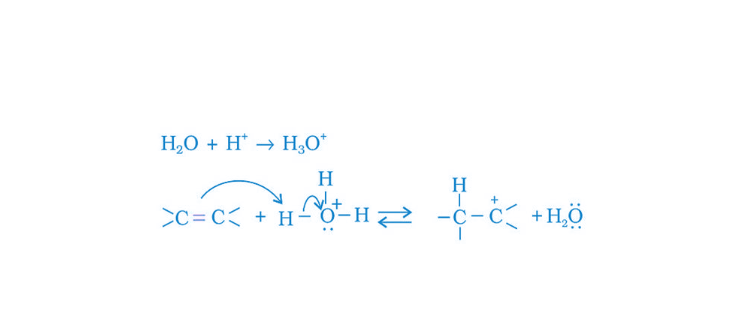
Step (1) Protonation of alkene and formation of a carbocation
NCERT Exemplar Solutions of Class 12 Chemistry Chapter 11 Alcohol, Phenols and Ethers-16

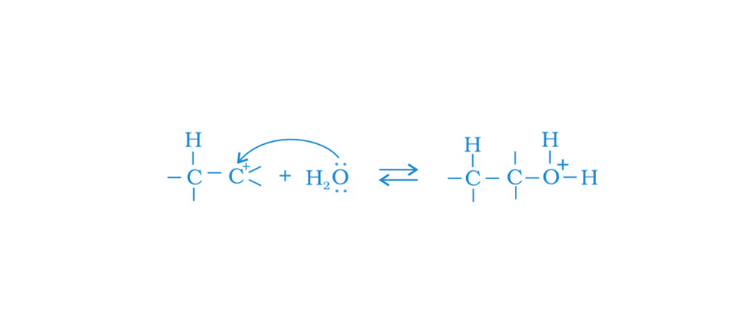
Step (2) Nucleophilic attack of water

NCERT Exemplar Solutions of Class 12 Chemistry Chapter 11 Alcohol, Phenols and Ethers-17

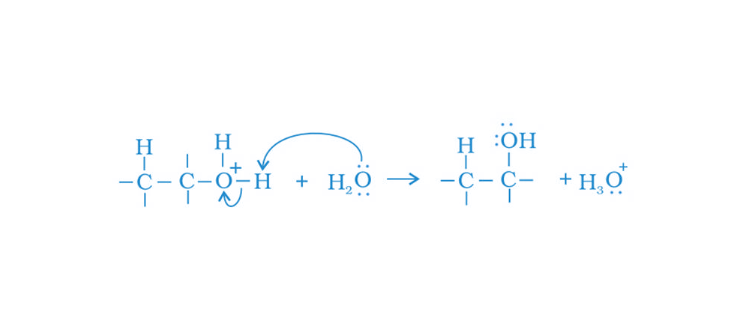
Step (3) Deprotonation occurs, and alcohol is formed. H30+ is released.

NCERT Exemplar Solutions of Class 12 Chemistry Chapter 11 Alcohol, Phenols and Ethers-18

Q44Written answer

Explain why O=C=O is nonpolar while R—O—R is polar.

Show solutionHide solution
Worked solution

O=C=O nonpolar because the dipole moment of the two C=O bonds is exactly equal and opposite of each other. Therefore, they cancel each other, and so, the net dipole moment of O=C=O is zero.

Q45Written answer

Why is the reactivity of all three classes of alcohols with conc? Are HCl and ZnCl2 (Lucas reagent) different?

Show solutionHide solution
Worked solution

This is because of the steric hindrance of the alkyl group and the stability of carbocation.

Primary alcohol does not show any reaction at room temperature because the 1° carbocation is the least stable.

Secondary alcohol does not show any turbidity at room temperature, but on heating, turbidity appears.

Tertiary alcohol immediately shows turbidity after the addition of Lucas reagent as they can form halides easily due to the higher stability of the carbocation.

Q46Written answer

Write steps to carry out the conversion of phenol to aspirin.

Show solutionHide solution
Worked solution

Phenol is treated with NaOH to produce phenoxide ions. Phenoxide ion then undergoes electrophilic substitution with CO2 to yield salicylic acid as the major product. This is called Kolbe’s reaction.

Q47Written answer

Nitration is an example of aromatic electrophilic substitution, and its rate depends upon the group already present in the benzene ring. Out of benzene and phenol, which one is more easily nitrated and why?

Show solutionHide solution
Worked solution

Phenol is more nitrated because of the presence of the hydroxyl group in phenol. Due to the resonance effect caused by –OH group, the ortho- and para-positions in the benzene ring becomes electron-rich and, therefore, activates it towards electrophilic substitution reaction. Thus, Nitration, an aromatic electrophilic substitution, occurs at a position where the electron density is high.

Q48Written answer

In Kolbe’s reaction, instead of phenol, phenoxide ion is treated with carbon dioxide. Why?

Show solutionHide solution
Worked solution

In Kolbe’s reaction, instead of phenol, phenoxide ion is treated with carbon dioxide (a weak electrophile) because phenoxide ion is more reactive towards electrophilic aromatic substitution.

Q49Written answer

The dipole moment of phenol is smaller than that of methanol. Why?

Show solutionHide solution
Worked solution

The dipole moment of phenol is smaller than that of methanol due to the electron-withdrawing effect of the phenyl ring. Due to the resonance, the polarity of the C-O bond in phenol decreases.

Q50Written answer

Ethers can be prepared by Williamson synthesis, in which an alkyl halide is reacted with sodium alkoxide. Di-tert-butyl ether can’t be prepared by this method. Explain.

Show solutionHide solution
Worked solution

Ethers can be prepared by Williamson synthesis, in which an alkyl halide is reacted with sodium alkoxide. Di-tert-butyl ether can’t be prepared by this method because in this case, elimination is more favoured over substitution.