Q11Multiple choice
Which of the following is an example of vic-dihalide?
Show answerHide answer
Correct option: B
Show solutionHide solution
Worked solution
Option (ii) is the answer.
Your cart is empty.
Practice each question, then open the answer or worked solution.
Which of the following is an example of vic-dihalide?
Option (ii) is the answer.
The position of –Br in the compound in CH3CH==CHC(Br)(CH3)2 can be
classified as ____________.
(i) Allyl
(ii) Aryl
(iii) Vinyl
(iv) Secondary
Optuion (i) is the answer.
Chlorobenzene is formed by the reaction of chlorine with benzene in the presence
of AlCl3. Which of the following species attacks the benzene ring in this reaction?
Option (ii) is the answer.
Ethylidene chloride is a/an ______________.
(i) vic-dihalide
(ii) gem-dihalide
(iii) allylic halide
(iv) vinylic halide
Option (ii) is the answer.
What is ‘A’ in the following reaction?
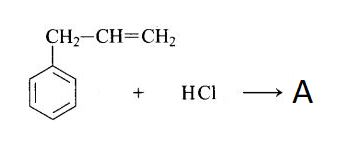
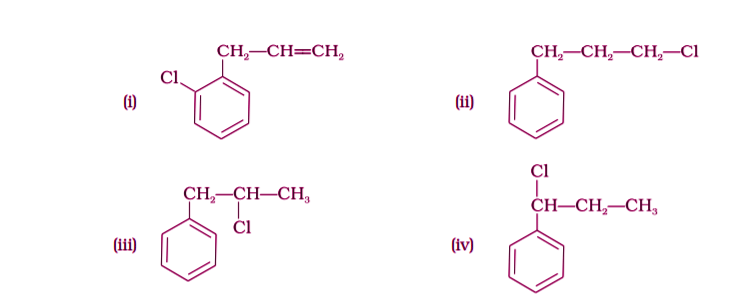
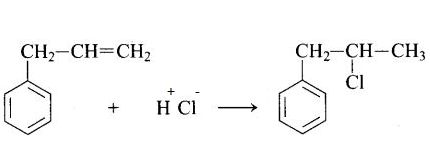
Option (iii) is the answer.
In the above reaction, the addition of HCl across the double bond takes place as per the Markovnikov rule. According to Markovnikov rule, the negative part of the adding molecule gets attached to that carbon atom which possesses a lesser number of hydrogen atoms.
16. A primary alkyl halide would prefer to undergo _____________.
(i) SN1 reaction
(ii) SN2 reaction
(iii) α–Elimination
(iv) Racemisation
Option (ii) is the answer.
A primary alkyl halide would prefer to undergo
Ans: The Correct Answer is Option (ii).
When an alkyl halide with -hydrogen atoms reacts with a base or a nucleophile, depending on the nature of the alkyl halide, the strength of the base or nucleophile, the size of the molecules, and the reaction circumstances, it can undergo a specific kind of reaction. A substitution or elimination process can be followed by an alkyl halide, as well as the two kinds of substitution, \[{SN}^1\] and \[{SN}^2\]. Because the entering nucleophile cannot engage with the bulky substituents on or near the carbon atom, the main alkyl halide prefers the \[{SN}^2\] reaction. As a result, primary alkyl halides and methyl halides have the greatest proclivity for \[{SN}^2\] reactions.
Which of the following alkyl halides will undergo SN1 reaction most readily?
Option (iv) is the answer.
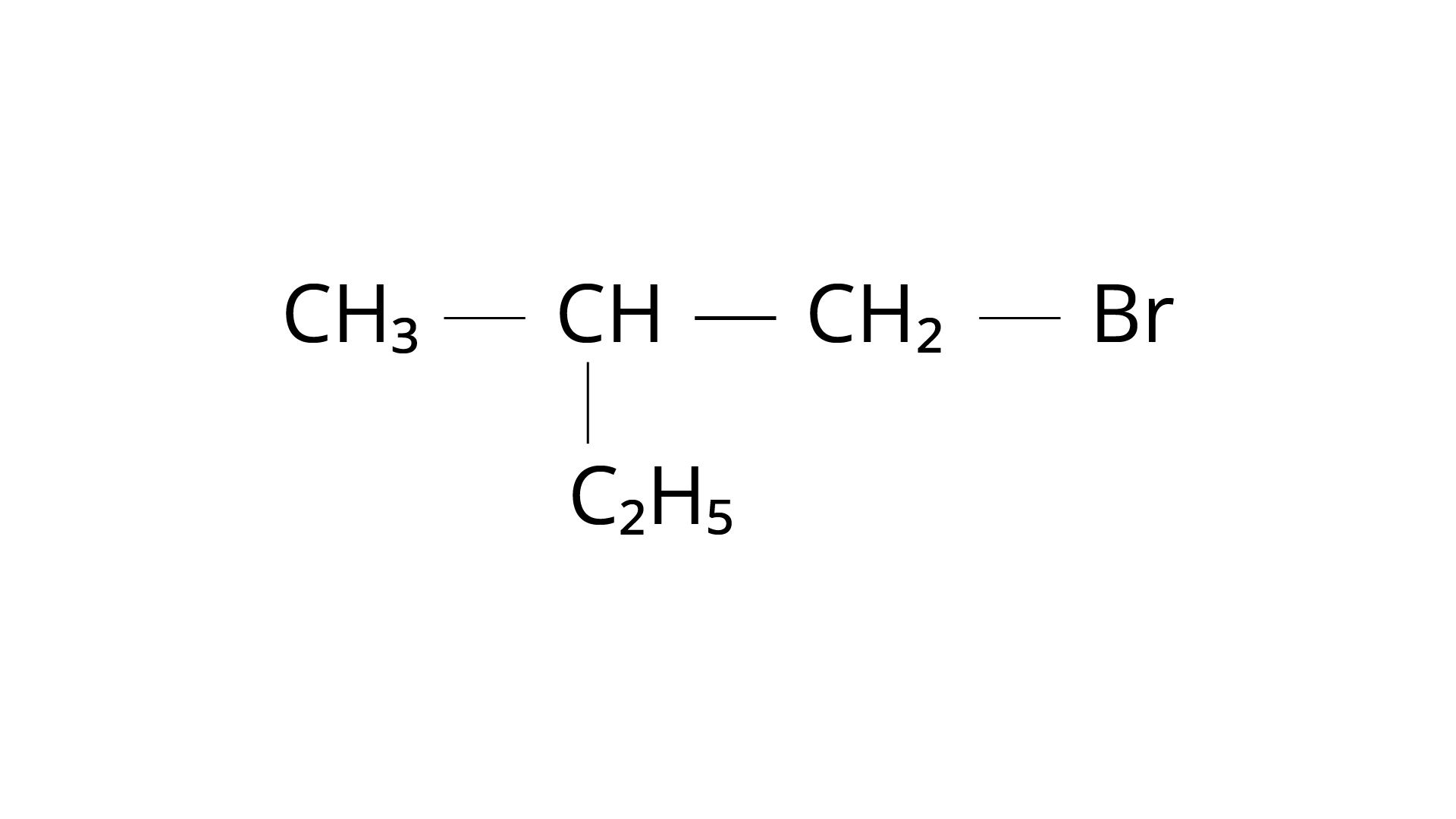
18. Which is the correct IUPAC name for?
(i) 1-Bromo-2-ethylpropane
(ii) 1-Bromo-2-ethyl-2-methylethane
(iii) 1-Bromo-2-methylbutane
(iv) 2-Methyl-1-bromobutane
Option (iii) is the answer.
Which is the correct IUPAC name for :
Correct Answer: Option (iii)
Ans: The correct answer is option iii.
First, we must determine which carbon chain is the longest. After that, we should have \[{\text{C}}{{\text{H}}_{\text{3}}}{\text{---C}}{{\text{H}}_{\text{2}}}{\text{---CH}}\left( {{\text{C}}{{\text{H}}_{\text{3}}}} \right){\text{---C}}{{\text{H}}_{\text{2}}}{\text{---Br}}\] as the real structure. \[{\text{--Br}}\], because the functional halide group is linked to the first carbon atom, we begin numbering there. The methyl group branch is joined to the chain's second carbon atom. Butane is named from the number of carbons in the unbranched parent chain, which is four. 1-Bromo-2-methylbutane is the name of the molecule. Option (iii) is the right answer.
What should be the correct IUPAC name for diethylbromomethane?
Option (ii) is the answer.
The reaction of toluene with chlorine in the presence of iron and the absence
of light yields ____________.
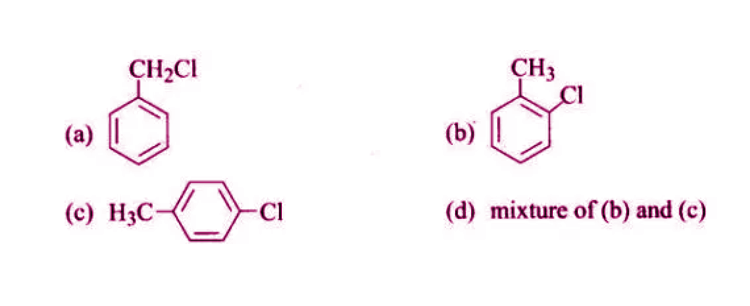
Option (d) is the answer.