My Cart
Your Cart 0

    Your cart is empty.

  • Total (Amount) ₹0.00
NCERT Exemplar · Class 12 · Chemistry

Chapter 1: Solid State

Practice each question, then open the answer or worked solution.

II. Multiple Choice Questions (Type-II)

23 questions
Q38Written answer

Which of the following is not true about the voids formed in 3-dimensional

hexagonal close-packed structure?

(i) A tetrahedral void is formed when a sphere of the second layer is present

above triangular void in the first layer.

(ii) All the triangular voids are not covered by the spheres of the second

layer.

(iii) Tetrahedral voids are formed when the triangular voids in the second

layer lies above the triangular voids in the first layer and the triangular

shapes of these voids do not overlap.

(iv) Octahedral voids are formed when the triangular voids in the second

layer exactly overlap with similar voids in the first layer

Show solutionHide solution
Worked solution

Option (iii) and (iv) are the answers.
Q39Written answer

The value of the magnetic moment is zero in the case of antiferromagnetic

substances because the domains ________.

(i) get oriented in the direction of the applied magnetic field.

(ii) get oriented opposite to the direction of the applied magnetic field.

(iii) are oppositely oriented with respect to each other without the application

of the magnetic field.

(iv) cancel out each other’s magnetic moment.

Show solutionHide solution
Worked solution

Option (iii) and (iv) are the answers.
Q40Written answer

Which of the following statements is not true?

(i) Vacancy defect results in a decrease in the density of the substance.

(ii) Interstitial defects increase the density of the substance.

(iii) Impurity defect does not affect the density of the substance.

(iv) Frankel defect results in an increase in the density of the substance.

Show solutionHide solution
Worked solution

Option (iii) and (iv) are the answers.

Q41Written answer

Which of the following statements are true about metals?

(i) Valence band overlaps with conduction band.

(ii) The gap between the valence band and the conduction band is negligible.

(iii) The gap between the valence band and the conduction band cannot be

determined.

(iv) Valence band may remain partially filled.

Show solutionHide solution
Worked solution

Option (i), (ii) and (iv) are the answers.

Q42Written answer

Under the influence of the electric field, which of the following statements is true

about the movement of electrons and holes in a p-type semiconductor?

(i) The electron will move towards the positively charged plate through the electron

holes.

(ii) Holes will appear to be moving towards the negatively charged plate.

(iii) Both electrons and holes appear to move towards the positively charged

plate.

(iv) Movement of electrons is not related to the movement of holes.

Show solutionHide solution
Worked solution

Option (i) and (ii) are the answers.

Q43Written answer

Which of the following statements about semiconductors are true?

(i) Silicon doped with an electron-rich impurity is a p-type semiconductor.

(ii) Silicon doped with an electron-rich impurity is an n-type semiconductor.

(iii) Delocalised electrons increase the conductivity of doped silicon.

(iv) An electron vacancy increases the conductivity of the n-type semiconductor.

Show solutionHide solution
Worked solution

Option (ii) and (iii0 are the answers.

Q44Written answer

An excess of potassium ions makes KCl crystals appear violet or lilac in colour

since ________.

(i) some of the anionic sites are occupied by an unpaired electron.

(ii) some of the anionic sites are occupied by a pair of electrons.

(iii) there are vacancies at some anionic sites.

(iv) F-centres are created, which impart colour to the crystals.

Show solutionHide solution
Worked solution

Option (i) and (iv) are the answers.

Q45Written answer

The number of tetrahedral voids per unit cell in NaCl crystal is ________.

(i) 4

(ii) 8

(iii) twice the number of octahedral voids.

(iv) four times the number of octahedral voids.

Show solutionHide solution
Worked solution

Option (ii) and (iii) are the answers.

Q46Written answer

Amorphous solid can also be called ________.

(i) pseudo solids

(ii) true solids

(iii) supercooled liquids

(iv) supercooled solids

Show solutionHide solution
Worked solution

Option (i) and (iii) are the answers.

Q47Written answer

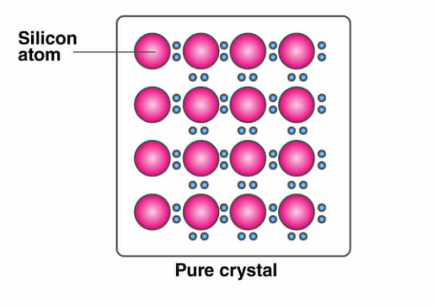
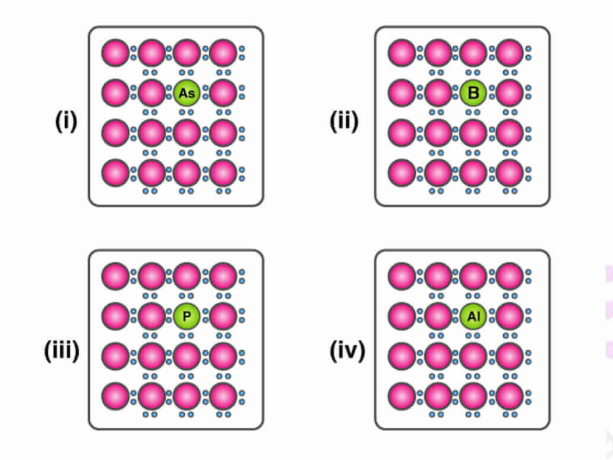
A perfect crystal of silicon (Fig. 1.1) is doped with some elements as given in the options. Which of these options shows n-type semiconductors?

47q

47s

Show solutionHide solution
Worked solution

Option (i) and (iii) are the answers.