My Cart
Your Cart 0

    Your cart is empty.

  • Total (Amount) ₹0.00
NCERT Exemplar · Class 11 · Chemistry

Chapter 9: Hydrogen

Practice each question, then open the answer or worked solution.

II. Multiple Choice Questions (Type-II)

37 questions
Q39Written answer

Calculate the strength of 5 volume H2O2 solution.

Solution;

The molar mass of H2O2 is 34gm. According to this reaction, 2 moles of peroxide is involved, so mass becomes 68gm.

we know that 1mole of any gas occupies a volume of 22.4L at NTP.

Now, 5 volume H2O2 solution means that 1 L of 5 volume H2O2 on decomposition gives 5L of O2 at NTP.

5L of O2 at NTP, we need (68/22.4*5 ) gm H2O2

= 15.179gm.

Strength of H2O2 in 5 volumes of it is 15.179gm/L

Show solutionHide solution
Worked solution

Solution coming soon.
Q40Written answer

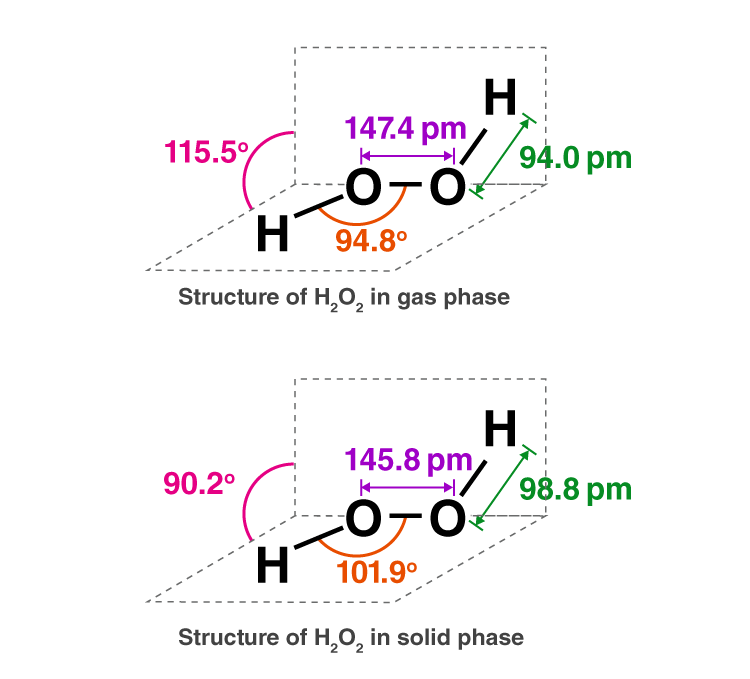
(i) Draw the gas phase and solid phase structure of H2O2.

(ii) H2O2 is a better oxidising agent than water. Explain.

Show solutionHide solution
Worked solution

(i)

NCERT Exemplar Solutions of Class 11 Chemistry Chapter 9 Hydrogen-1

(ii) The oxidising state of the oxygen atom on H2O2 is -1 which is an intermediate state. It means that it can reduce itself to H2O where the oxidation state of O is -2. So here, H2O2 acts as an oxidising agent so we can say that H2O2 is a better oxidising agent than water.

Q41Written answer

Melting point, enthalpy of vapourisation and viscosity data of H2O and D2O is

given below :

Melting point / K

Enthalpy of vapourisation

at (373 K)/ kJ mol–1

Viscosity/centipoise

H2O

373.0

40.66

0.8903

D2O

374.4

41.61

1.107

Based on this data explain in which of these liquids intermolecular

forces are stronger?

Show solutionHide solution
Worked solution

The values corresponding to the properties are higher for D2O than that of H2O. So, we can say that the intermolecular forces in D2O are stronger.

Q42Written answer

Dihydrogen reacts with dioxygen (O2) to form water. Write the name and formula of the product when the isotope of hydrogen which has one proton and one neutron in its nucleus is treated with oxygen. Will the reactivity of both the isotopes be the same towards oxygen? Justify your answer.

Show solutionHide solution
Worked solution

Hydrogen has three isotopes – Protium (1H1), Deuterium (2H1), Tritium (3H1). The number of neutrons is the reason why these isotopes differ from each other despite having the same atomic number.

When deuterium reacts with oxygen, deuterium oxide which is heavy water (D2O), is produced.

The D – D bond is stronger than H-H bond, therefore, H2 is more reactive than D2 towards reaction with oxygen. So, they would not have the same reactivity.

Q43Written answer

Explain why HCl is a gas and HF is a liquid.

Show solutionHide solution
Worked solution

Due to the formation of strong and stable hydrogen bonding, high energy is required to break the H-F bond. So the boiling point of HF is more than HCl and due to which HF is a liquid and HCl is a gas.

Q44Written answer

When the first element of the periodic table is treated with dioxygen, it gives a compound whose solid-state floats on its liquid state. This compound can act as an acid as well as a base. What products will be formed when this compound undergoes authorisation?

Show solutionHide solution
Worked solution

Hydrogen is the first element and when it reacts with dioxygen it forms water. Water has an amphoteric nature that acts as both acid and base. The solid-state of water is ice. It floats on water due to its lower density.

Auto protolysis or auto ionisation of water is self ionisation of water. It is one of the chemical properties of water. Here, two same molecules react to give ions involving proton transfer. This reaction also shows amphoteric nature.

Q45Written answer

Rohan heard that instructions were given to the laboratory attendant to store a particular chemical i.e., keep it in the darkroom, add some urea in it, and keep it away from dust. This chemical acts as an oxidising as well as a reducing agent in both acidic and alkaline media. This chemical is important for use in the pollution control treatment of domestic and industrial effluents

(i) Write the name of this compound.

(ii) Explain why such precautions are taken for storing this chemical.

Show solutionHide solution
Worked solution

(i) Hydrogen peroxide is the compound which acts as both oxidizing and reducing agent In acidic and alkali media.

(ii) H2O2 may undergo decomposition into H2Oif it is placed in contact with sunlight or with dust particles. So it is kept in wax-lined coloured bottles.

Q46Written answer

Give reasons why hydrogen resembles alkali metals?

Show solutionHide solution
Worked solution

Hydrogen is an analogous element as its properties are shared with alkali and halogens in its electronic configuration. The electronic configuration of hydrogen (1s1) is similar to that of alkali metals (ns1) which shows that only one electron is present in their valence shell. So if they lose that single electron, a uni-positive ion would be formed.

Q47Written answer

Hydrogen generally forms covalent compounds. Give reason.

Show solutionHide solution
Worked solution

Hydrogen can lose or gain an electron to attain noble gas configuration as it has only one electron in its outermost shell. The ionization enthalpy of hydrogen is high and their electron gain enthalpy is slightly negative. So they generally form covalent compounds.

Q48Written answer

Why is the Ionisation enthalpy of hydrogen higher than that of sodium?

Show solutionHide solution
Worked solution

To remove a valence electron from the H atom is more difficult than Na atom due to higher nuclear attraction so more energy would be required. Thus, ionisation enthalpy of hydrogen is higher than sodium.