My Cart
Your Cart 0

    Your cart is empty.

  • Total (Amount) ₹0.00
NCERT Exemplar · Class 11 · Chemistry

Chapter 8: Redox Reactions

Practice each question, then open the answer or worked solution.

Short Answer Questions

16 questions
Q17Written answer

The reaction 

\[\mathbf{C}{{\mathbf{l}}_{\mathbf{2}}}\text{ }\left( \mathbf{g} \right)+\mathbf{2O}{{\mathbf{H}}^{}}\text{ }\left( \mathbf{aq} \right)\text{ }\to \text{ }\mathbf{Cl}{{\mathbf{O}}^{}}\left( \mathbf{aq} \right)+\text{ }\mathbf{C}{{\mathbf{l}}^{}}\left( \mathbf{aq} \right)+{{\mathbf{H}}_{\mathbf{2}}}\mathbf{O}\text{ }\left( \mathbf{l} \right)\]

represents the process of bleaching. Identify and name the species that bleaches the substances due to its oxidising action. 

Show solutionHide solution
Worked solution

Ans: The given reaction is as below-

\[\text{C}{{\text{l}}_{\text{2}}}\text{ }\left( \text{g} \right)\text{+2O}{{\text{H}}^{\text{--}}}\text{ }\left( \text{aq} \right)\to \text{Cl}{{\text{O}}^{\text{--}}}\left( \text{aq} \right)\text{+ C}{{\text{l}}^{\text{--}}}\left( \text{aq} \right)\text{+}{{\text{H}}_{\text{2}}}\text{O }\left( \text{l} \right)\]

In the given reaction, oxidation number  of Cl increases from 0 (in Cl2) to +1 (in ClO-) and decreases to -1 (in Cl-). Therefore, Cl2 is both oxidized to ClO- and reduced to Cl-. Since Cl- ion cannot act as an oxidizing agent (because it cannot decrease its O.N. lower than -1), hence, Cl2 bleaches substances due to oxidizing action of hypochlorite, ClO ion.


Q18Written answer

\[Mn{{O}_{4}}^{2-}\] undergoes disproportionate reaction in acidic medium but \[\mathbf{Mn}{{\mathbf{O}}_{\mathbf{4}}}^{\mathbf{-}}\] does not. Give reason. 

Show solutionHide solution
Worked solution

Ans: In \[\text{Mn}{{\text{O}}_{\text{4}}}^{\text{2-}}\], Mn is in highest oxidation state that is +7 hence here manganese cannot undergo oxidation that is why disproportionate is not possible whereas in  \[\text{Mn}{{\text{O}}_{\text{4}}}^{\text{2-}}\] manganese is in +6 oxidation state which can be oxidized as well as reduced.


Q19Written answer

PbO and PbO2 react with HCl according to following chemical equations:

2PbO + 4HCl → 2PbCl2 + 2H2O

PbO2 + 4HCl → PbCl2 + Cl2 +2H2O

Why do these compounds differ in their reactivity? 

Show solutionHide solution
Worked solution

Ans:  The given compound can differ in reactivity as-Lead is present in +4 oxidation state, whereas the stable oxidation state of lead in PbO is +2. PbO2 thus, can act as an oxidant (oxidising agent) and, therefore, can oxidise chloride ions of HCl into chlorine.


Q20Written answer

Nitric acid is an oxidising agent and reacts with PbO, but it does not react with PbO2 . Explain why? 

Show solutionHide solution
Worked solution

Ans: Since nitric acid itself is an oxidising agent therefore, it is unlikely that the reaction may occur between PbO2 and nitric acid. However, the acid-base reaction occurs between PbO and nitric acid because PbO is a basic oxide.


Q21Written answer

Write balanced chemical equation for the following reactions: 

(i) Permanganate ion (\[\mathbf{MnO}_{4}^{-}\]) reacts with sulphur dioxide gas in acidic medium to produce \[\mathbf{M}{{\mathbf{n}}^{\mathbf{2}+}}\]and hydrogen sulphate ion. (Balance by ion electron method). 

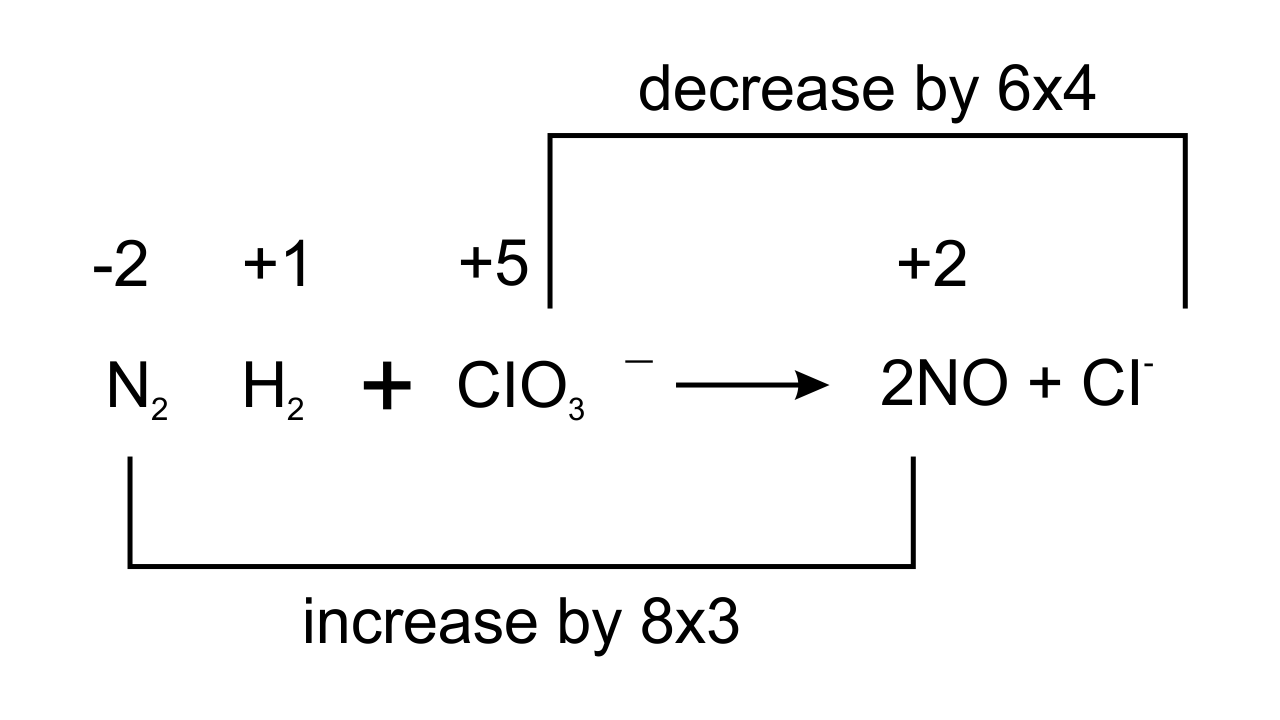
(ii) Reaction of liquid hydrazine (N2H2) with chlorate ion (\[ClO_3^{-}\]) in basic medium produces nitric oxide gas and chloride ion in gaseous state. (Balance by oxidation number method).

(iii) Dichlorine heptaoxide (Cl2O7) in gaseous state combines with an aqueous solution of hydrogen peroxide in acidic medium to give chlorite ion \[(C{{l}_{2}}{{O}_{7}})\] and oxygen gas. (Balance by ion electron method).

Show solutionHide solution
Worked solution

Ans: We can balance the given reaction by ion electron method as-

\[\text{Mn}{{\text{O}}_{\text{4}}}^{\text{-}}\text{+S}{{\text{O}}_{\text{2}}}\to \text{M}{{\text{n}}^{\text{2+}}}\text{+HS}{{\text{O}}_{\text{4}}}^{\text{-}}\left( \text{acidic medium} \right)\]

Balancing by ion electron method

\[2 \times MnO_{4}^{-} + 8H^{+} + 5e^{-} \rightarrow Mn^{2+} + 4 H_{2}O \]

\[ 5 \times SO_{2} + 2H_{2}O \rightarrow HSO_{4}^{-} + 3H^{+} + 2e^{-}\]

The balanced chemical is given as-

\[2MnO_{4}^{-} + 16H^{+} + \not {10e^{-}} \rightarrow 2Mn^{2+} + 8H_{2}O \\\underline{5SO_{2}+10H_{2}O \rightarrow 5HSO_{4} ^{-} + 15H^{+} + \not {10e^{-}}}\\ \\\underline{2MnO_4^- + H^{+}+ 5SO_{2} + H_{2}O \rightarrow 2Mn^{2+} + 5HSO_{4}^{-}} \]


Ans: We can balance the given reaction by oxidation number method-

Balancing by oxidation number method as to make the electron gain and loss equal as given - 

\[3N_{2}H_{4}+4ClO_{3}^{-}\rightarrow 6NO +4Cl^{-} +6H_{2}O \]

The balanced chemical is given as-


seo images


Ans: We can balance the given reaction by ion electron method as

\[Cl_{2}O_{7} (g) + H_{2}O_{2} (aq) \rightarrow ClO_{2}^{-}+O_{2} \] (acidic medium)

Balancing bu ion electron method

2 × { Cl2O7 + 6H+ + 8e- → 2ClO2- + 3H2O

8  × { H2O2 → O2 + 2H+ + 2e- 

The balanced chemical is given as-

2Cl2O7 + 12H+ + 16e- → 4ClO2- + 6H2O

                         8H2O2 → 8O2 + 16H+ + 16e-

          2Cl2O7 + 8H2O2 → 4ClO2- + 6H2O + 8O2 + 4H+


Q22Written answer

Calculate the oxidation number of phosphorus in the following species. (a) \[\mathbf{HP}{{\mathbf{O}}_{\mathbf{3}}}^{\mathbf{2-}}\] and (b) \[\mathbf{P}{{\mathbf{O}}_{\mathbf{4}}}^{\mathbf{3-}}\]

(a) \[\mathbf{HP}{{\mathbf{O}}_{\mathbf{3}}}^{\mathbf{2-}}\]

(b) \[\mathbf{P}{{\mathbf{O}}_{\mathbf{4}}}^{\mathbf{3-}}\]

Show solutionHide solution
Worked solution

Ans:

Let the oxidation number of P in \[\text{HP}{{\text{O}}_{\text{3}}}^{\text{2-}}\] be x. 

Therefore, +1 + x + (-6) = -2 

x = +3

Oxidation number of phosphorus is= +3.


Ans: 

Let the oxidation number of P in \[\text{P}{{\text{O}}_{\text{4}}}^{\text{3-}}\] be x. 

Therefore, x + (-8) = -3

x = +5 

Oxidation number of phosphorus is= +5.


Q23Written answer

Calculate the oxidation number of each sulphur atom in the following compounds: 

(a) Na2S2O3

(b) Na2S4O6

(c) Na2SO3

Show solutionHide solution
Worked solution

Ans: let x= oxidation number of   sulphur, and   +1 is oxidation number of Na, -2 is oxidation number of O, also we can assume total charge on compound = 0 then solving we get.

+2 + 2x - 6 = 0 

x = +2. 


Ans: let x= oxidation number of   sulphur, and   +1 is   oxidation number of Na, -2 is oxidation number of O, also we can assume total charge on compound = 0 then solving we get.

+2 + 4x - 12 = 0

x= +2.5 


Ans: let x= oxidation number of   sulphur, and   +1 is   oxidation number of Na, -2 is oxidation number of O, also we can assume total charge on compound = 0 then solving we get.

+2 + x - 6 = 0

x = +4


\[\left( \mathbf{d} \right)\text{ }\mathbf{N}{{\mathbf{a}}_{\mathbf{2}}}\mathbf{S}{{\mathbf{O}}_{\mathbf{4}}}\].

Ans: let x= oxidation number of   sulphur, and   +1 is   oxidation number of Na, -2 is oxidation number of O, also we can assume total charge on compound = 0 then solving we get.

+2 + x -8=0

x = +6.


Q24Written answer

Balance the following equations by the oxidation number method.

\[\left( \mathbf{i} \right)\text{ }\mathbf{F}{{\mathbf{e}}^{\mathbf{2}+}}+{{\mathbf{H}}^{+}}+\mathbf{C}{{\mathbf{r}}_{\mathbf{2}}}^{\mathbf{2}}{{\mathbf{O}}_{\mathbf{7}}}\text{ }\to \text{ }\mathbf{C}{{\mathbf{r}}^{\mathbf{3}+}}+\mathbf{F}{{\mathbf{e}}^{\mathbf{3}+}}+{{\mathbf{H}}_{\mathbf{2}}}\mathbf{O}\].

Show solutionHide solution
Worked solution

Ans: We can balance the given equation by oxidation number method- 

\[\overset{\text{+2}}{\mathop{\text{F}}}\,{{\text{e}}^{\text{2+}}}\text{+}{{\text{H}}^{\text{+}}}\text{+}\overset{\text{+6}}{\mathop{\text{C}}}\,{{\text{r}}_{\text{2}}}\text{O}_{\text{7}}^{^{\overset{\text{-2}}{\mathop{\text{2-}}}\,}}\to \overset{\text{+3}}{\mathop{\text{C}}}\,{{\text{r}}^{\text{3+}}}\text{+F}{{\text{e}}^{\text{3+}}}\text{+}{{\text{H}}_{\text{2}}}\text{O}\]

(a) Balance the increase and decrease in O.N.

\[6\overset{\text{+2}}{\mathop{\text{F}}}\,{{\text{e}}^{\text{2+}}}\text{+}{{\text{H}}^{\text{+}}}\text{+}\overset{\text{+6}}{\mathop{\text{C}}}\,{{\text{r}}_{\text{2}}}\text{O}_{\text{7}}^{^{\overset{\text{-2}}{\mathop{\text{2-}}}\,}}\to \overset{\text{+3}}{\mathop{\text{C}}}\,{{\text{r}}^{\text{3+}}}\text{+6}\overset{3+}{\mathop{\text{F}}}\,{{\text{e}}^{\text{3+}}}\text{+}{{\text{H}}_{\text{2}}}\text{O}\]

(b) Balancing H and O atoms by adding H+ and H2O molecules

\[6\overset{\text{+2}}{\mathop{\text{F}}}\,{{\text{e}}^{\text{2+}}}\text{+14}{{\text{H}}^{\text{+}}}\text{+}\overset{\text{+6}}{\mathop{\text{C}}}\,{{\text{r}}_{\text{2}}}\text{O}_{\text{7}}^{2-}\to 2\overset{{}}{\mathop{\text{C}}}\,{{\text{r}}^{\text{3+}}}\text{+6}\overset{{}}{\mathop{\text{F}}}\,{{\text{e}}^{\text{3+}}}\text{+7}{{\text{H}}_{\text{2}}}\text{O}\]


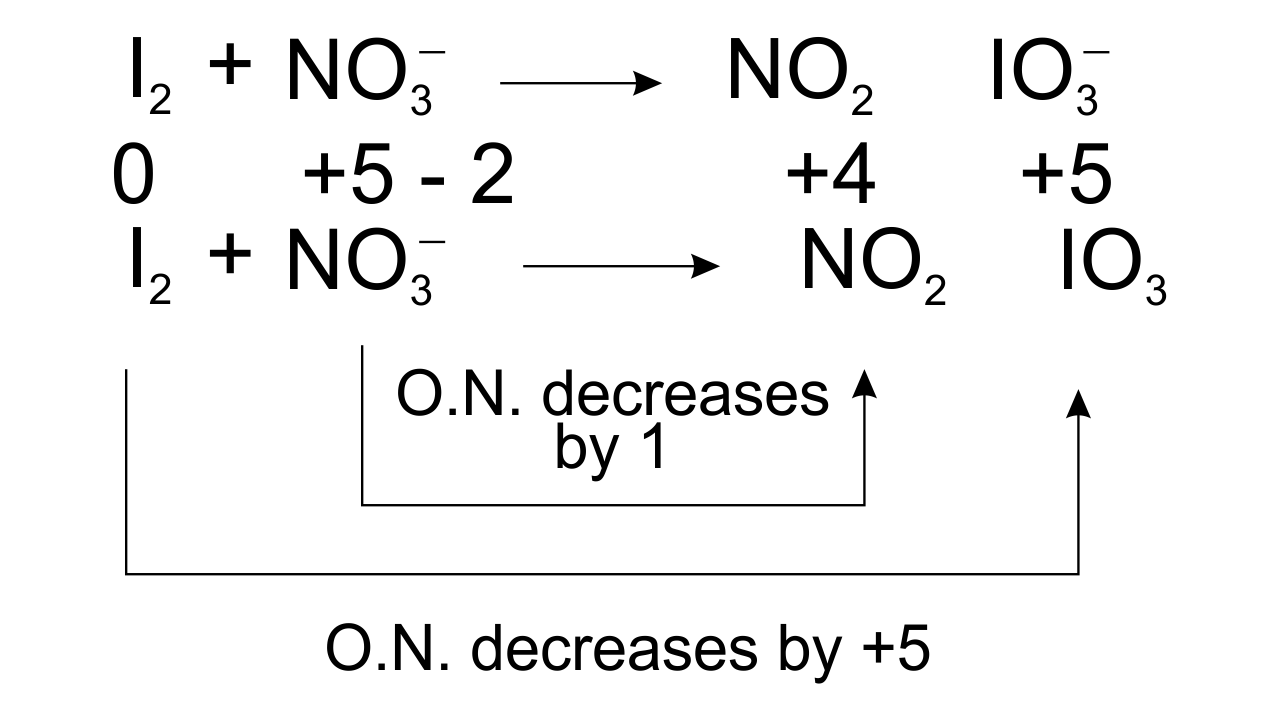
\[\left( \mathbf{ii} \right)\text{ }\mathbf{I}{{\text{ }}_{\mathbf{2}\text{ }}}+\mathbf{N}{{\mathbf{O}}_{\mathbf{3}}}^{\text{ -}}\to \text{ }\mathbf{N}{{\mathbf{O}}_{\mathbf{2}}}\text{ }+\text{ }\mathbf{I}{{\mathbf{O}}_{\mathbf{3}}}^{\mathbf{-}}\].

Ans: We can balance the given equation by oxidation number method- 


seo images


Total decrease in O.N. = 1

To equilize O.N. multiply NO3-, by 10

I2 + 10 NO3- → 10NO2 + IO3-

Balancing atoms other than O and H

I2 + 10 NO3- → 10NO2 + 2 IO3-

Balancing O and H

I2 + 10 NO3- + 8H+ → 10NO2 + 2 IO3- + 4H2O


\[\left( \mathbf{iii} \right)\text{ }\mathbf{I}{{\text{ }}_{\mathbf{2}}}+\text{ }{{\mathbf{S}}_{\mathbf{2}}}{{\mathbf{O}}_{\mathbf{3}}}^{\mathbf{2}}\text{ }\to \text{ }{{\mathbf{I}}^{}}\text{ }+\text{ }{{\mathbf{S}}_{\mathbf{4}}}{{\mathbf{O}}_{\mathbf{6}}}^{\mathbf{2}}\].

 Ans: We can balance the given equation by oxidation number method

\[\overset{0}{\mathop{{{\text{I}}_{\text{2}}}}}\,+\overset{+2}{\mathop{{{S}_{2}}}}\,\overset{-2}{\mathop{O_{3}^{2-}}}\,\to \overset{-1}{\mathop{{{I}^{-}}}}\,+\overset{+2.5}{\mathop{{{S}_{4}}}}\,O_{6}^{2-}\]

Total increase in O.N. = 0.5 × 4 = 2

Total increase in O.N. = 1 × 2 = 2

To equilize O.N. multiply \[{{S}_{2}}O_{3}^{2-}\] and I- by 2.

\[{{I}_{2}}+2{{S}_{2}}O_{3}^{2-}\to 2{{I}^{-}}+{{S}_{4}}O_{6}^{2-}\]


\[\left( \mathbf{iv} \right)\text{ }\mathbf{Mn}{{\mathbf{O}}_{\mathbf{2}}}\text{ }+\text{ }{{\mathbf{C}}_{\mathbf{2}}}{{\mathbf{O}}_{\mathbf{4}}}^{\mathbf{2}}\text{ }\to \text{ }\mathbf{M}{{\mathbf{n}}^{\mathbf{2}+}}+\mathbf{C}{{\mathbf{O}}_{\mathbf{2}}}\].

Ans: We can balance the given equation by oxidation number method-

\[\overset{+4}{\mathop{Mn}}\,{{O}_{2}}+\overset{+3}{\mathop{{{C}_{2}}}}\,O_{4}^{2-}\to \overset{+2}{\mathop{M{{n}^{2+}}+}}\,\overset{+4}{\mathop{C{{O}_{2}}}}\,\]

The balanced chemical reaction is given as-

\[\text{Total increase in O}\text{.N}\text{. = 5 }\!\!\times\!\!\text{ 2= 10}\]

\[\text{To equalize O}\text{.N}\text{. multiply C}{{\text{O}}_{\text{2}}}\text{ }\!\!~\!\!\text{ by 2}\text{. }\]

\[\text{Mn}{{\text{O}}_{\text{2}}}\text{ }\!\!~\!\!\text{ + }{{\text{C}}_{\text{2}}}{{\text{O}}^{\text{2-}}}_{\text{4}}\text{ }\!\!~\!\!\text{ }\to \text{ M}{{\text{n}}^{\text{2+}}}\text{ }\!\!~\!\!\text{ + 2C}{{\text{O}}_{\text{2}}}\]

\[\text{Balance H and O by adding 2}{{\text{H}}_{\text{2}}}\text{O }\!\!~\!\!\text{ on right side, and 4}{{\text{H}}^{\text{+}}}\text{ }\!\!~\!\!\text{ on left side of equation}\text{.}\]

\[\text{Mn}{{\text{O}}_{\text{2}}}\text{ }\!\!~\!\!\text{ + }{{\text{C}}_{\text{2}}}{{\text{O}}_{\text{4}}}^{\text{2-}}\text{ }\!\!~\!\!\text{ + 4}{{\text{H}}^{\text{+}}}\text{ }\!\!~\!\!\text{ }\to \text{ M}{{\text{n}}^{\text{2+}}}\text{ }\!\!~\!\!\text{ + 2C}{{\text{O}}_{\text{2}}}\text{ }\!\!~\!\!\text{ + 2}{{\text{H}}_{\text{2}}}\text{O }\text{.}\]


Q25Written answer

Identify the redox reactions out of the following reactions and identify the oxidising and reducing agents in them.

\[\left( \mathbf{i} \right)\text{ }\mathbf{3HCl}\left( \mathbf{aq} \right)+\mathbf{HN}{{\mathbf{O}}_{\mathbf{3}}}\left( \mathbf{aq} \right)\text{ }\to \text{ }\mathbf{C}{{\mathbf{l}}_{\mathbf{2}}}\text{ }\left( \mathbf{g} \right)+\mathbf{NOCl}\text{ }\left( \mathbf{g} \right)+\mathbf{2}{{\mathbf{H}}_{\mathbf{2}}}\mathbf{O}\text{ }\left( \mathbf{l}\text{ } \right)\].

Show solutionHide solution
Worked solution

Ans: We can write the given reaction along with their oxidation numbers as-

\[3\overset{+1}{\mathop{H}}\,\overset{-1}{\mathop{Cl}}\,(aq)+\overset{+1}{\mathop{H}}\,\overset{+5}{\mathop{N}}\,\overset{-2}{\mathop{{{O}_{3}}}}\,(aq)\to \overset{0}{\mathop{C{{l}_{2}}}}\,+\overset{+3}{\mathop{N}}\,\overset{-2}{\mathop{O}}\,\overset{-1}{\mathop{Cl(g)}}\,+2\overset{+1}{\mathop{{{H}_{2}}}}\,\overset{-2}{\mathop{O(l)}}\,\]

As, chlorine is oxidised in hydrochloric acid (behaving as reducing agent) -as its oxidation number is increases during the reaction from -1 to 0) and nitric acid is reduced (behaving as oxidising agent) as its oxidation number is decreases during the reaction from +5 to +3). Hence, it is the redox reaction.


\[\left( \mathbf{ii} \right)\text{ }\mathbf{HgC}{{\mathbf{l}}_{\mathbf{2}}}\left( \mathbf{aq} \right)+\mathbf{2KI}\text{ }\left( \mathbf{aq} \right)\text{ }\to \text{ }\mathbf{Hg}{{\mathbf{I}}_{\mathbf{2}}}\left( \mathbf{s} \right)+\mathbf{2KCl}\left( \mathbf{aq} \right)\].

Ans: We can write the given reaction along with their oxidation numbers as-

\[\overset{+2}{\mathop{Hg}}\,{{\overset{-1}{\mathop{Cl}}\,}_{2}}(aq)+2\overset{+1}{\mathop{K}}\,\overset{-1}{\mathop{l}}\,(aq)\to \overset{0}{\mathop{C{{l}_{2}}}}\,+\overset{+2}{\mathop{Hg}}\,\overset{-1}{\mathop{{{l}_{2}}}}\,(aq)+\overset{+1}{\mathop{K}}\,\overset{-1}{\mathop{Cl}}\,(aq)\]

Here, oxidation number of none of the atoms change hence it is not a redox reaction.


\[\left( \mathbf{iii} \right)\text{ }\mathbf{F}{{\mathbf{e}}_{\mathbf{2}}}{{\mathbf{O}}_{\mathbf{3}}}\left( \mathbf{s} \right)\text{ }+\mathbf{3CO}\left( \mathbf{g} \right)\text{ }\to \mathbf{2Fe}\left( \mathbf{s} \right)+\mathbf{3C}{{\mathbf{O}}_{\mathbf{2}}}\left( \mathbf{g} \right)\].

Ans: We can write the given reaction along with their oxidation numbers as-

\[\overset{\text{+3}}{\mathop{\text{F}{{\text{e}}_{\text{2}}}}}\,\overset{\text{-2}}{\mathop{{{\text{O}}_{\text{3}}}}}\,\left( \text{s} \right)\text{+3}\overset{\text{+2}}{\mathop{\text{C}}}\,\overset{\text{-2}}{\mathop{\text{O}}}\,\left( \text{g} \right)\text{ }\xrightarrow{\text{ }\!\!\Delta\!\!\text{ }}\overset{\text{0}}{\mathop{\text{2}}}\,\text{Fe}\left( \text{s} \right)\text{+3}\overset{\text{+4}}{\mathop{\text{C}}}\,\overset{\text{-2}}{\mathop{{{\text{O}}_{\text{2}}}}}\,\left( \text{g} \right)\]

As, carbon is oxidised in carbon monoxide (behaving as reducing agent) -as its oxidation number is increases during the reaction from +2 to +4) and ferric oxide is reduced (behaving as oxidising agent) as its oxidation number is decreases during the reaction from +3to 0). Hence, it is the redox reaction.


\[\left( \mathbf{iv} \right)\text{ }\mathbf{PC}{{\mathbf{l}}_{\mathbf{3}}}\text{ }\left( \mathbf{l} \right)+\mathbf{3}{{\mathbf{H}}_{\mathbf{2}}}\mathbf{O}\text{ }\left( \mathbf{l} \right)\text{ }\to \mathbf{3HCl}\text{ }\left( \mathbf{aq} \right)+{{\mathbf{H}}_{\mathbf{3}}}\mathbf{P}{{\mathbf{O}}_{\mathbf{3}}}\left( \mathbf{aq} \right)\].

Ans: We can write the given reaction along with their oxidation numbers as-

\[\overset{\text{+3}}{\mathop{\text{P}}}\,\overset{\text{-1}}{\mathop{\text{C}{{\text{l}}_{\text{3}}}}}\,\left( \text{l} \right)\text{+3}\overset{\text{+1}}{\mathop{{{\text{H}}_{\text{2}}}}}\,\overset{\text{-2}}{\mathop{\text{O}}}\,\left( \text{l} \right)\to \text{3}\overset{\text{+1}}{\mathop{\text{H}}}\,\overset{\text{-1}}{\mathop{\text{Cl}}}\,\left( \text{aq} \right)\text{+}\overset{\text{+1}}{\mathop{{{\text{H}}_{\text{3}}}}}\,\overset{\text{+3}}{\mathop{\text{P}}}\,\overset{\text{-2}}{\mathop{{{\text{O}}_{\text{2}}}}}\,\left( \text{aq} \right)\]

Here, oxidation number of none of the atoms change hence it is not a redox reaction.


\[\left( \mathbf{v} \right)\text{ }\mathbf{4N}{{\mathbf{H}}_{\mathbf{3}}}\mathbf{(l)}+\mathbf{3}{{\mathbf{O}}_{\mathbf{2}}}\left( \mathbf{g} \right)\text{ }\to \text{ }\mathbf{2}{{\mathbf{N}}_{\mathbf{2}}}\left( \mathbf{g} \right)+\mathbf{6}{{\mathbf{H}}_{\mathbf{2}}}\mathbf{O}\left( \mathbf{g} \right)\].

Ans: We can write the given reaction along with their oxidation numbers as-

\[\overset{\text{+3}}{\mathop{4N}}\,\overset{\text{+1}}{\mathop{{{\text{H}}_{\text{3}}}}}\,\left( g \right)\text{+3}\overset{0}{\mathop{{{O}_{\text{2}}}}}\,\left( g \right)\to 2\overset{\text{+1}}{\mathop{{{N}_{2}}}}\,\left( g \right)\text{+6}{{\text{H}}_{\text{2}}}\overset{\text{+1}}{\mathop{\text{O}}}\,\overset{\text{-2}}{\mathop{\text{(g)}}}\,\]

As, nitrogen is oxidised in ammonia (behaving as reducing agent) -as its oxidation number is increases during the reaction from -3 to 0) and oxygen is reduced (behaving as oxidising agent) as its oxidation number is decreases during the reaction from 0 to -2). Hence, it is the redox reaction.
Q26Written answer

Balance the following ionic equations-

\[\left( \mathbf{i} \right)\text{ }\mathbf{C}{{\mathbf{r}}_{\mathbf{2}}}{{\mathbf{O}}_{\mathbf{7}}}{{\text{ }}^{\mathbf{2}}}\text{+ }{{\mathbf{H}}^{+}}+\text{ }{{\mathbf{I}}^{}}\to \text{ }\mathbf{C}{{\mathbf{r}}^{\mathbf{3}+}}+{{\mathbf{I}}_{\mathbf{2}}}\text{ }+{{\mathbf{H}}_{\mathbf{2}}}\mathbf{O}\]

Show solutionHide solution
Worked solution

Ans: The balanced chemical is given as -

\[\text{C}{{\text{r}}_{\text{2}}}{{\text{O}}_{\text{7}}}^{\text{2}-}\text{+6}{{\text{I}}^{\text{-}}}\text{+14}{{\text{H}}^{\text{+}}}\rightleftharpoons \text{2C}{{\text{r}}^{\text{+3}}}\text{+3}{{\text{I}}_{\text{2}}}\text{+7}{{\text{H}}_{\text{2}}}\text{O}\]


\[\left( \mathbf{ii} \right)\text{ }\mathbf{C}{{\mathbf{r}}_{\mathbf{2}}}{{\mathbf{O}}_{\mathbf{7}}}^{\mathbf{2}}+\text{ }\mathbf{F}{{\mathbf{e}}^{\mathbf{2}+\text{ }}}+{{\mathbf{H}}^{+\text{ }}}\to \text{ }\mathbf{C}{{\mathbf{r}}^{\mathbf{3}+}}+\text{ }\mathbf{F}{{\mathbf{e}}^{\mathbf{3}+}}+{{\mathbf{H}}_{\mathbf{2}}}\mathbf{O}\]

Ans: The balanced chemical is given as -

\[\text{C}{{\text{r}}_{\text{2}}}{{\text{O}}_{\text{7}}}^{\text{2-}}\text{+6F}{{\text{e}}^{\text{+2}}}\text{+14}{{\text{H}}^{\text{+}}}\rightleftharpoons \text{2C}{{\text{r}}^{\text{+3}}}\text{+6F}{{\text{e}}^{\text{+3}}}\text{+7}{{\text{H}}_{\text{2}}}\text{O}\]


\[~\left( \mathbf{iii} \right)\text{ }\mathbf{Mn}{{\mathbf{O}}_{\mathbf{4}\text{ }}}^{\text{ }}+{{\mathbf{S}}_{\mathbf{2}}}{{\mathbf{O}}_{\mathbf{3}}}+{{\mathbf{H}}^{+}}\text{ }\to \text{ }\mathbf{M}{{\mathbf{n}}^{\mathbf{2}+}}+{{\mathbf{S}}_{\mathbf{2}}}{{\mathbf{O}}_{\mathbf{4}}}+{{\mathbf{H}}_{\mathbf{2}}}\mathbf{O}\]

Ans: The balanced chemical is given as -

\[\text{2Mn}{{\text{O}}_{\text{4}}}^{\text{-}}\text{+5S}{{\text{O}}_{\text{3}}}^{\text{2-}}\text{+6}{{\text{H}}^{\text{+}}}\rightleftharpoons \text{2M}{{\text{n}}^{\text{+2}}}\text{+5S}{{\text{O}}_{\text{4}}}^{\text{2-}}\text{+3}{{\text{H}}_{\text{2}}}\text{O}\]


\[\left( \mathbf{iv} \right)\text{ }\mathbf{Mn}{{\mathbf{O}}_{\mathbf{4}}}^{\text{-}}+{{\mathbf{H}}^{\mathbf{+}}}+\mathbf{B}{{\mathbf{r}}^{\mathbf{}}}\text{ }\to \mathbf{M}{{\mathbf{n}}^{\mathbf{2}+}}+\text{ }\mathbf{B}{{\mathbf{r}}_{\mathbf{2}}}+{{\mathbf{H}}_{\mathbf{2}}}\mathbf{O}\]

Ans: The balanced chemical is given as -

\[\text{2Mn}{{\text{O}}_{\text{4}}}^{\text{-}}\text{+10B}{{\text{r}}^{\text{-}}}\text{+16}{{\text{H}}^{\text{+}}}\rightleftharpoons \text{2M}{{\text{n}}^{\text{+2}}}\text{+5B}{{\text{r}}_{\text{2}}}\text{+8}{{\text{H}}_{\text{2}}}\text{O}\]


Matching Type