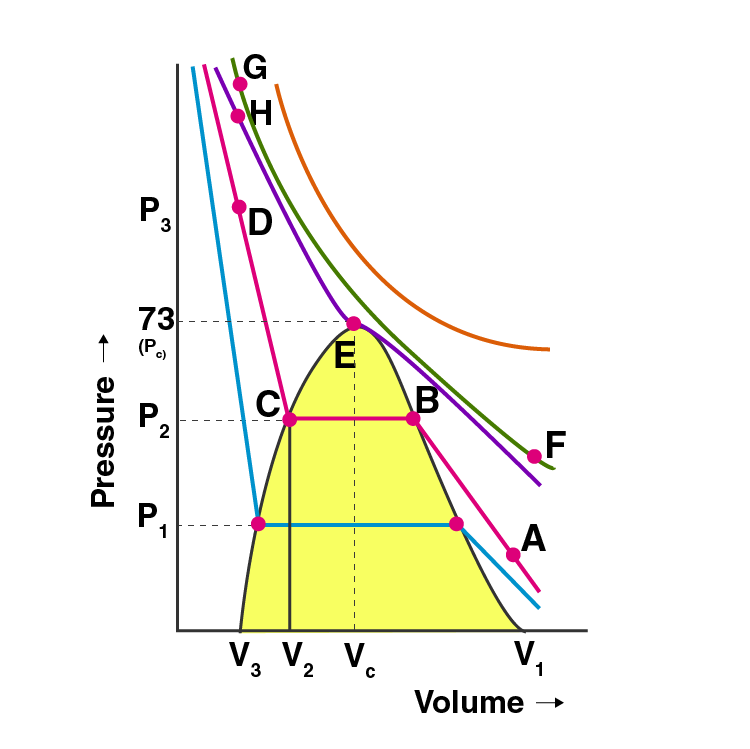
By moving from A to F in the graph, the temperature increases and we reach a point G by compressing the gas at constant temperature along with the isotherm. The pressure increases at that instant. Then move vertically down towards D by lowering the temperature.
The point when H is crossed, we get liquid. The process is carried at the critical temperature, the substance will remain in one phase only.
Important Concepts Discussed in Class 11 Chemistry Chapter 5 States of Matter: Gases and Liquids
- Intermolecular Forces
- Dispersion Forces or London Forces
- Dipole-dipole Forces
- Dipole-induced Dipole Forces
- Hydrogen Bond
- Thermal Energy
- Intermolecular Forces vs Thermal Interactions
- The Gaseous State Ex
- The Gas Laws Ex
- Boyle’s Law (Pressure-volume Relationship)
- Charles’ Law (Temperature-volume Relationship)
- Gay Lussac’s Law (Pressure-temperature Relationship)
- Avogadro Law (Volume-amount Relationship)
- Ideal Gas Equation
- Density and Molar Mass of a Gaseous Substance
- Dalton’s Law of Partial Pressures
- Kinetic Molecular Theory of Gases
- Behaviour of Real Gases: Deviation from Ideal Gas Behaviour
- Liquefaction of Gases
- Liquid State
- Vapour Pressure
- Surface Tension Ex 5.10.3 – Viscosity
BYJU’S provides chapter-wise NCERT Exemplar Solutions for Science subjects of all classes. In order to score good marks in the annual examination, students must refer to these NCERT Exemplars, provided by us.