My Cart
Your Cart 0

    Your cart is empty.

  • Total (Amount) ₹0.00
NCERT Exemplar · Class 11 · Chemistry

Chapter 5: States of Matter

Practice each question, then open the answer or worked solution.

II. Multiple Choice Questions (Type-II)

42 questions
Q34Written answer

For real gases the relation between p, V and T are given by van der Waals equation:

P + an2(V – nb) / V2= nRT

Where‘a’ and ‘b’ are van der Waals constants, ‘nb’ is approximately equal to the total volume of the molecules of a gas.

‘a’ is the measure of the magnitude of intermolecular attraction.

(i) Arrange the following gases in the increasing order of ‘b’. Give reason. O2, CO2, H2, He

(ii) Arrange the following gases in the decreasing order of magnitude of ‘a’. Give reason. CH4, O2, H2

Show solutionHide solution
Worked solution

(i) the increasing order of ‘b’ is as follows:

He < H2< O2< CO2 As the Vander Waals constants,‘b’ is approximately equal to the total volume of the molecules of a gas.

(ii)The decreasing order will be:

CH4> O2> H2 as the surface area of CH4 is highest so, it has highest Vander Waal’s force of attraction so, has the highest value of ‘a’, followed by O2 and H2.
Q35Written answer

he relation between the pressure exerted by an ideal gas (Pideal) and observed pressure (Pearl) is given by the equation:

Pideal = Preal+ an2/V2

If the pressure is taken in Nm-2, the number of moles in mol and volume in m3, Calculate the unit of ‘a’.

What will be the unit of ‘a’ when pressure is in atmosphere and volume in dm3?

Show solutionHide solution
Worked solution

We know Pideal = Preal+ an2/V2

Pedal – Preal= an2/V2

Nm-2 = a*mol2/m6

A = Nm4mol-2

The unit of ‘a’ when the pressure is taken in Nm-2, number of moles in “mol” and volume in m3 is Nm4mol-2

when pressure is in atmosphere and volume in dm3 than, the value of ‘a’ is:

a = atm x mol2 x dm-6

Q36Written answer

Name two phenomena that can be explained on the basis of surface tension.

Show solutionHide solution
Worked solution

1. Bubbles are round due to surface tension.

2. A needle can float in water is because of surface tension present on the surface of the water.

Q37Written answer

The viscosity of a liquid arises due to strong intermolecular forces existing between the molecules. Stronger the intermolecular forces, greater is the viscosity. Name the intermolecular forces existing in the following liquids and arrange them in the increasing order of their viscosities. Also, give a reason for the assigned order in one line.

Water, hexane (CH3CH2CH2CH2CH2CH3), glycerine (CH2 OH CH(OH) CH2 OH)

Show solutionHide solution
Worked solution

Water has hydrogen bonding existing as intermolecular forces, hexane has Vander Waal force of attraction existing as intermolecular force, glycerin also has hydrogen bonding as a major intermolecular force

Glycerin > Water > hexane is the order of viscosities. This is because glycerin has the most number of the hydrogen bond, followed by water, and followed by hexane which has Vander Waal force of attraction.

Q38Written answer

Explain the effect of increasing the temperature of a liquid, on intermolecular forces operating between its particles, what will happen to the viscosity of a liquid if its temperature is increased?

Show solutionHide solution
Worked solution

As the temperature increases, the intermolecular force operating between its particle decreases, the bond strength increases and also the kinetic energy increases. Hence, as the temperature increases viscosity decreases because the viscosity decreases when the intermolecular forces operating reduced.

As the temperature increases the viscosity decreases.

Q39Written answer

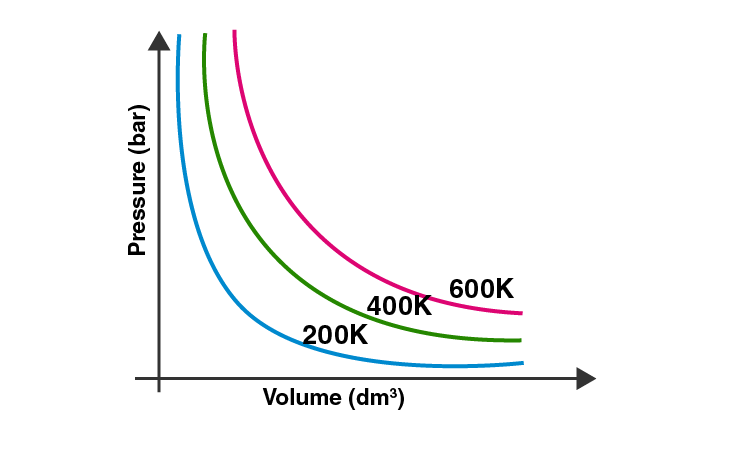
The variation of pressure with the volume of the gas at different temperatures can be graphically represented as shown in Fig. 5.3. Based on this graph answer the following questions.

(i) How will the volume of a gas change if its pressure is increased at constant temperature?

(ii) At constant pressure, how will the volume of a gas change if the temperature is increased from 200K to 400K?

NCERT Exemplar Solutions of Class 11 Chemistry Chapter 5 States of Matter-3

Show solutionHide solution
Worked solution

(i) As the temperature is constant, and the pressure is increasing the change in the volume is seen as decreasing exponentially.

(ii) At the constant pressure, by increasing temperature the volume of gas increases.

Q40Written answer

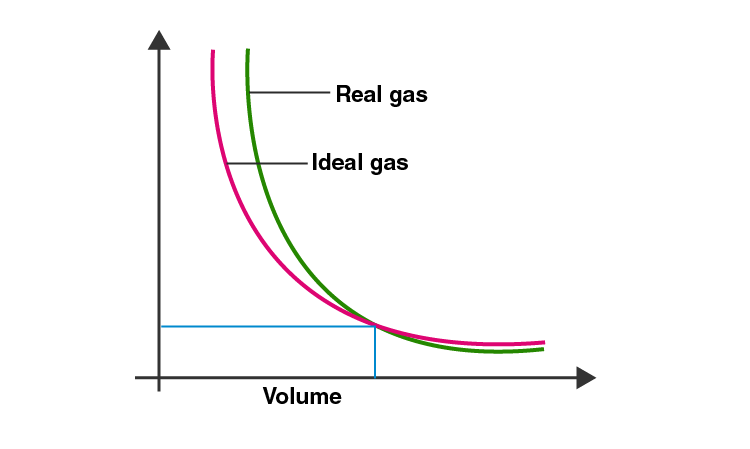
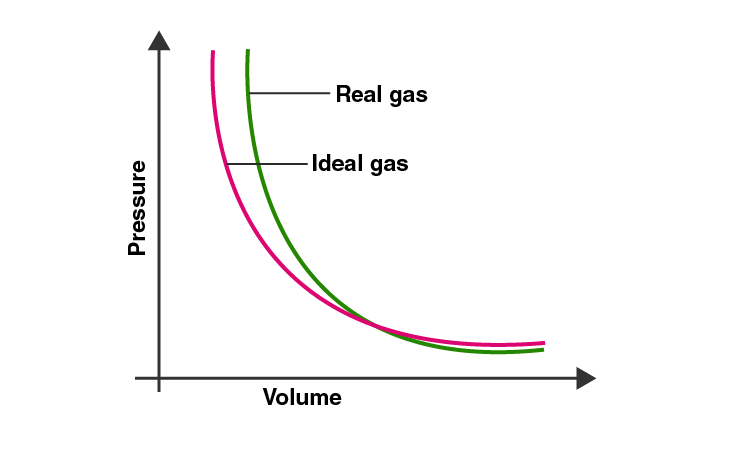
Pressure versus volume graph for a real gas and an ideal gas is shown in Fig. 5.4. Answer the following questions based on this graph.

NCERT Exemplar Solutions of Class 11 Chemistry Chapter 5 States of Matter-4

(i) Interpret the behaviour of real gas with respect to an ideal gas at low pressure.

(ii) Interpret the behaviour of real gas with respect to an ideal gas at high pressure.

(iii)Mark the pressure and volume by drawing a line at the point where real gas behaves as an ideal gas.

Show solutionHide solution
Worked solution

(i) At low pressure as the red curve and the blue curve are approaching each other, which shows that the real gas is behaving as an ideal gas at the low pressure.

(ii) At high pressure as the red curve and the blue curve are deviating and going away from each other, which indicates that the real gas and ideal gas have distinct characters at high pressure

(iii)

NCERT Exemplar Solutions of Class 11 Chemistry Chapter 5 States of Matter-5

IV. Matching Type

Q41Written answer

Match the graphs between the following variables with their names :

Graphs

(i) Pressure vs temperature

graph at constant molar volume.

(ii) Pressure vs volume graph

at constant temperature.

(iii) Volume vs temperature graph

at constant pressure.


Names

(a) Isotherms

(b) Constant temperature curve

(c) Isochores

(d) Isobars

Show solutionHide solution
Worked solution

(i) is c

(ii) is a

(iii) is d

Q42Written answer

Match the following gas laws with the equation representing them.

(i) Boyle’s law

(ii) Charle’s law

(iii) Dalton’s law

(iv) Avogadro law

(a) V ∝ n at constant T and p

(b) pTotal = p1 + p2 + p3+…… at constant T, V

(c) PV/T = Constant

(d) V ∝ T at constant n and p

(e) p V ∝ 1 at constant n and T

Show solutionHide solution
Worked solution

(i) is e

(ii) is d

(iii) is b

(iv) is a

Q43Written answer

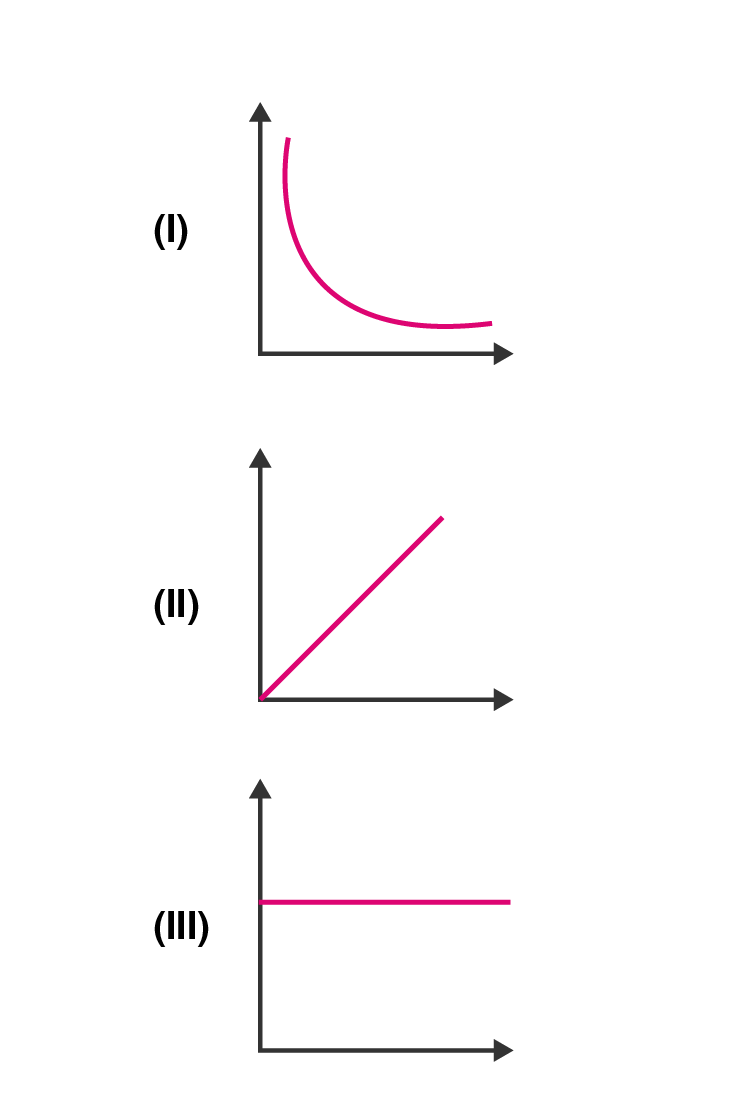
Match the following graphs of an ideal gas with their co-ordinates :

NCERT Exemplar Solutions of Class 11 Chemistry Chapter 5 States of Matter-6

(a) pV vs V

(b) p vs. V

(c) p vs. 1/V

Show solutionHide solution
Worked solution

(i) is b

(ii) is c

(iii) is a

V. Assertion and Reason Type

In the following questions, a statement of Assertion (A) followed by a statement

of Reason (R) is given. Choose the correct option out of the choices given

below each question.