My Cart
Your Cart 0

    Your cart is empty.

  • Total (Amount) ₹0.00
NCERT Exemplar · Class 11 · Chemistry

Chapter 2: Structure of Atom

Practice each question, then open the answer or worked solution.

Multiple Choice Questions (Type-I)

16 questions
Q1Written answer

Which of the following conclusions could not be derived from Rutherford’s α -particle scattering experiment? 

(i) Most of the space in the atom is empty. 

(ii) The radius of the atom is about 10–10 m while that of nucleus is 10–15 m. 

(iii) Electrons move in a circular path of fixed energy called orbits. 

(iv) Electrons and the nucleus are held together by electrostatic forces of attraction.

Show solutionHide solution
Worked solution

Ans: (iii) Electrons move in a circular path of fixed energy called orbits 

As per Rutherford’s α-particle scattering experiment the nucleus is surrounded by electrons that move around the nucleus with a very high speed in circular paths called orbits. It does not mention the energy or stability of the electrons revolving around the nucleus.
Q2Written answer

Which of the following options does not represent ground state electronic configuration of an atom? 

(i) 1s2 2s2 2p6 3s2 3p6 3d8 4s2 

(ii) 1s2 2s2 2p6 3s2 3p6 3d9 4s2 

(iii) 1s2 2s2 2p6 3s2 3p6 3d10 4s1

 (iv) 1s2 2s2 2p6 3s2 3p6 3d5 4s1

Show solutionHide solution
Worked solution

Ans: (ii) 1s2 2s2 2p6 3s2 3p6 3d9 4s2 

As per the Hund’s rule the half filled and fully filled orbital leads to the extra stability due to the symmetry thus fully filled 3d and half filled 4s is preferred.


Q3Written answer

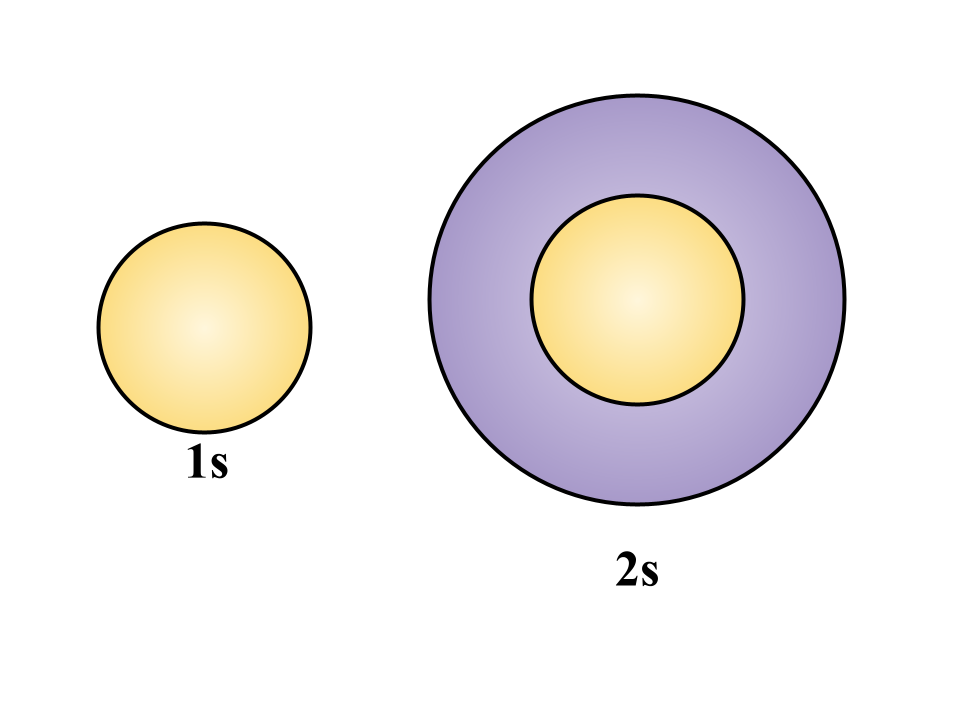
The probability density plots of 1s and 2s orbitals are given in Fig. 2.1:


seo images


The density of dots in a region represents the probability density of finding electrons in the region.

On the basis of above diagram which of the following statements is incorrect? 

(i) 1s and 2s orbitals are spherical in shape.

(ii) The probability of finding the electron is maximum near the nucleus.

(iii) The probability of finding the electron at a given distance is equal in all  directions. 

(iv) The probability density of electrons for 2s orbital decreases uniformly as distance from the nucleus increases.

Show solutionHide solution
Worked solution

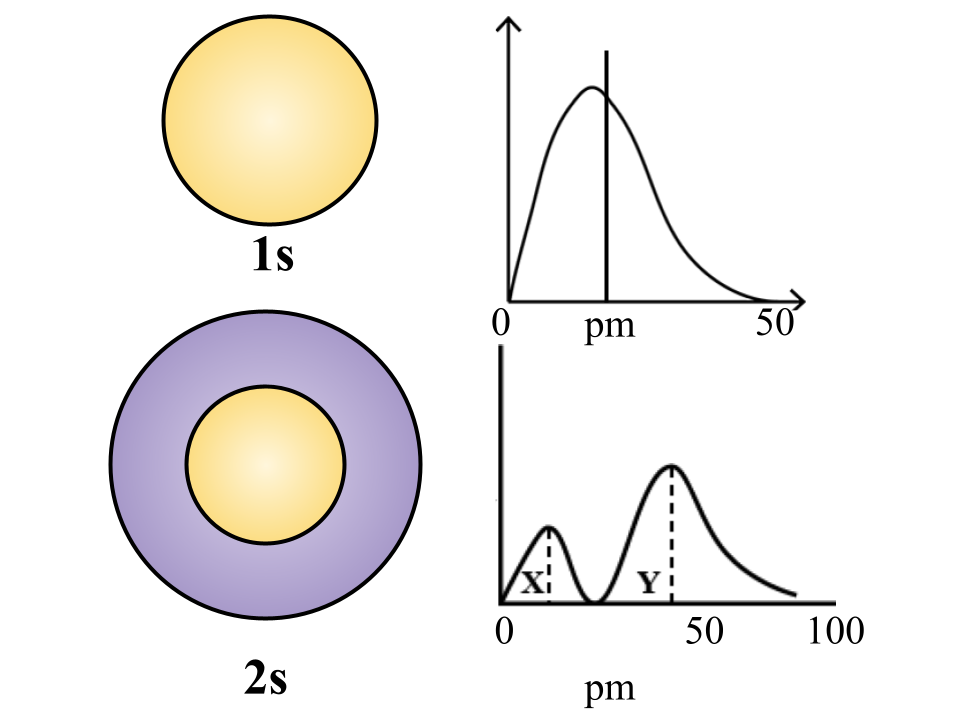
Ans: (iv) The probability density of electrons for 2s orbital decreases uniformly as distance from the nucleus increases.


seo images


As per the probability density curve , the probability of finding the electrons at the 1s orbital decreases as we move far from the nucleus,however in case of 2s the probability decreases initially then it increases with the distance and thereafter at a certain point it starts decreasing with the distance.


Q4Written answer

Which of the following statements is not correct about the characteristics of cathode rays?

(i) They start from the cathode and move towards the anode. 

(ii) They travel in a straight line in the absence of an external electrical or magnetic field.

(iii) Characteristics of cathode rays do not depend upon the material of electrodes in the cathode ray tube. 

(iv) Characteristics of cathode rays depend upon the nature of gas present in the cathode ray tube.

Show solutionHide solution
Worked solution

Ans: (iv) Characteristics of cathode rays depend upon the nature of gas present in the cathode ray tube.

As per the result obtained from the cathode ray discharge tube experiment the characteristics of cathode rays (electrons) does not depend upon the material of electrodes and the nature of the gas present in the cathode ray tube. Which concludes that electrons are the basic constituent of all the atoms.


Q5Written answer

Which of the following statements about the electron is incorrect?

(i) It is a negatively charged particle.

(ii) The mass of an electron is equal to the mass of a neutron. 

(iii) It is a basic constituent of all atoms. 

(iv) It is a constituent of cathode rays.

Show solutionHide solution
Worked solution

Ans: (ii) The mass of an electron is equal to the mass of a neutron. 

The neutron is heavier than the electron as 

Mass of the neutron = 1.67 x 10⁻²⁷ kg 

Mass of the electron = 9.11 x 10⁻³¹kg


Q6Written answer

Which of the following properties of an atom could be explained correctly by Thomson Model of atom?

(i) Overall neutrality of atom.

(ii) Spectra of hydrogen atom. 

(iii) Position of electrons, protons and neutrons in atom. 

(iv) Stability of atom.

Show solutionHide solution
Worked solution

Ans: (i) Overall neutrality of atom.

According to the J.J Thomson model the positive charge is uniformly distributed and the electrons are embedded into it in such a manner as to give the most stable electrostatic arrangement just as watermelon of positive charge with plums or seeds (electrons) embedded into it.Thus this model is able to explain the overall neutrality of the atom.

Thomson model of atom


seo images


Q7Written answer

Two atoms are said to be isobars if.

(i) they have same atomic number but different mass number. 

(ii) they have same number of electrons but different number of neutrons. 

(iii) they have same number of neutrons but different number of electrons. 

(iv) sum of the number of protons and neutrons is same but the number of protons is different

Show solutionHide solution
Worked solution

Ans: (iv) sum of the number of protons and neutrons is same but the number of protons is different

Isobars are the atoms which have same mass number (sum of number of neutrons and protons) but different atomic number (i.e. different proton number)

For example,  614C and 7 14N.


Q8Written answer

The number of radial nodes for 3p orbital is __________.

 (i) 3 

(ii) 4 

(iii) 2 

(iv) 1

Show solutionHide solution
Worked solution

Ans: (iv) 1

The number of radial nodes is given by n-l-1

where n is principal quantum number,l is azimuthal quantum number

For 3p orbital,n=3 and l=1 

Thus, the number of radial nodes =n-l-1 =3-1-1 =1


Q9Written answer

Number of angular nodes for 4d orbital is __________.

 (i) 4 

(ii) 3 

(iii) 2 

(iv) 1

Show solutionHide solution
Worked solution

Ans: (iii) 2

The number of angular nodes is given by n-l 

where n is principal quantum number,l is azimuthal quantum number

For 4d orbital,n=4 and l=2 

Thus, the number of angular nodes =n-l = 4-2 = 2


Q10Written answer

Which of the following is responsible to rule out the existence of definite paths or trajectories of electrons? 

(i) Pauli’s exclusion principle. 

(ii) Heisenberg’s uncertainty principle. 

(iii) Hund’s rule of maximum multiplicity. 

(iv) Aufbau principle.

Show solutionHide solution
Worked solution

Ans: (ii) Heisenberg’s uncertainty principle. 

According to Heisenberg's uncertainty principle it is impossible to determine simultaneously the exact position and exact momentum (or velocity) of an electron. Thus it implies that determining the trajectory of an electron is impossible as it requires exact position and velocity which is not possible as per the uncertainty principle.