My Cart
Your Cart 0

    Your cart is empty.

  • Total (Amount) ₹0.00
NCERT Exemplar · Class 11 · Chemistry

Chapter 13: Hydrocarbons

Practice each question, then open the answer or worked solution.

Questions

47 questions
Q21Written answer

Alkynes on reduction with sodium in liquid ammonia form trans alkenes. Will the butene thus formed on the reduction of the 2-butyne show the geometrical isomerism?

Show solutionHide solution
Worked solution

The negative charged developed on one carbon attacks the proton from NH3 and another sodium atom lose its electron to develop a second negative charge on the atom. This negative charge is finally neutralised by the attack of the second proton to give a trans-but-2-ene.

This but-2-ene produced shows geometrical isomers as cis and trans.
Q22Written answer

Rotation around carbon-carbon single bond of ethane is not completely free. Justify the statement.

Show solutionHide solution
Worked solution

The single bond in ethane is a σ – bond, which is a coaxial overlap of orbitals, so the C ─ C bond can be rotated on its axis. But this rotation is not completely free due to the torsional strain that the bond undergoes due to rotation.

Q23Written answer

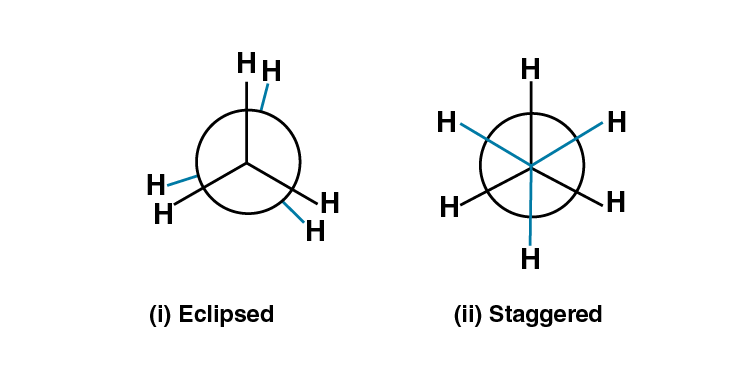
Draw Newman and Sawhorse projections for the eclipsed and staggered conformations of ethane. Which of these conformations is more stable and why?

Show solutionHide solution
Worked solution

NCERT Exemplar Solutions of Class 11 Chemistry Chapter 13 Hydrocarbons-10

The staggered configuration is more stable as compared to an eclipse, as there is less C – H bond pair repulsion and the atoms are at a maximum distance away from each other.

Q24Written answer

The intermediate carbocation formed in the reactions of HI, HBr and HCl with propane is the same and the bond energy of HCl, HBr and HI is 430.5 kJ mol-1, 363.7 kJ mol-1 and 296.8 kJ mol-1 respectively. What will be the order of reactivity of these halogen acids?

Show solutionHide solution
Worked solution

HI >HBr>HCl is the increasing order of reactivity. The increasing order of reactivity of halogen is same as their increase in bond energies.

Q25Written answer

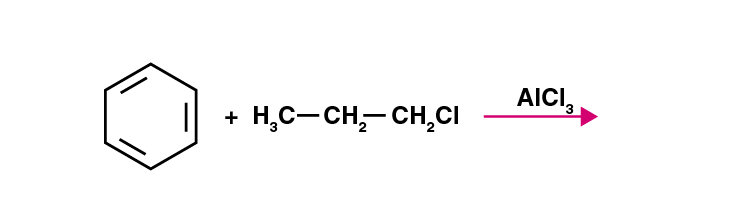
What will be the product obtained as a result of the following reaction and why?

NCERT Exemplar Solutions of Class 11 Chemistry Chapter 13 Hydrocarbons-11

Show solutionHide solution
Worked solution

This reaction is an example of Friedel Crafts alkylation using a lewis acid.

In the first step, there will be a formation of the carbocation, then a secondary carbocation will be formed which is more stable. There will be a hydride shift. At last nucleophilic attack will happen to the benzene ring which forms the major product cumene and a minor product of primary carbocation.

Q26Written answer

How will you convert benzene into

(i) p – nitrobromobenzene

(ii) m – nitrobromobenzene

Show solutionHide solution
Worked solution

(i) when bromine is treated with Br2 in presence anhydrous FeBr3 it undergoes electrophilic substitution to give bromobenzene. Again treated with conc. HNO3 and Conc. H2SO4 at 323K we get a p-nitrobromobenzene

(ii) We need to deactivate the benzene by the introduction of a nitro group using conc. HNO3 and H2SO4 and then treat with Br2 in presence of FeBr3 we will get m-nitrobromobenzene.

Q27Written answer

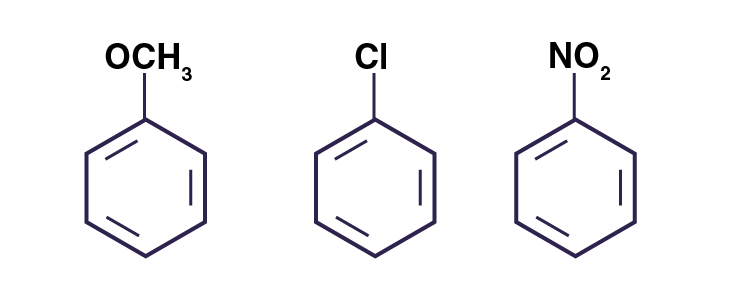
Arrange the following set of compounds in the order of their decreasing relative reactivity with an electrophile. Give reason.

NCERT Exemplar Solutions of Class 11 Chemistry Chapter 13 Hydrocarbons-12

Show solutionHide solution
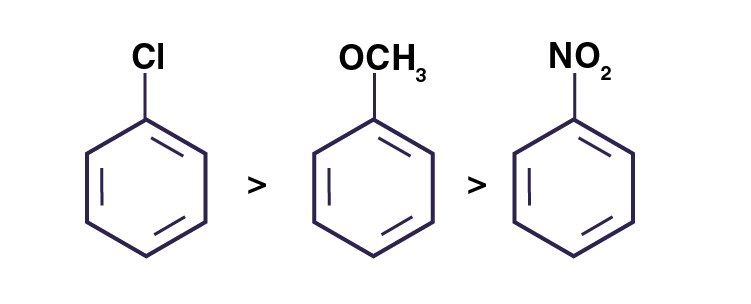
Worked solution

NCERT Exemplar Solutions of Class 11 Chemistry Chapter 13 Hydrocarbons-13

Q28Written answer

Despite their – I effect, halogens are o- and p-directing in halo-arenes. Explain.

Show solutionHide solution
Worked solution

Halogens have an outer configuration of ns2p5 which shows it can accept one electron and are close to completing its octate; halogens show a strong affinity to attract one electron and thus having a higher electronegativity and show negative inductive effect.

Q29Written answer

Why does the presence of a nitro group make the benzene ring less reactive in comparison to the unsubstituted benzene ring? Explain.

Show solutionHide solution
Worked solution

Nitro group has a nitrogen atom bonded to two highly electronegative oxygen atoms. This results in a net decrease of electron density around nitrogen atom and imparts a positive δ+ charge on nitrogen.

Q30Written answer

Suggest a route for the preparation of nitrobenzene starting from acetylene?

Show solutionHide solution
Worked solution

(i) By intermolecular condensation method, we can cycle acetylene and then treated at high temperature in a red hot iron tube.

(ii) The aliphatic compound thus converted into benzene is treated with con.HNO3 and Conc.H2SO4 which undergoes nitration to give nitrobenzene.