My Cart
Your Cart 0

    Your cart is empty.

  • Total (Amount) ₹0.00
NCERT Exemplar · Class 11 · Chemistry

Chapter 13: Hydrocarbons

Practice each question, then open the answer or worked solution.

Questions

47 questions
Q31Written answer

Predict the major product (s) of the following reactions and explain their formation.

NCERT Exemplar Solutions of Class 11 Chemistry Chapter 13 Hydrocarbons-14

Show solutionHide solution
Worked solution

NCERT Exemplar Solutions of Class 11 Chemistry Chapter 13 Hydrocarbons-15

Step 1: Homolysis of peroxide to from free radicals
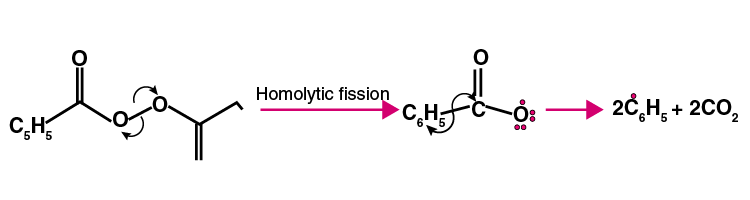
NCERT Exemplar Solutions of Class 11 Chemistry Chapter 13 Hydrocarbons-16

Step 2: Formation of Bromine free radical

∙C6H5 + H-BR → C6H6 + Br∙
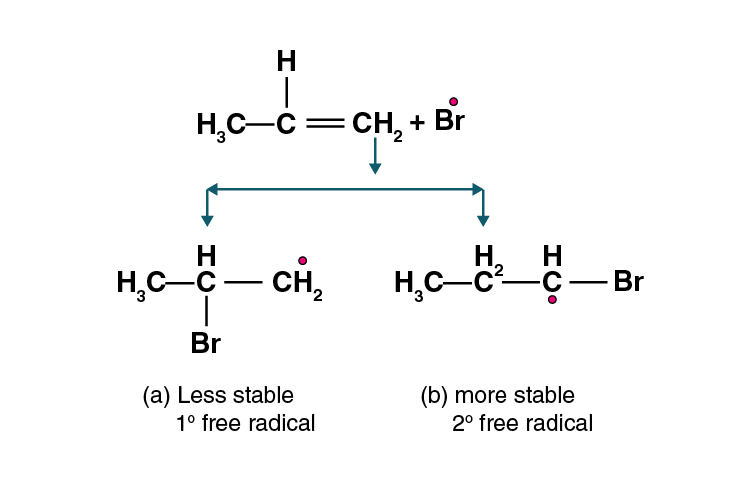
NCERT Exemplar Solutions of Class 11 Chemistry Chapter 13 Hydrocarbons-17

Step 3: reaction of hydrogen bromide with an alkyl radical
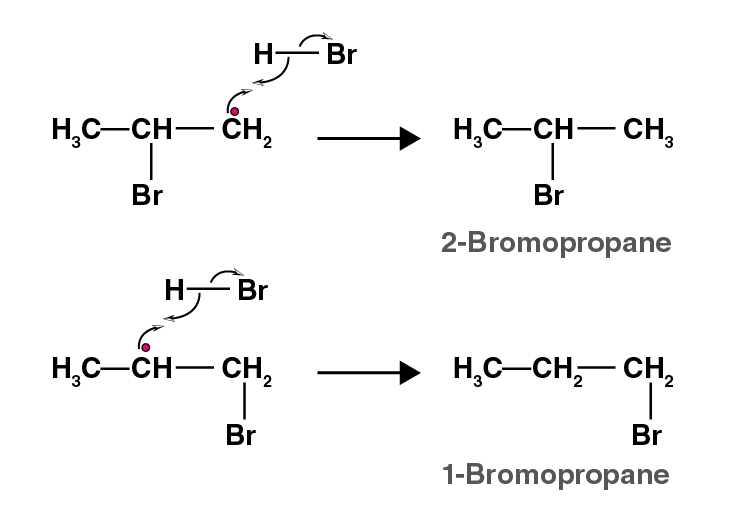
NCERT Exemplar Solutions of Class 11 Chemistry Chapter 13 Hydrocarbons-18

Q32Written answer

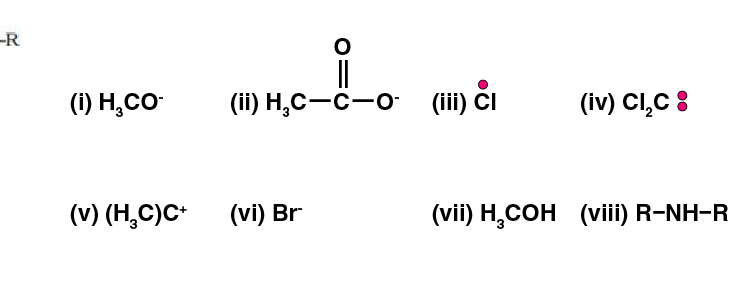
Nucleophiles and electrophiles are reaction intermediates having electron-rich and electron-deficient centres’ respectively. Hence, they tend to attack electron-deficient and electron-rich centres respectively. Classify the following species as electrophiles and nucleophiles.

NCERT Exemplar Solutions of Class 11 Chemistry Chapter 13 Hydrocarbons-19

Show solutionHide solution
Worked solution

(i), (vi), (vii), (viii) are nucleophiles

(ii), (iii), (iv), (v) are electrophiles

Q33Written answer

The relative reactivity of 1°, 2°, 3° hydrogen’s towards chlorination is 1: 3.8: 5. Calculate the percentages of all mono-chlorinated products obtained from 2-methyl butane.

Show solutionHide solution
Worked solution

Amount of mono-chlorinated products = No. of hydrogen reactivity

Mono-chlorinated products from 1° H = 9 1 = 9

Mono-chlorinated products from 2° H = 2 3.8 = 7.6

Mono-chlorinated products from 3° H = 1 5 = 5

Total mono-chlorinated products = 9+7.6+5 = 21.6

Yield % for 1° H chlorination = 9×100/21.6 = 41.67%

Yield % for 2° H chlorination = 7.6×100/21.6 = 35.18%

Yield % for 3° H chlorination = 5×100/21.6 = 23.15%

Q34Written answer

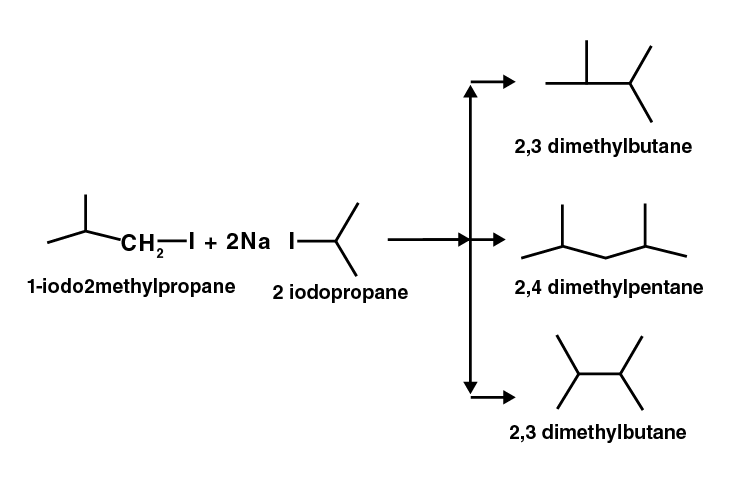
Write the structures and names of products obtained in the reactions of sodium with a mixture of 1-iodo-2-methylpropane and 2-iodopropane.

Show solutionHide solution
Worked solution

When the mixture of 1-iodo-2-methylpropane and 2-iodopropane is treated with sodium it gives a mixture of three products formed by intermolecular and intramolecular reaction as follows:

NCERT Exemplar Solutions of Class 11 Chemistry Chapter 13 Hydrocarbons-20

Q35Written answer

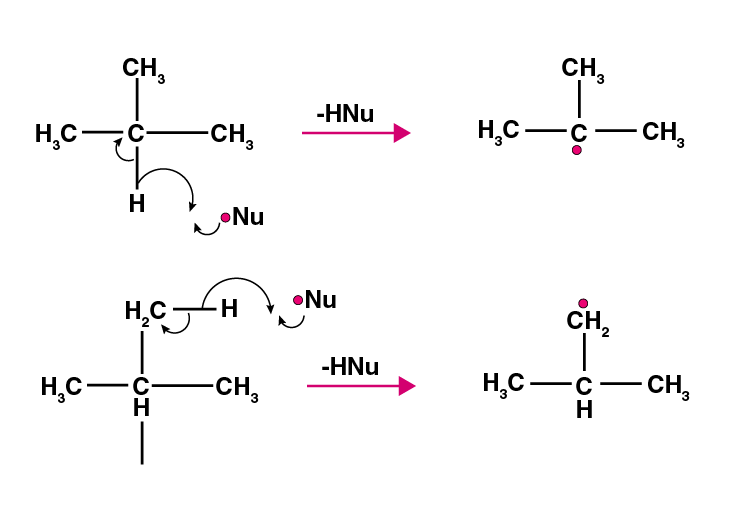
Write hydrocarbon radicals that can be formed as intermediates during monochlorination of 2-methylpropane? Which of them is more stable? Give reasons.

Show solutionHide solution
Worked solution

NCERT Exemplar Solutions of Class 11 Chemistry Chapter 13 Hydrocarbons-21

The 3° free radical is stabilised by 9 hyperconjugation structures and thus has more stability as compared to 1° free radical.

Q36Written answer

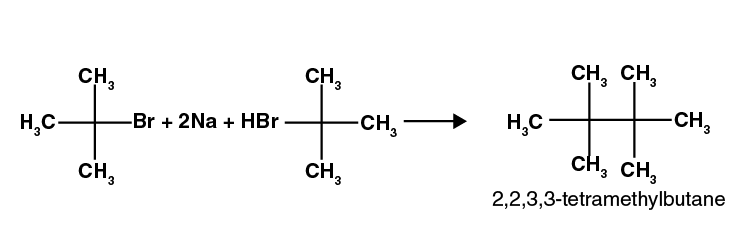
An alkane C8H18 is obtained as the only product on subjecting a primary alkyl halide to Wurtz reaction. On monobromination, this alkane yields a single isomer of a tertiary bromide. Write the structure of alkane and the tertiary bromide.

Show solutionHide solution
Worked solution

NCERT Exemplar Solutions of Class 11 Chemistry Chapter 13 Hydrocarbons-22

Q37Written answer

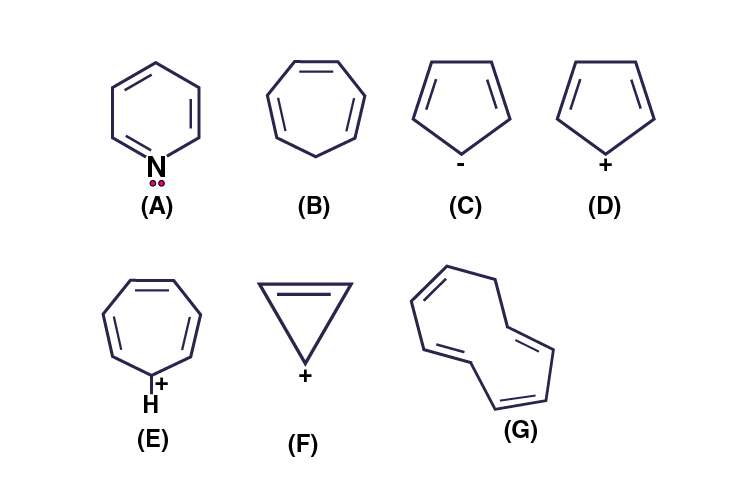
The ring systems having the following characteristics are aromatic.

(i) Planar ring containing conjugated π bonds.

(ii) Complete delocalisation of the π−electrons in-ring system i.e. each atom in the ring has unhybridised p-orbital, and

(iii) Presence of (4n+2)−electrons in the ring where n is an integer (n = 0, 1, 2,………..) [Huckel rule].

Using this information classifies the following compounds as aromatic/non-aromatic.

NCERT Exemplar Solutions of Class 11 Chemistry Chapter 13 Hydrocarbons-23

Show solutionHide solution
Worked solution

Aromatic compounds: A, E and F

Non-Aromatic : B, C, D and G

Q38Written answer

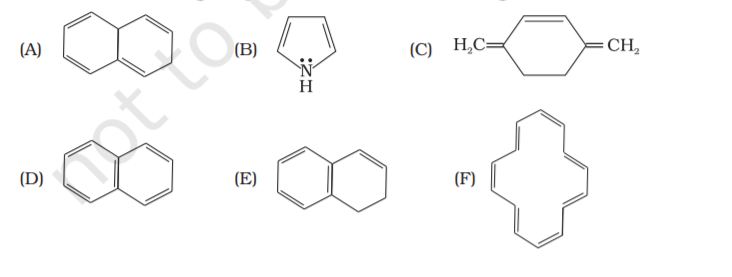
Which of the following compounds are aromatic according to Huckel’s rule?

NCERT Exemplar Solutions of Class 11 Chemistry Chapter 13 Hydrocarbons-24

Show solutionHide solution
Worked solution

According to Huckel’s rule, it should satisfy (4n+π) rule

Compound B, C, D and F are aromatic.

Q39Written answer

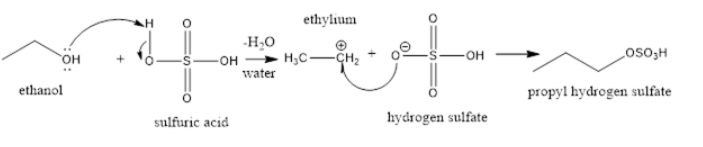
Suggest a route to prepare ethyl hydrogen sulphate (CH3–CH2–OSO2—OH) starting from ethanol (C2H5OH)

Solution;

Ethanol when treated with sulphuric acid at around 140°C gives hydrogen sulphate. The reaction is

NCERT Exemplar Solutions of Class 11 Chemistry Chapter 13 Hydrocarbons-25

IV. Matching Type

40. Match the reagent from Column I which on reaction with CH3

—CH=CH2 gives some product given in Column II as per the codes given below :

Column I

(i) O3/Zn + H2O

(ii) KMnO4/H+

(iii) KMnO4/OH–

(iv) H2O/H+

(v) B2H6/NaOH and H2O2

Column II

(a) Acetic acid and CO2

(b) Propan-1-ol

(c) Propan-2-ol

(d) Acetaldehyde and formaldehyde

(e) Propane-1,2-diol

Show solutionHide solution
Worked solution

(i) is d

(ii) is a

(iii) is e

(iv) is c

(v) is b

Q40Written answer

Match the reagent from Column I which on reaction with 

CH3 – CH=CH2 gives some product given in Column II as per the codes given below:

Column I

Column II

(i) O3/Zn + H2O

(a) Acetic acid and CO2

(ii) KMnO4/H+

(b) Propan-1-ol

(iii) KMnO4/OH-

(c) Propan-2-ol

(iv) H2O/H+

(d) Acetaldehyde and formaldehyde

(v) B2H6/NaOH and H2O2

(e) Propan-1,2-diol

Show solutionHide solution
Worked solution

Ans: 

(i) O3/Zn + H2O

(d) Acetaldehyde and formaldehyde

(ii) KMnO4/H+

(a)Acetic acid and CO2

(iii) KMnO4/OH-

(e) Propan-1,2-diol

(iv) H2O/H+

(c) Propan-2-ol

(v) B2H6/NaOH and H2O2

(b) Propan-1-ol