My Cart
Your Cart 0

    Your cart is empty.

  • Total (Amount) ₹0.00
NCERT Exemplar · Class 11 · Chemistry

Chapter 13: Hydrocarbons

Practice each question, then open the answer or worked solution.

Questions

47 questions
Q11Written answer

Some oxidation reactions of methane are given below. Which of them is/are controlled oxidation reactions?

(i) CH4 + O2→ CO2 (g) +  2H2O (l)

(ii) CH4 + O2→ C (s) +  2H2O (l)

(iii) CH4 + O2 \[\xrightarrow{M_20_3}\] HCHO +  H2O

(iv) 2CH4 + O2 \[\xrightarrow{Cu/523k/100atm}\] 2CH3OH

Show solutionHide solution
Worked solution

Ans: (iii) & (iv)

Methane is a controlled oxidation reaction that leads to giving formaldehyde and methanol.

Q12Written answer

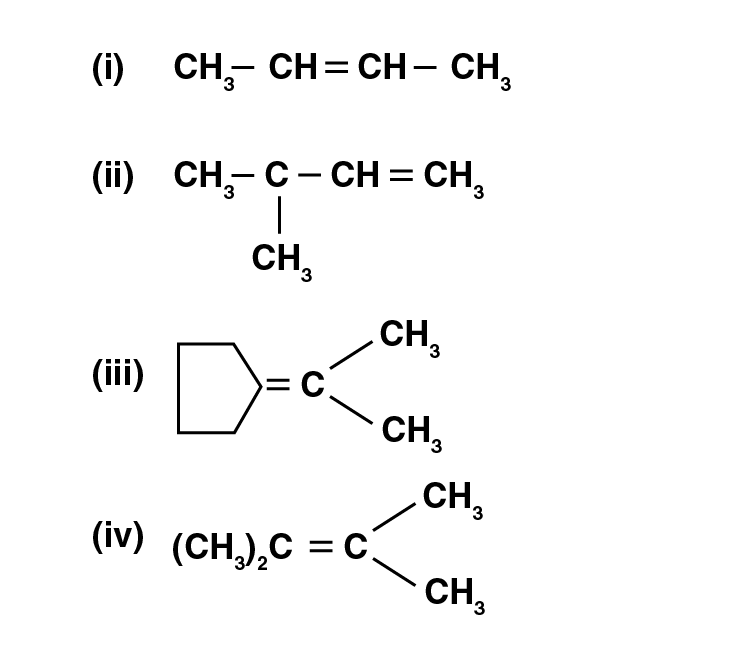
Which of the following alkenes on ozonolysis give a mixture of ketones only?

NCERT Exemplar Solutions of Class 11 Chemistry Chapter 13 Hydrocarbons-6

Show solutionHide solution
Worked solution

Option (iii) and (iv) are the answers.

Q13Multiple choice

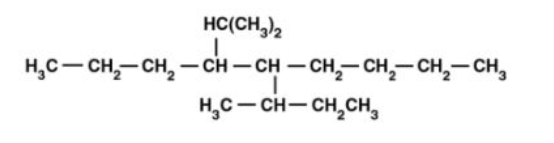
Which are the correct IUPAC names of the following compound?

NCERT Exemplar Solutions of Class 11 Chemistry Chapter 13

Show answerHide answer
Correct option: C
Show solutionHide solution
Worked solution

Option (iii) and (iv) are the answers.

Q14Multiple choice

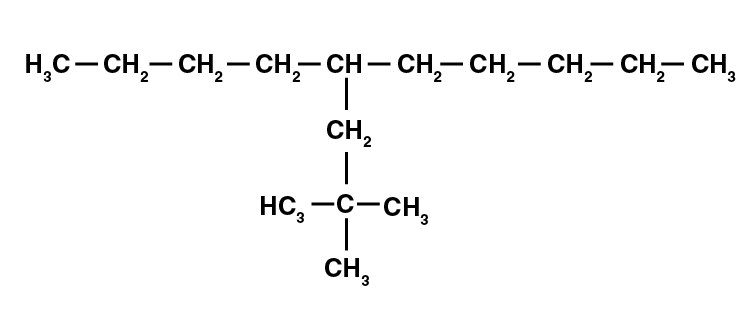
Which are the correct IUPAC names of the following compound?

NCERT Exemplar Solutions of Class 11 Chemistry Chapter 13 Hydrocarbons-7

Show answerHide answer
Correct option: A
Show solutionHide solution
Worked solution

Option (i) and (iv) are the answers.

Q15Written answer

For an electrophilic substitution reaction, the presence of a halogen atom in

the benzene ring _______.

(i) deactivates the ring by the inductive effect

(ii) deactivates the ring by resonance

(iii) increases the charge density at ortho and para position relative to meta

position by resonance

(iv) directs the incoming electrophile to meta position by increasing the

charge density relative to ortho and para position.

Show solutionHide solution
Worked solution

Option (i) and (iii) are the answers.

Q16Written answer

In an electrophilic substitution reaction of nitrobenzene, the presence of nitro

group ________.

(i) deactivates the ring by an inductive effect.

(ii) activates the ring by an inductive effect.

(iii) decreases the charge density at ortho and para position of the ring

relative to meta position by resonance.

(iv) increases the charge density at meta position relative to the ortho and

para positions of the ring by resonance

Show solutionHide solution
Worked solution

Option (i) and (iii) are the answers.

Q17Written answer

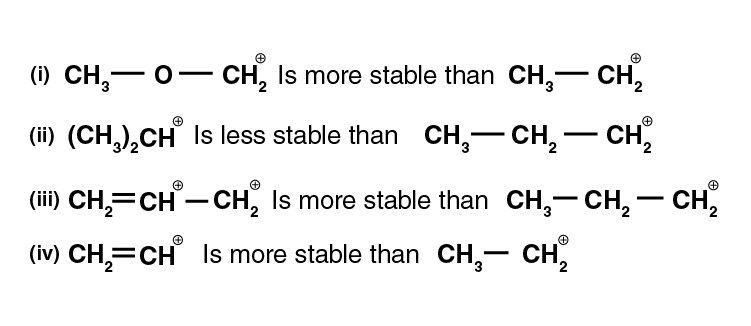
Which of the following is correct?

NCERT Exemplar Solutions of Class 11 Chemistry Chapter 13 Hydrocarbons-8

Show solutionHide solution
Worked solution

Option (i) and (iii) are the answers.

Q18Written answer

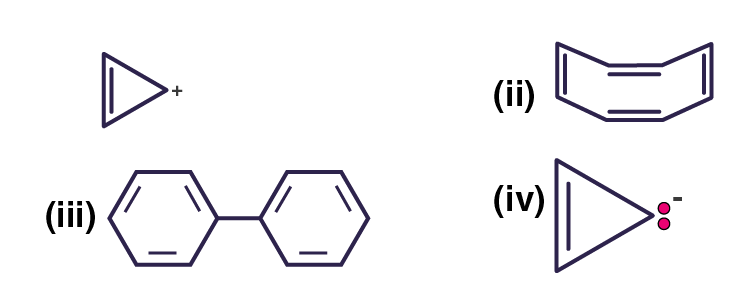
Four structures are given in options (i) to (iv). Examine them and select the

aromatic structures.

NCERT Exemplar Solutions of Class 11 Chemistry Chapter 13 Hydrocarbons-9

Show solutionHide solution
Worked solution

Option (i) and (iii) are the answers.

Q19Written answer

The molecules having dipole moment are __________.(i) 2,2-Dimethylpropane

(ii) trans-Pent-2-ene

(iii) cis-Hex-3-ene

(iv) 2, 2, 3, 3 – Tetramethylbutane.

Show solutionHide solution
Worked solution

Option (ii) and (iii) are the answers.

III. Short Answer Type

Q20Written answer

Why do alkenes prefer to undergo electrophilic addition reaction while arenes

prefer electrophilic substitution reactions? Explain.

Show solutionHide solution
Worked solution

Alkenes undergo addition reaction to give a more stable saturated product. In this reaction hybridization changes from sp2to sp3.

The resonance stability of arene is maintained by a substitution reaction.