My Cart
Your Cart 0

    Your cart is empty.

  • Total (Amount) ₹0.00
NCERT Exemplar · Class 11 · Chemistry

Chapter 13: Hydrocarbons

Practice each question, then open the answer or worked solution.

Questions

47 questions
Q1Written answer

Arrange the following in decreasing order of their boiling points.

(A) n–butane (B) 2–methylbutane

(C) n-pentane (D) 2,2–dimethylpropane

(i) A > B > C > D

(ii) B > C > D > A

(iii) D > C > B > A

(iv) C > B > D > A

Show solutionHide solution
Worked solution

Option (iv) is the answer.
Q2Written answer

Arrange the halogens F2 , Cl2 , Br2 , I2 , in order of their increasing reactivity

with alkanes.

(i) I2 < Br2 < Cl2 < F2

(ii) Br2 < Cl2 < F2 < I2

(iii) F2 < Cl2 < Br2 < I2

(iv) Br2 < I2< Cl2 < F2

Show solutionHide solution
Worked solution

Option (i) is the answer.

Q3Written answer

The increasing order of reduction of alkyl halides with zinc and dilute HCl is

(i) R–Cl < R–I < R–Br

ii) R–Cl < R–Br < R–I

(iii) R–I < R–Br < R–Cl

(iv) R–Br < R–I < R–Cl

Show solutionHide solution
Worked solution

Option (ii) is the answer.

Q4Multiple choice

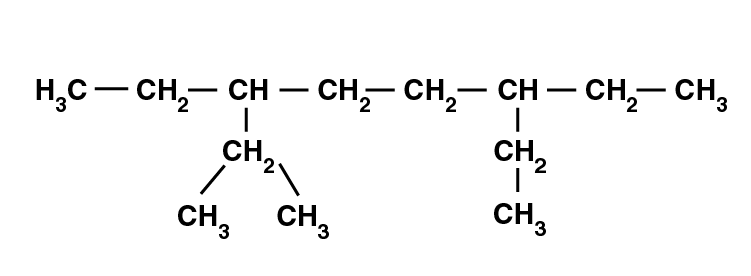
The correct IUPAC name of the following alkane is

NCERT Exemplar Solutions of Class 11 Chemistry Chapter 13 Hydrocarbons-1

Show answerHide answer
Correct option: A
Show solutionHide solution
Worked solution

Option (i) is the answer.

Q5Written answer

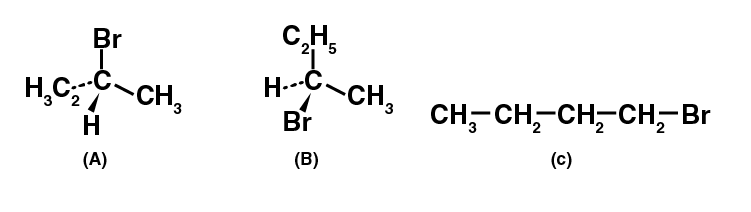
The addition of HBr to 1-butene gives a mixture of products A, B and C

NCERT Exemplar Solutions of Class 11 Chemistry Chapter 13 Hydrocarbons-2

The mixture consists of

(i) A and B as major and C as minor products

(ii) B as major, A and C as minor products

(iii) B as minor, A and C as major products

(iv) A and B as minor and C as major products

Show solutionHide solution
Worked solution

Option (i) is the answer.

Q6Written answer

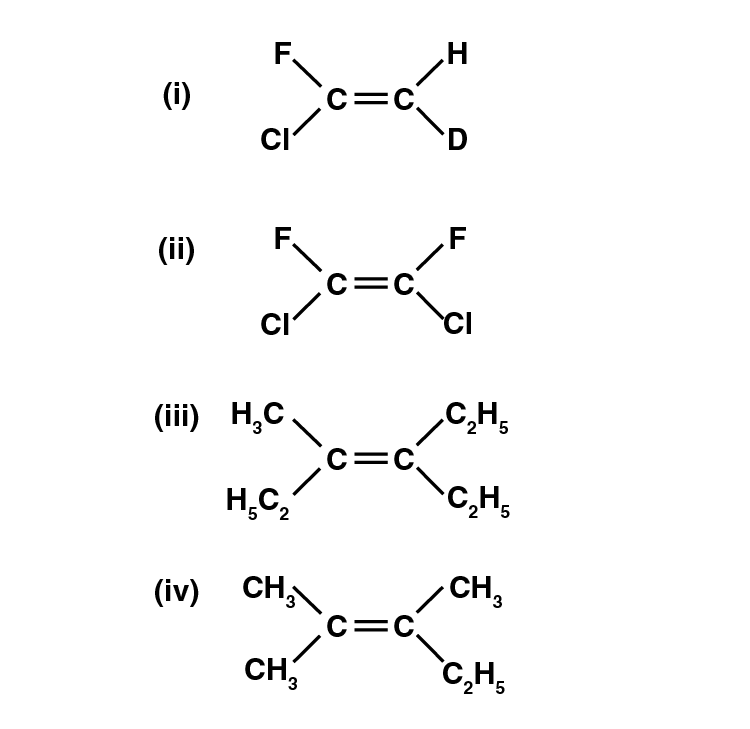
. Which of the following will not show geometrical isomerism?

NCERT Exemplar Solutions of Class 11 Chemistry Chapter 13 Hydrocarbons-3

Show solutionHide solution
Worked solution

Option (iv) is the answer.
Q7Written answer

Arrange the following hydrogen halides in order of their decreasing reactivity

with propane.

(i) HCl > HBr > HI

(ii) HBr > HI > HCl

(iii) HI > HBr > HCl

(iv) HCl > HI > HBr

Show solutionHide solution
Worked solution

Option (iii) is the answer.

Q8Written answer

Arrange the following carbanions in order of their decreasing stability.

(A) H3C – C ≡ C– (B) H – C ≡ C– (C) H3C-CH–2

(i) A > B > C

(ii) B > A > C

(iii) C > B > A

(iv) C > A > B

Show solutionHide solution
Worked solution

Option (ii) is the answer.

Q9Written answer

Arrange the following alkyl halides in decreasing order of the rate of

β– elimination reaction with alcoholic KOH.NCERT Exemplar Solutions of Class 11 Chemistry Chapter 13 Hydrocarbons-4

(i) A > B > C

(ii) C > B > A

(iii) B > C > A

(iv) A > C > B

Show solutionHide solution
Worked solution

Option (iv) is the answer.
Q10Written answer

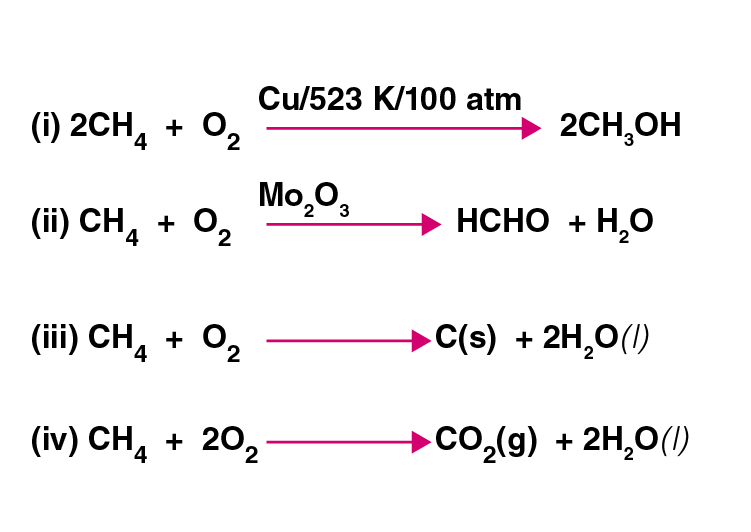
Which of the following reactions of methane is incomplete combustion:

NCERT Exemplar Solutions of Class 11 Chemistry Chapter 13 Hydrocarbons-5

Show solutionHide solution
Worked solution

Option (iii) is the answer.

II. Multiple Choice Questions (Type-II)

In the following questions, two or more options may be correct.

Some oxidation reactions of methane are given below. Which of them is/are

controlled oxidation reactions?

(i) CH4 (g) + 2O2 (g)→ CO2 (g) + 2H2O (l)

(ii) CH4 (g) + O2 (g) → C (s) + 2H2O (l)

(iii) CH4 (g) + O2 (g) →(Mo O2 3) HCHO + H2O

(iv) 2CH4 (g) + O2 (g) → (Cu/523/100 atm) 2CH3OH

Option (iii) and (iv) are the answers.