My Cart
Your Cart 0

    Your cart is empty.

  • Total (Amount) ₹0.00
NCERT Exemplar · Class 11 · Chemistry

Chapter 12: Organic Chemistry: Some Basic Principles and Techniques

Practice each question, then open the answer or worked solution.

Questions

15 questions
Q11Multiple choice

In which of the following compounds the carbon marked with an asterisk is

expected to have the greatest positive charge?

Show answerHide answer
Correct option: A
Show solutionHide solution
Worked solution

Option (i) is the answer.
Q12Written answer

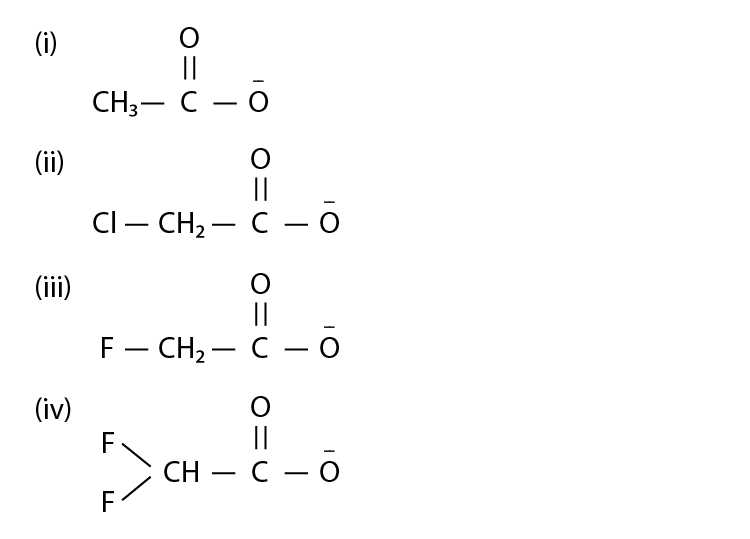
Ionic species are stabilised by the dispersal of charge. Which of the

following carboxylate ion is the most stable?

NCERT Exemplar Solutions for Class 11 Chemistry Chapter 12 Organic Chemistry Some Basic Principles and Techniques-5

Show solutionHide solution
Worked solution

Option (iv) is the answer.

Q13Written answer

Electrophilic addition reactions proceed in two steps. The first step

involves the addition of an electrophile. Name the type of intermediate

formed in the first step of the following addition reaction.

H3

C—HC = CH2 + H+ →?

(i) 2° Carbanion

(ii) 1° Carbocation

(iii) 2° Carbocation

(iv) 1° Carbanion

Show solutionHide solution
Worked solution

Option (iii) is the answer.

Q14Written answer

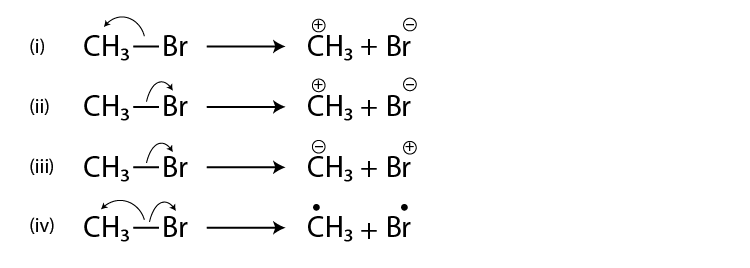
A covalent bond can undergo fission in two different ways. The correct

representation involving heterolytic fission of CH3—Br is

NCERT Exemplar Solutions for Class 11 Chemistry Chapter 12 Organic Chemistry Some Basic Principles and Techniques-6

Show solutionHide solution
Worked solution

Option (ii) is the answer.

Q15Written answer

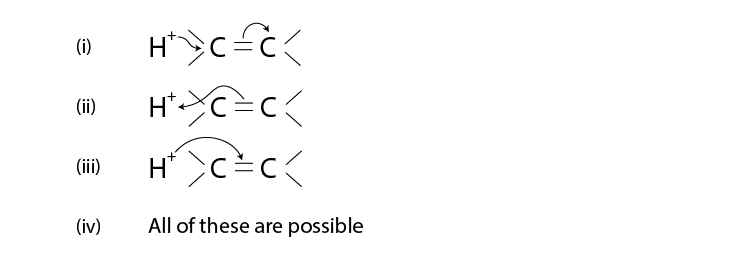
The addition of HCl to alkene proceeds in two steps. The first step is the

attack of H+ ion C=C to a portion which can be shown asNCERT Exemplar Solutions for Class 11 Chemistry Chapter 12 Organic Chemistry Some Basic Principles and Techniques-7

Show solutionHide solution
Worked solution

Option (ii) is the answer.