My Cart
Your Cart 0

    Your cart is empty.

  • Total (Amount) ₹0.00
NCERT Exemplar · Class 11 · Chemistry

Chapter 12: Organic Chemistry: Some Basic Principles and Techniques

Practice each question, then open the answer or worked solution.

II. Multiple Choice Questions (Type-II)

39 questions
Q46Written answer

Why does SO3 act as an electrophile?

Show solutionHide solution
Worked solution

Oxygen is more electronegative than sulphur and the electron density at S in SO3 is reduced and they need more electrons to suppress the partial positive charge and hence they act as an electrophile.

Q47Written answer

Resonance structures of propenal are given below. Which of these resonating structures is more stable? Give a reason for your answer.

NCERT Exemplar Solutions for Class 11 Chemistry Chapter 12 Organic Chemistry Some Basic Principles and Techniques-26

Show solutionHide solution
Worked solution

The structure I will be more stable than structure II because all the atoms have a complete octet in structure I, and the carbon atom having a positive charge don’t have a complete octet in structure II.

Q48Written answer

By mistake, an alcohol (boiling point 97°C) was mixed with a hydrocarbon (boiling point 68°C). Suggest a suitable method to separate the two compounds. Explain the reason for your choice.

Show solutionHide solution
Worked solution

We can separate the mixture by steam distillation. Both alcohol and hydrocarbon don’t have much difference in the boiling point. Steam distillation is particularly used for the purification of temperature-sensitive material.

Q49Written answer

Which of the two structures (A) and (B) given below is more stabilised by resonance? Explain.

(A) CH3COOH (B) CH3COO-

Show solutionHide solution
Worked solution

The two resonating structures in compound A are not equivalent, whereas compound B, having a negative charge on the oxygen atom, has the two equivalent structures; hence compound B is more stable.

IV. Matching Type

In the following questions, more than one correlation is possible between

options of Column I and Column II. Make as many correlations as you can.

Q50Written answer

Match the type of mixture of compounds in Column I with the technique of

separation/purification given in Column II.

Column I

(i) Two solids which have different solubilities in a solvent and which

do not undergo a reaction when

dissolved in it.

(ii) The liquid that decomposes at its boiling point

(iii) Steam volatile liquid

(iv) Two liquids which have boiling

points close to each other

(v) Two liquids with the large difference in boiling points.

Column II

(a) Steam distillation

(b) Fractional distillation

(c) Simple distillation

(d) Distillation under reduced pressure

(e) Crystallisation

Show solutionHide solution
Worked solution

(i) is e

(ii) is d

(iii) is a

(iv) is b

(v) is c

Q51Written answer

Match the terms mentioned in Column I with the terms in Column II.

Column I

(i) Carbocation

(ii) Nucleophile

(iii) Hyperconjugation

(iv) Isomers

(v) sp hybridisation

(vi) Electrophile

Column II

(a) Cyclohexane and 1- hexene

(b) Conjugation of electrons of C–Hσ bond with empty p-orbital present at adjacent positively charged carbon.

(c) sp2 hybridised carbon with empty p-orbital

(d) Ethyne

(e) Species that can receive a pair of electrons

(f) Species that can supply a pair of electrons.

Show solutionHide solution
Worked solution

(i) is c

(ii) is f

(iii) is b

(iv) is a

(v) is d

(vi) is e

Q52Written answer

Match Column I with Column II.

Column I

(i) Dumas method

(ii) Kjeldahl’s method

(iii) Carius method

(iv) Chromatography

Column II

(a) AgNO3

(b) Silica gel

(c) Nitrogen gas

(d) Free radicals

(e) Ammonium sulphate

Show solutionHide solution
Worked solution

(i) is c

(ii) is e

(iii) is a

(iv) is b

(v) is d

Q53Written answer

Match the intermediates given in Column I with their probable structure in

Column II.

Column I

(i) Free radical

(ii) Carbocation

(iii) Carbanion

Column II

(a) Trigonal planar

(b) Pyramidal

(c) Linear

Show solutionHide solution
Worked solution

(i) is a

(ii) is a

(iii) is b

Q54Written answer

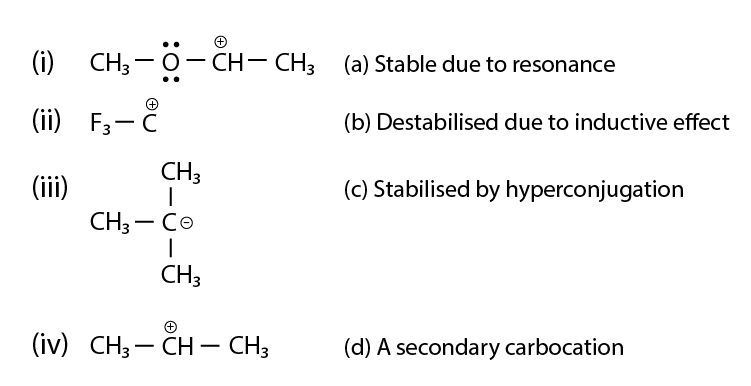
Match the ions given in Column I with their nature given in Column II.

NCERT Exemplar Solutions for Class 11 Chemistry Chapter 12 Organic Chemistry Some Basic Principles and Techniques-27

Show solutionHide solution
Worked solution

(i) is a, b and d

(ii) is b

(iii) is b

(iv) are c and d