My Cart
Your Cart 0

    Your cart is empty.

  • Total (Amount) ₹0.00
NCERT Exemplar · Class 11 · Chemistry

Chapter 12: Organic Chemistry: Some Basic Principles and Techniques

Practice each question, then open the answer or worked solution.

II. Multiple Choice Questions (Type-II)

39 questions
Q36Written answer

Which of the following ions is more stable? Use resonance to explain your answer.

NCERT Exemplar Solutions for Class 11 Chemistry Chapter 12 Organic Chemistry Some Basic Principles and Techniques-15

Show solutionHide solution
Worked solution
NCERT Exemplar Solutions for Class 11 Chemistry Chapter 12 Organic Chemistry Some Basic Principles and Techniques-16

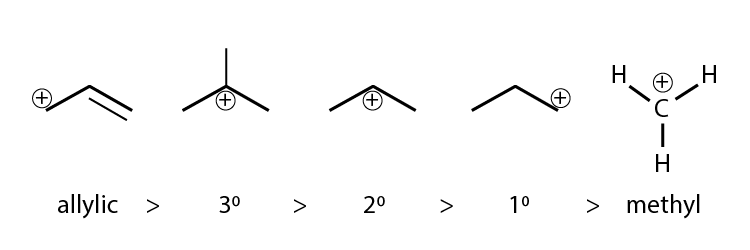
The stability of carbocation is decided by inductive effect, hyperconjugation, resonance etc.

As structure A has a carbocation, which is primary and allylic carbocation, whereas the carbocation in structure B has secondary and allylic carbocation.

Hence, structure B is more stable.
Q37Written answer

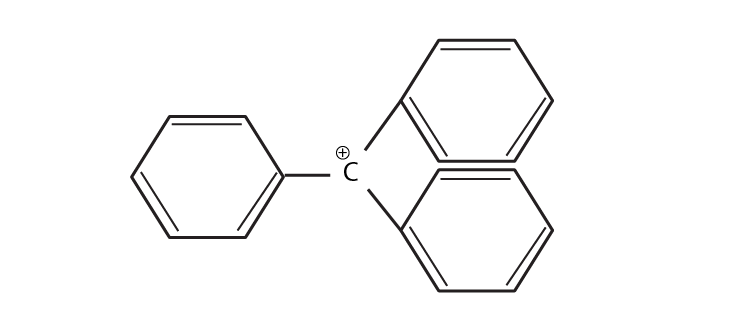
The structure of triphenylmethylcation is given below. This is very stable, and some of its salts can be stored for months. Explain the cause of the high stability of this cation.

NCERT Exemplar Solutions for Class 11 Chemistry Chapter 12 Organic Chemistry Some Basic Principles and Techniques-17

Show solutionHide solution
Worked solution

Triphenylcarbocation is tertiary carbocation and the positive charge is on the carbon atom, which is stabilised by the three phenyl group by resonance. Due to the resonance, the stability increases.

Q38Written answer

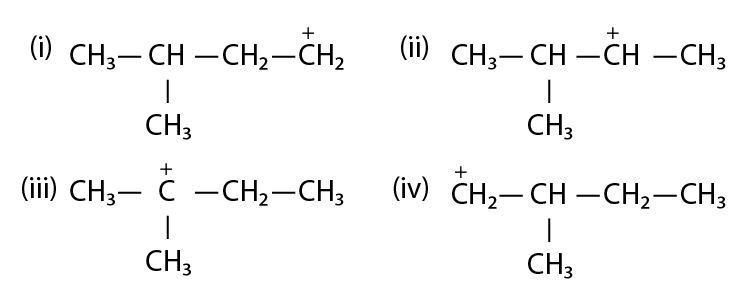
Write structures of various carbocation that can be obtained from 2-methyl butane. Arrange these carbocations in the order of increasing stability.

Show solutionHide solution
Worked solution

NCERT Exemplar Solutions for Class 11 Chemistry Chapter 12 Organic Chemistry Some Basic Principles and Techniques-18

the stability order is found to be:

(III) > (II) > (I) > (IV)

This is because (III) is tertiary carbocation, (II) is secondary carbocation, (I) and (IV) are primary,

Q39Written answer

Three students, Manish, Ramesh and Rajni were determining the extra

elements present in an organic compound given by their teacher. They

prepared the Lassaigne’s extract (L.E.) independently by the fusion of the

compound with sodium metal. Then they added solid FeSO4 and dilute

sulphuric acid to a part of Lassaigne’s extract. Manish and Rajni obtained

Prussian blue colour, but Ramesh got a red colour. Ramesh repeated the test

with the same Lassaigne’s extract but again got red colour only. They were

surprised and went to their teacher and told him about their observation.

A teacher asked them to think over the reason for this. Can you help them by

giving the reason for this observation? Also, write the chemical equations to

explain the formation of compounds of different colours

Show solutionHide solution
Worked solution

3NaCNS + FeSO4 + dilute sulphuric→ Fe(CNS)3 (Blood red colour) + 3Na+

Ramesh has Nitrogen as well as Sulphur present in his organic compound, so he observed the Blood-red colour of Fe(CNS)3 and Manish and Rajni had only Nitrogen in their compound; hence they got Prussian blue colour.

Q40Written answer

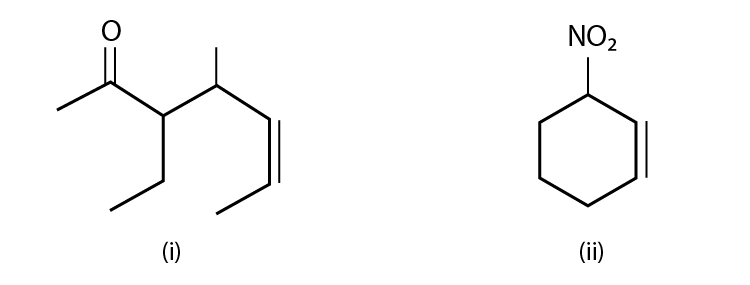
Name the compounds whose line formulae are given below:

NCERT Exemplar Solutions for Class 11 Chemistry Chapter 12 Organic Chemistry Some Basic Principles and Techniques-19

Show solutionHide solution
Worked solution

(i) The name of the compound is 3-ethyl-4-methyl-5-heptane-2-one.

(ii) The name of the compound is; 1-nitro-cyclohexane-2-ene.

Q41Written answer

Write structural formulae for compounds named as-

(a) 1-Bromoheptane

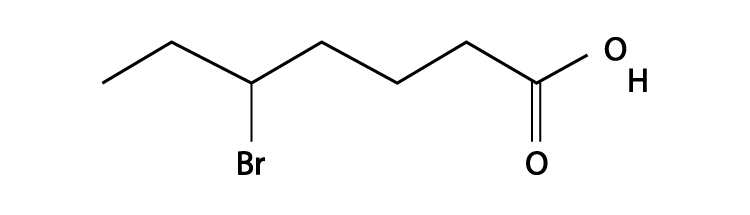
(b) 5-Bromoheptanoic acid

Show solutionHide solution
Worked solution

(a)

NCERT Exemplar Solutions for Class 11 Chemistry Chapter 12 Organic Chemistry Some Basic Principles and Techniques-20(a)

(b)

NCERT Exemplar Solutions for Class 11 Chemistry Chapter 12 Organic Chemistry Some Basic Principles and Techniques-20(b)

Q42Written answer

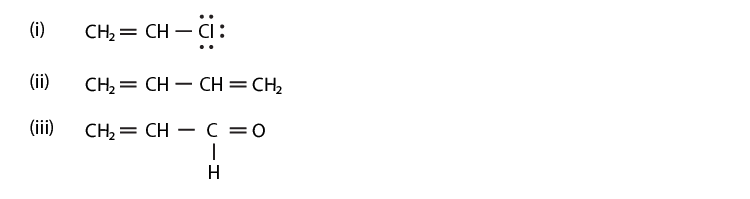
Draw the resonance structures of the following compounds;

NCERT Exemplar Solutions for Class 11 Chemistry Chapter 12 Organic Chemistry Some Basic Principles and Techniques-21

Show solutionHide solution
Worked solution

NCERT Exemplar Solutions for Class 11 Chemistry Chapter 12 Organic Chemistry Some Basic Principles and Techniques-22

NCERT Exemplar Solutions for Class 11 Chemistry Chapter 12 Organic Chemistry Some Basic Principles and Techniques-23

NCERT Exemplar Solutions for Class 11 Chemistry Chapter 12 Organic Chemistry Some Basic Principles and Techniques-24

Q43Written answer

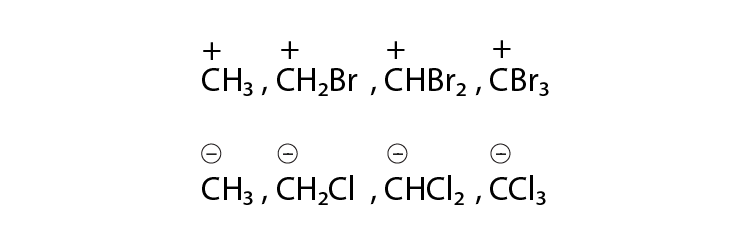
Identify the most stable species in the following set of ions giving reasons:

NCERT Exemplar Solutions for Class 11 Chemistry Chapter 12 Organic Chemistry Some Basic Principles and Techniques-25

Show solutionHide solution
Worked solution

(i) C+H3 will be more stable as the bromine atom destabilizes the positive charge on a carbon atom. Bromine atom is an electron-withdrawing group and has a lone pair of electrons.

(ii) CCl3 will be most stable because chlorine is more electron-withdrawing atom and the negative charge on carbon will be stabilized by the chlorine atom. As the number of chlorine atom attached to carbocation increases the stability also increases.

Q44Written answer

Give three points of differences between the inductive effect and resonance effect.

Show solutionHide solution
Worked solution

1. In the inductive effect, the transmission of the electron is only from sigma bond whereas in resonance effect the transmission occurs from both sigma and pi bond.

2. It is possible when the polarization of bond takes place whereas the resonance effect is possible only if the system is conjugated.

3. Electronegativity plays role in inductive effect whereas in resonance effect more number of an alternative double bond will lead to more resonating structure and hence more stability.

Q45Written answer

Which of the following compounds will not exist as a resonance hybrid. Give the reason for your answer:

Show solutionHide solution
Worked solution

Conjugation is only possible when an atom has any of the charge or alternative position of the double bond. Here CH3OH will not exist as resonance hybrid because of the reason.