My Cart
Your Cart 0

    Your cart is empty.

  • Total (Amount) ₹0.00
NCERT Exemplar · Class 11 · Chemistry

Chapter 12: Organic Chemistry: Some Basic Principles and Techniques

Practice each question, then open the answer or worked solution.

II. Multiple Choice Questions (Type-II)

39 questions
Q26Written answer

Identify the pairs of compounds that represent chain isomerism.

Show solutionHide solution
Worked solution

I and III, I and IV, II and III, II and IV, II and IV, V and VII, VI and VII are the compounds which represent chain isomerism. Compounds having the same molecular formula but varying in the length of the parent chain(as they are branched) is called chain isomerism.

Q27Written answer

For testing halogens in an organic compound with AgNO3 solution, sodium extract (Lassaigne’s test) is acidified with dilute HNO3. What will happen if a student acidifies the extract with dilute H2 SO4 in place of dilute HNO3?

Show solutionHide solution
Worked solution

If dilute H2 SO4is added, then sodium sulphide and sodium cyanine are not decomposed thereby, we will not get the correct result if halides are also present.

Q28Written answer

What is the hybridisation of each carbon in H2C = C = CH2?

Show solutionHide solution
Worked solution

The terminal carbons are sp2 hybridised as they form 3 (2 with H and 1 with C) sigma bonds and 1 pi bond(between carbons) while the centre carbon is sp hybridised (as it forms 2 sigma bonds, 1 with each carbon and 2 pi bonds, one with each carbon).

Q29Written answer

Explain how is the electronegativity of carbon atoms related to their state of hybridisation in an organic compound?

Show solutionHide solution
Worked solution

Hybridization for carbon in organic compounds is of three types, sp, sp2 and sp3. The more the ‘s’ character, the more is the electronegativity of the carbon as ‘s’ orbitals are closer to the nucleus; hence electrons held more closely.

Q30Written answer

Show the polarisation of the carbon-magnesium bond in the following structure.

CH3—CH2—CH2—CH2—Mg—X

Show solutionHide solution
Worked solution

CH3—CH2—CH2—δ-CH2—δ+Mg+ X-

Carbon is more electronegative than Mg because of the electronegativity difference in the bond between C-Mg is highly polarised. C being more electronegative the electron density is towards C hence Mg readily loses its electron to form C-( carbanion).

Q31Written answer

Compounds with same molecular formula but differing in their structures are

said to be structural isomers. What type of structural isomerism is shown by

NCERT Exemplar Solutions for Class 11 Chemistry Chapter 12 Organic Chemistry Some Basic Principles and Techniques-11

Show solutionHide solution
Worked solution

In the above structures, both have the same functional group (thioether/sulphide), but there is a difference in the arrangement of atoms in the main chain. So they can exhibit chain isomerism.

Q32Written answer

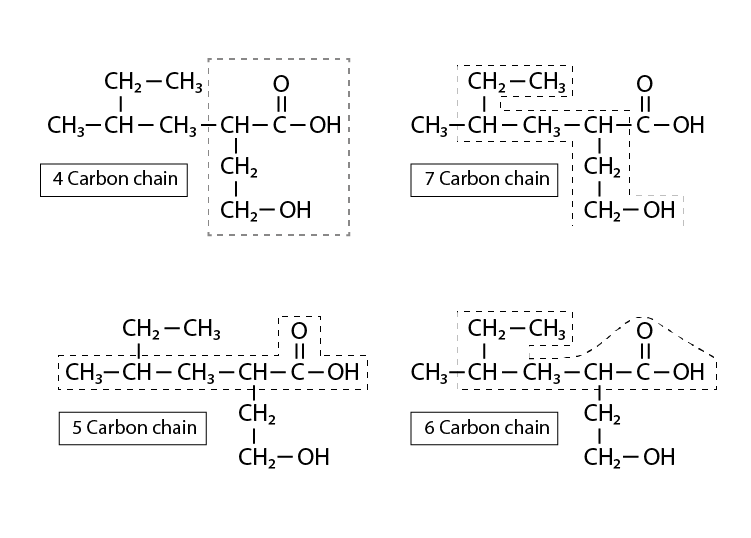
Which of the following selected chains is correct to name the given compound according to the IUPAC system.

NCERT Exemplar Solutions for Class 11 Chemistry Chapter 12 Organic Chemistry Some Basic Principles and Techniques-12

a. The main(parent) chain should be the longest possible carbon chain with all the carbons with the functional groups included in them. The above selection is the only possible one with both the functional groups in the main chain.

b. Out of carboxylic acid and alcohol acid gets the priority hence the numbering starts from carboxylic carbon.

c. There is a branched alkyl group substitution at second carbon

d. There is a hydroxyl group at 4th carbon therefore it can be named as 2-(2-methyl butyl)-4-hydroxybutanoic acid.

Show solutionHide solution
Worked solution

Solution coming soon.

Q33Written answer

In DNA and RNA, the nitrogen atom is present in the ring system. Can the Kjeldahl method be used for the estimation of nitrogen present in these? Give reasons.

Show solutionHide solution
Worked solution

The Kjeldahl method cannot be used for the estimation of nitrogen present in DNA and RNA because nitrogen cannot be converted into ammonium sulphate in the conditions provided in this method. The difficulty in decomposing ring structures limits this test for DNA and RNA.

Q34Written answer

If a liquid compound decomposes at its boiling point, which method(s) can you choose for its purification. It is known that the compound is stable at low pressure, steam volatile and insoluble in water.

Show solutionHide solution
Worked solution

As the liquid compound decomposes at its boiling point, which means that the compound is heat-sensitive, hence we use “Steam distillation” for its purification. It is done for temperature-sensitive materials.

Note: Answer questions 35 to 38 based on the information given below:

“Stability of carbocations depends upon the electron releasing inductive effect

of groups adjacent to positively charged carbon atom involvement of

neighbouring groups in hyperconjugation and resonance.”

Q35Written answer

Draw the possible resonance structures for NCERT Exemplar Solutions for Class 11 Chemistry Chapter 12 Organic Chemistry Some Basic Principles and Techniques-13 and predict which of the structures is more stable. Give the reason for your answer.

Show solutionHide solution
Worked solution

NCERT Exemplar Solutions for Class 11 Chemistry Chapter 12 Organic Chemistry Some Basic Principles and Techniques-14

Structure C is more stable than that of structure A because, in structure C, the octet of all the atoms is complete, whereas, in structure A, C-atom having a positive charge is not having 8 electrons in its valence shell.
