My Cart
Your Cart 0

    Your cart is empty.

  • Total (Amount) ₹0.00
NCERT Exemplar · Class 11 · Chemistry

Chapter 12: Organic Chemistry: Some Basic Principles and Techniques

Practice each question, then open the answer or worked solution.

II. Multiple Choice Questions (Type-II)

39 questions
Q16Written answer

Which of the following compounds contains all the carbon atoms in the same

hybridisation state?

(i) H—C ≡ C—C ≡ C—H

(ii) CH3—C ≡ C—CH3

(iii) CH2 = C = CH2

(iv) CH2 = CH—CH = CH2

Show solutionHide solution
Worked solution

Option (i) and (iv) are the answers.
Q17Written answer

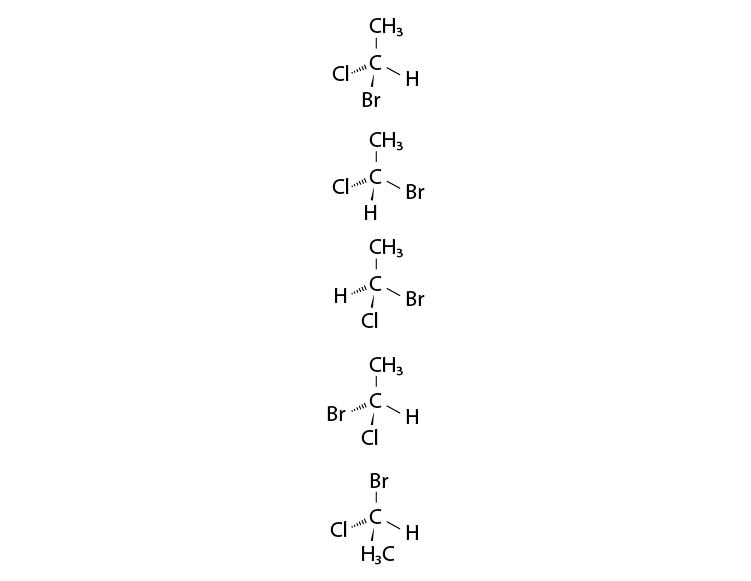
In which of the following representations given below spatial arrangement of

group/ atom different from that given in structure ‘A’?

NCERT Exemplar Solutions for Class 11 Chemistry Chapter 12 Organic Chemistry Some Basic Principles and Techniques-8

Show solutionHide solution
Worked solution

Option (i), (iii) and (iv) are the answers.

Q18Written answer

Electrophiles are electron-seeking species. Which of the following groups contain only electrophiles?

(i) BF3, NH3, H2O

(ii) AlCl3, SO3 , + NO2

(iii) NO2+ , CH3+ , CH3 –C+ = O

(iv) C2H-5, C2H5, CH5+

Show solutionHide solution
Worked solution

Option (ii) and (iii) are the answers.

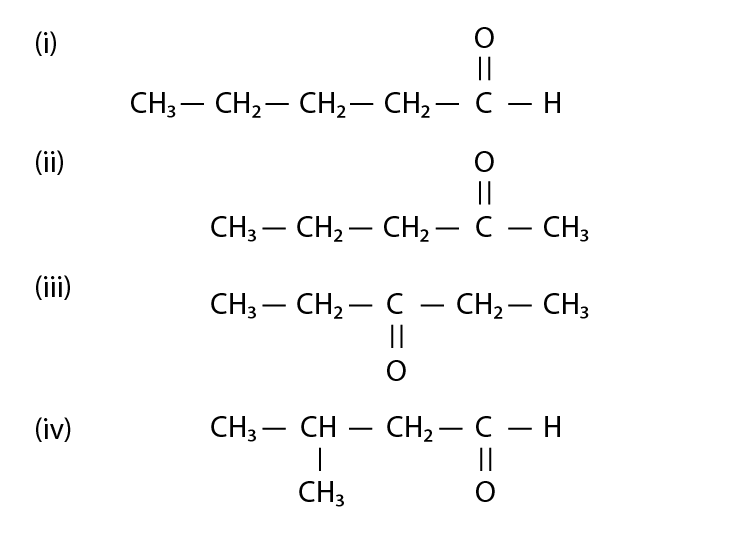
Note: Consider the following four compounds for answering question 19

and 20.

NCERT Exemplar Solutions for Class 11 Chemistry Chapter 12 Organic Chemistry Some Basic Principles and Techniques-9

Q19Written answer

Which of the following pairs are position isomers?

(i) I and II

(ii) II and III

(iii) II and IV

(iv) III and IV

Show solutionHide solution
Worked solution

Option (ii) is the answer.

Q20Written answer

Which of the following pairs are not functional group isomers?

(i) II and III

(ii) II and IV

(iii) I and IV

(iv) I and II

Show solutionHide solution
Worked solution

Option (i) and (iii) are the answers.

Q21Written answer

A nucleophile is a species that should have

(i) a pair of electrons to donate

(ii) positive charge

(iii) negative charge

(iv) electron-deficient speciesSolution:

Option (i) and (iii) are the answers.

Show solutionHide solution
Worked solution

Solution coming soon.

Q22Written answer

Hyperconjugation involves the delocalisation of ___________.

(i) electrons of the carbon-hydrogen σ bond of an alkyl group directly attached

to an atom of the unsaturated system.

(ii) electrons of carbon-hydrogen σ bond of alkyl group directly attached to

the positively charged carbon atom.

(iii) π-electrons of carbon-carbon bond

(iv) lone pair of electrons

Show solutionHide solution
Worked solution

Option (i) and (ii) are the answers.

III. Short Answer Type

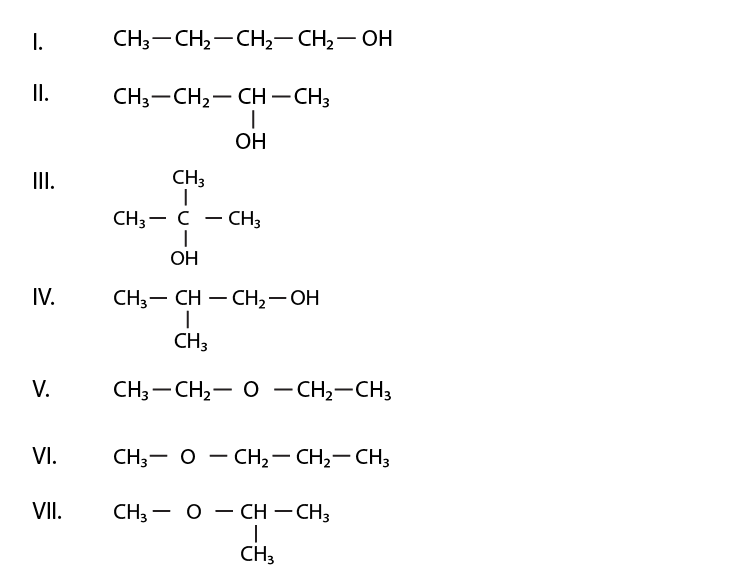
Note: Consider structures I to VII and answer questions 23–26.

NCERT Exemplar Solutions for Class 11 Chemistry Chapter 12 Organic Chemistry Some Basic Principles and Techniques-10

Q23Written answer

Which of the above compounds form pairs of metamers?

Show solutionHide solution
Worked solution

V and VI form pairs of metamers. (metamers of ethers). Here in compounds V and VI, the chain length is the same, but the distribution of carbons is different around oxygen atom.

Q24Written answer

Identify the pairs of compounds which are functional group isomers.

Show solutionHide solution
Worked solution

I and V, I and VI, I and VII, II and V, II and VI, II and VII, III and V, III and VI, III and VII, IV and V, IV and VI, IV and VII. Alcholol is the function group of each ether in the given seven compounds.

Q25Written answer

Identify the pairs of compounds that represent position isomerism.

Show solutionHide solution
Worked solution

I and II, III and IV, V and VI are the compounds which represent the position isomerism.

Position isomerism means where the length of the parent chain and functional group is the same, but the position of the functional group is different; then it is called position isomer.