My Cart
Your Cart 0

    Your cart is empty.

  • Total (Amount) ₹0.00
NCERT · Class 9 · Science

Chapter 9: Gravitation

Practice each question, then open the answer or worked solution.

Exercises-10.6

Textbook page 143 · 22 questions
Q11Written answer

Why will a sheet of paper fall slower than one that is crumpled into a ball?

Show solutionHide solution
Worked solution

A sheet of paper has a larger surface area when compared to a crumpled paper ball. A sheet of paper will face a lot of air resistance. Thus, a sheet of paper falls slower than the crumpled ball.
Q12Written answer

Gravitational force on the surface of the moon is only 1/6 as strong as gravitational force on the earth. What is the weight in newton’s of a 10 kg object on the moon and on the earth?

Show solutionHide solution
Worked solution

Given data:

Acceleration due to earth’s gravity = ge or g = 9.8 m/s2

Object’s mass, m = 10 kg

Acceleration due to moon gravity = gm

Weight on the earth= We

Weight on the moon = Wm

Weight = mass x gravity

gm = (1/6) ge (given)

So Wm = m gm = m x (1/6) ge

Wm = 10 x (1/6) x 9.8 = 16.34 N

We = m x ge = 10 x 9.8

We = 98N

Q13Written answer

A ball is thrown vertically upwards with a velocity of 49 m/s.

Calculate

(i) The maximum height to which it rises,

(ii) The total time it takes to return to the surface of the earth.

Show solutionHide solution
Worked solution

Given data:

Initial velocity u = 49 m/s

Final speed v at maximum height = 0

Acceleration due to earth gravity g = -9.8 m/s2 (thus negative as ball is thrown up).

By third equation of motion,

2gH = v2 – u2

2 × (- 9.8) × H = 0 – (49)2

– 19.6 H = – 2401

H = 122.5 m

Total time T = Time to ascend (Ta) + Time to descend (Td)

v = u + gt

0 = 49 + (-9.8) x Ta

Ta = (49/9.8) = 5 s

Also, Td = 5 s

Therefore T = Ta + Td

T = 5 + 5

T = 10 s

Q14Written answer

A stone is released from the top of a tower of height 19.6 m. Calculate its final velocity just before touching the ground.

Show solutionHide solution
Worked solution

Given data:

Initial velocity

u = 0

Tower height = total distance = 19.6m

g = 9.8 m/s2

Consider third equation of motion

v2 = u2 + 2gs

v2 = 0 + 2 × 9.8 × 19.6

v2 = 384.16

v = √(384.16)

v = 19.6m/s

Q15Written answer

A stone is thrown vertically upward with an initial velocity of 40 m/s. Taking g = 10 m/s2, find the maximum height reached by the stone. What is the net displacement and the total distance covered by the stone?

Show solutionHide solution
Worked solution

Given data:

Initial velocity u = 40m/s

g = 10 m/s2

Max height final velocity = 0

Consider third equation of motion

v2 = u2 – 2gs [negative as the object goes up]

0 = (40)2 – 2 x 10 x s

s = (40 x 40) / 20

Maximum height s = 80m

Total Distance = s + s = 80 + 80

Total Distance = 160m

Total displacement = 0 (The first point is the same as the last point)

Q16Written answer

Calculate the force of gravitation between the earth and the Sun, given that the mass of the earth = 6 × 1024 kg and of the Sun = 2 × 1030 kg. The average distance between the two is 1.5 × 10¹¹ m.

Show solutionHide solution
Worked solution

Given data:

Mass of the sun ms = 2 × 1030 kg

Mass of the earth me = 6 × 1024 kg

Gravitation constant G = 6.67 x 10⁻¹¹ N m2/ kg2

Average distance r = 1.5 × 10¹¹ m

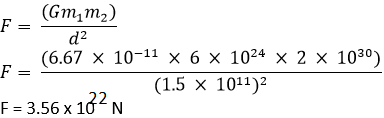
Consider Universal law of Gravitation

NCERT Solutions for Class 9 Science - Chapter 10 Image 12

Q17Written answer

A stone is allowed to fall from the top of a tower 100 m high and at the same time another stone is projected vertically upwards from the ground with a velocity of 25 m/s. Calculate when and where the two stones will meet.

Show solutionHide solution
Worked solution

Given data:

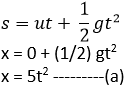
(i) When the stone from the top of the tower is thrown,

Initial velocity u’ = 0

Distance travelled = x

Time taken = t

Therefore,

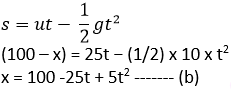
NCERT Solutions for Class 9 Science - Chapter 10 Image 13

(ii) When the stone is thrown upwards,

Initial velocity u = 25 m/s

Distance travelled = (100 – x)

Time taken = t

NCERT Solutions for Class 9 Science - Chapter 10 Image 14

From equations (a) and (b)

5t2 = 100 -25t + 5t2

t = (100/25) = 4sec.

After 4sec, two stones will meet

From (a)

x = 5t2 = 5 x 4 x 4 = 80m.

Putting the value of x in (100-x)

= (100-80) = 20m.

This means that after 4sec, 2 stones meet a distance of 20 m from the ground.

Q18Written answer

A ball thrown up vertically returns to the thrower after 6 s. Find

(a) The velocity with which it was thrown up,

(b) The maximum height it reaches, and

(c) Its position after 4s.

Show solutionHide solution
Worked solution

Given data:

g = 10m/s2

Total time T = 6sec

Ta = Td = 3sec

(a) Final velocity at maximum height v = 0

From first equation of motion:-

v = u – gta

u = v + gta

= 0 + 10 x 3

= 30m/s

The velocity with which stone was thrown up is 30m/s.

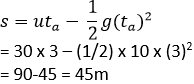
(b) From second equation of motion

NCERT Solutions for Class 9 Science - Chapter 10 Image 15

The maximum height stone reaches is 45m.

(c) In 3sec, it reaches the maximum height.

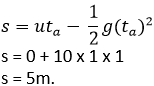
Distance travelled in another 1sec = s’

NCERT Solutions for Class 9 Science - Chapter 10 Image 16

The distance travelled in another 1sec = 5m.

Therefore in 4sec, the position of point p (45 – 5)

= 40m from the ground.

Q19Written answer

In what direction does the buoyant force on an object immersed in a liquid act?

Show solutionHide solution
Worked solution

The buoyant force on an object that is immersed in a liquid will be in a vertically upward direction.

Q20Written answer

Why a block of plastic when released under water come up to the surface of water?

Show solutionHide solution
Worked solution

The density of plastic is lesser than that of water. Therefore, the force of buoyancy on plastic block will be greater than the weight of plastic block. Hence, the acceleration of plastic block is going to be in the upward direction. So, the plastic block comes up to the surface of water.