My Cart
Your Cart 0

    Your cart is empty.

  • Total (Amount) ₹0.00
NCERT · Class 9 · Science

Chapter 6: Tissues

Practice each question, then open the answer or worked solution.

Exercise

Textbook page 78 · 15 questions
Q11Written answer

Identify the type of tissue in the following:

Skin, bark of tree, bone, lining of kidney tubule, vascular bundle.

Show solutionHide solution
Worked solution

➢ Skin: Stratified squamous epithelial tissue

➢ Bark of tree: Protective tissue and cork

➢ Bone: Connective tissue

➢ Lining of kidney tubule: Cuboidal epithelial tissue

➢ Vascular bundle: Conducting tissue (xylem and phloem), complex permanent tissue
Q12Written answer

Name the regions in which parenchyma tissue is present.

Show solutionHide solution
Worked solution

The parenchyma is found in:

  • The pith of stems and roots
  • When parenchyma contains chlorophyll it is called a chlorenchyma. It is found in green leaves
  • Parenchyma found in aquatic plants has large air cavities which enables them to float, and are hence called aerenchyma.
Q13Written answer

What is the role of epidermis in plants?

Show solutionHide solution
Worked solution

The epidermis in plants forms an uninterrupted and continuous layer that has no intercellular spaces. It provides protection.

Q14Written answer

How does the cork act as a protective tissue?

Show solutionHide solution
Worked solution

Cork cells are dead. The arrangement of cells is so dense, that there is no intercellular space. Deposition of suberin is observed on the walls of the cells that make them impervious to water and gases.

Q15Written answer

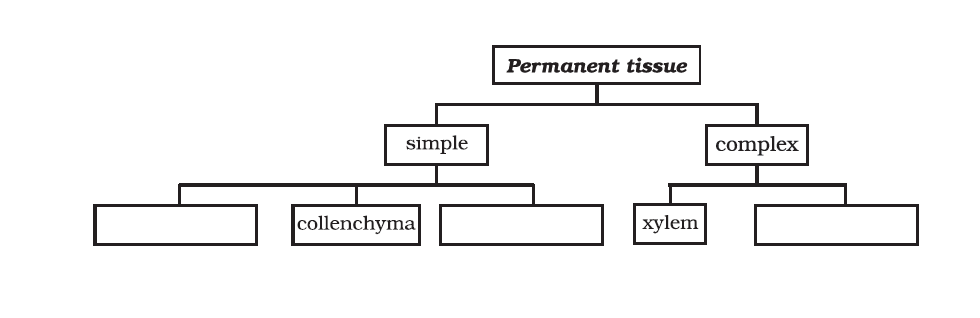
Complete the following chart.

NCERT Solution for Class 9 Science Chapter 6 Question No 15

Show solutionHide solution
Worked solution

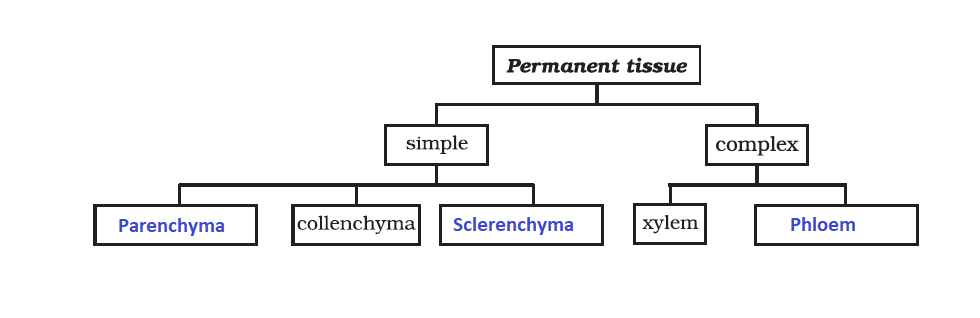
The completed chart is as follows:

NCERT Solution for Class 9 Science Chapter 6 Question No 15 Solution