Q1Written answer
Define the term ’tissue’.
Show solutionHide solution
Worked solution
A tissue is defined as a cluster of cells, which are similar in structure and work together to perform a particular function.
Your cart is empty.
Practice each question, then open the answer or worked solution.
Define the term ’tissue’.
A tissue is defined as a cluster of cells, which are similar in structure and work together to perform a particular function.
How many types of elements together make up the xylem tissue? Name them.
The xylem tissue is made up of four main elements, namely:
➢ Vessels
➢ Tracheids
➢ Xylem fibres
➢ Xylem parenchyma
How are simple tissues different from complex tissues in plants?
The following are the differences:
| Simple tissues | Complex tissues |
| They are made up of a single type of cell that performs only one common function | They are made up of more than one kind of a cell that coordinate to perform one particular function |
Differentiate between parenchyma, collenchyma and sclerenchyma on the basis of their cell wall.
The following are the differences between different tissues based on cell wall:
| Parenchyma | Collenchyma | Sclerenchyma |
| Cell walls are thin and made up of cellulose | Cell walls are thick at the edges due to the deposition of pectin | Cell walls are thick due to the deposition of lignin |
What are the functions of the stomata?
Stomata are the tiny pores present on the outer layer of the cells, the epidermis. Stomata bring about the exchange of gases and transpiration.
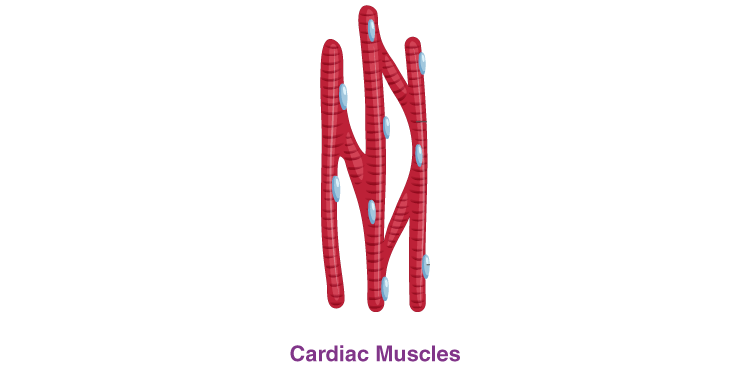
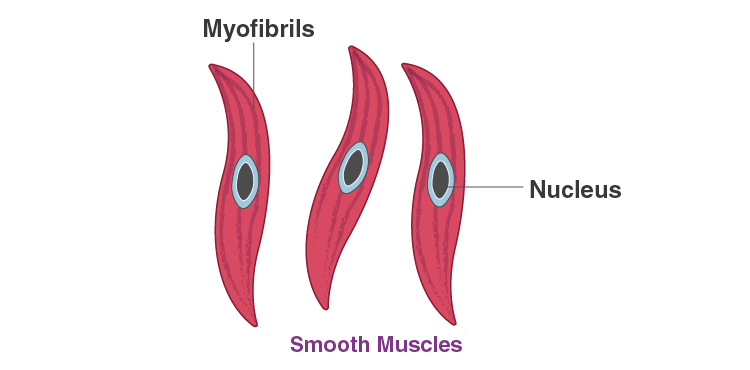
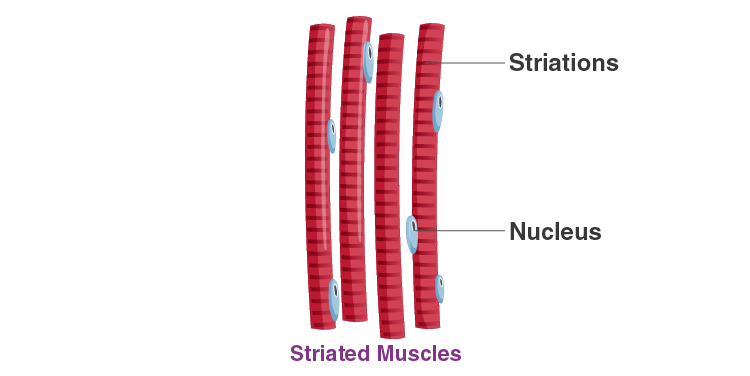
Show the difference between the three types of muscle fibres diagrammatically.
There are three types of muscle fibres, they are:
1. Cardiac muscles
2. Smooth muscles
3. Striated muscles
What is the specific function of the cardiac muscle?
The cardiac muscles are branched and cylindrical. They are uninucleated and are involuntary in nature. The cardiac muscles bring about a rhythmic contraction and relaxation throughout one’s lifetime.
Differentiate between striated, un-striated and cardiac muscles on the basis of their structure and site/location in the body.
The following are the differences between different types of muscles, based on their structure and location in the body.
| Character | Striated muscles | Un-striated muscles | Cardiac muscles |
| Shape/Structure | Long, cylindrical, non – tapering.
They are un-branched. |
Long and tapering.
They are un-branched. |
Cylindrical and non – tapering.
They are branched. |
| Location in body | Hands, legs and skeletal muscles | Wall of stomach, intestine, ureter and bronchi | Heart |
| Dark and light bands | Present | Absent | Present but less prominent |
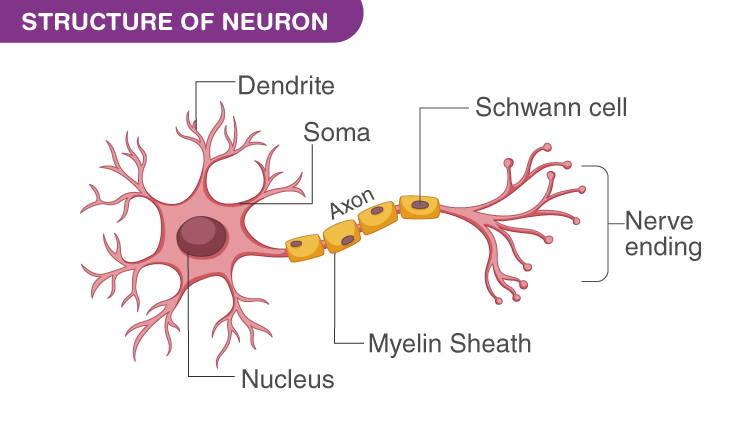
Draw a labelled diagram of a neuron.
Diagram of a neuron along with the labelling is as follows:
Name the following.
(a) Tissue that forms the inner lining of our mouth.
(b) Tissue that connects muscle to bone in humans.
(c) Tissue that transports food in plants.
(d) Tissue that stores fat in our body.
(e) Connective tissue with a fluid matrix.
(f) Tissue present in the brain.
(a) Tissue that forms the inner lining of our mouth – The epithelial tissue, Squamous epithelium.
(b) Tissue that connects muscle to bone in humans – Tendon
(c) Tissue that transports food in plants – Phloem
(d) Tissue that stores fat in our body – Adipose tissue
(e) Connective tissue with a fluid matrix – Blood, it is a fluid connective tissue
(f) Tissue present in the brain – Nervous tissue