My Cart
Your Cart 0

    Your cart is empty.

  • Total (Amount) ₹0.00
NCERT · Class 9 · Science

Chapter 4: Structure of the Atom

Practice each question, then open the answer or worked solution.

Exercise · Page 54

Textbook page 54 · 19 questions
Q1Written answer

Compare the properties of electrons, protons and neutrons.

Show solutionHide solution
Worked solution
Property Electrons Protons Neutrons
Charge Negatively charged Positively charged No charge.
Location Located outside the nucleus Located within the nucleus Located inside the nucleus of an atom
Weight Mass is negligible 1 a.m.u 1 a.m.u
Affinity Attracted towards positively charged Attracted towards negatively charged Do not get attracted to any charged particle
Q2Written answer

What are the limitations of J.J.Thomson’s model of the atom?

Show solutionHide solution
Worked solution

The following are the limitations of J.J. Thomson’s model of an atom:

  • The model failed to explain the outcome of alpha particle scattering, which was conducted by Rutherford. The model failed to depict why the majority of these alpha particles pass through the gold foil, while some diverted through small and big angles, while some others rebound completely, returning on their path.
  • It did not provide any experimental evidence and was established on imagination.
Q3Written answer

What are the limitations of Rutherford’s model of the atom?

Show solutionHide solution
Worked solution

The following are the limitations of Rutherford’s model of the atom:

  • There is no expected stability in the revolution of the electron in a circular orbit.
  • Charged particles radiate energy when accelerated, thus causing the revolving electrons to lose energy and would fall into the nucleus.
  • Hence, atoms must be highly unstable. The matter would not exist in its known form, which clearly is an assumption as atoms are highly stable.
Q4Written answer

Describe Bohr’s model of the atom.

Show solutionHide solution
Worked solution
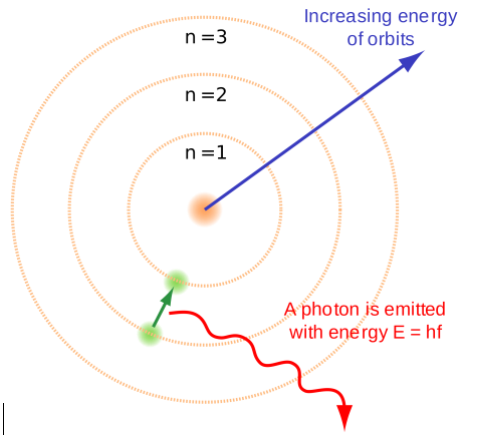
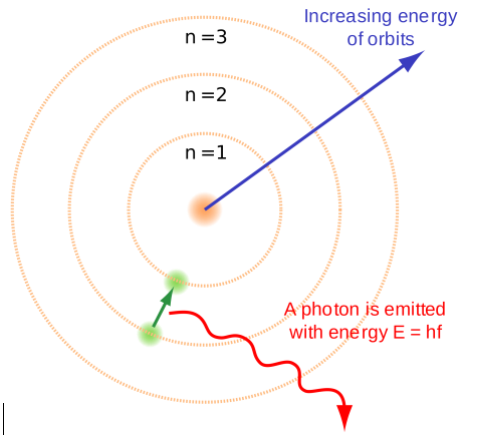
  • An atom holds the nucleus at the centre.
  • Negatively charged electrons revolve around the nucleus.
  • The atoms in it contain distinct orbits of electrons.
  • Electrons do not radiate energy when they are in their orbits.
  • The distinct orbits are named K, L, M, and N orbits. Numbers used to denote them are n=1, 2, 3, 4

NCERT Solution for Class 9 Science - Chapter 4 Question No 4 Solution

Q5Written answer

Compare all the proposed models of an atom given in this chapter.

Show solutionHide solution
Worked solution
Thomson Rutherford Bohr
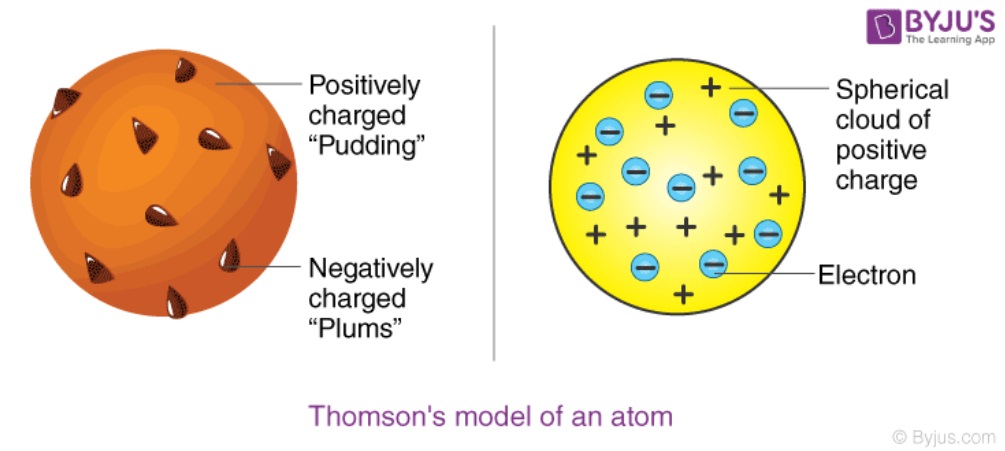
● Sphere is positively charged.

● Electrons are negatively charged and scattered all through the inside of the sphere.

● Positively charged = negatively charged

● The net charge in the atom is zero.

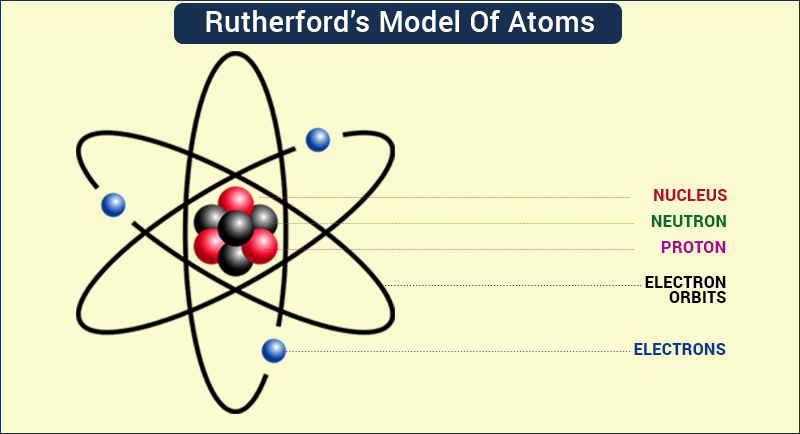
● The nucleus is at the centre and is positively charged, holding the entire mass.

● Electrons are negatively charged, revolving in a well-defined path

● In comparison with the nucleus, the size of the atom is very large.

● Force of attraction of the electrons towards the nucleus is balanced by centrifugal force acting away from it. As a result, electrons are not drawn close to the nucleus.

● Nucleus is present at the centre and is positively charged

● Electrons are negatively charged, revolving around but do not radiate energy.

● The distinct orbits are labelled as K, L, M, and N

6. Thomson’s Model of Atom.

NCERT Solution for Class 9 Science - Chapter 4 Question No 5 -1 Solution

7. Rutherford’s Model of Atoms.

Rutherford Atomic Model

8. Bohr’s model of the atom.

NCERT Solution for Class 9 Science - Chapter 4 Question No 5-3 Solution

Q6Written answer

Summarise the rules for the writing of the distribution of electrons in various shells for the first eighteen elements.

Show solutionHide solution
Worked solution
  • The maximum number of electrons that can be accommodated in a shell is given by the formula: 2n2, where n= 1, 2, 3…
  • The maximum number of electrons in different shells are:

K shell – n=1 ; 2n2 = 2(1)2 = 2

L shell – n=2 ; 2n2 = 2(2)2 = 8

M shell – n=3 ; 2n2 = 2(3)2 = 18

N shell- n=4 ; 2n2 = 2(4)2 = 32

  • The outermost orbit can be accommodated with 8 electrons at the maximum.
  • The electrons are not taken in unless the inner shells are filled, which are filled step-wise; hence, the highest element has K-2; L-8; M-8 distribution of electrons.
Q7Written answer

Define valency by taking examples of silicon and oxygen.

Show solutionHide solution
Worked solution

The definite combining capacity of the atoms of each element, wherein electrons are lost, gained or shared to make the octet of electrons present in the outermost shell, is defined as valency. To measure valency, we can figure out the number of electrons that are required to complete the shell in which it is contained or losing excess electrons, if present, once the filling is complete.

Example: To find the valency of silicon,

The atomic number of silicon is 14.

The number of electrons is equal to the number of protons in silicon, i.e., 14.

The distribution of electrons in silicon atoms is K – 2, L – 8, M – 4

Hence, from the distribution of silicon, it is clearly evident that to fill the M shell, 4 electrons are required. Therefore, its valency is 8-4=4

To find the valency of oxygen,

The atomic number of oxygen is 8.

The number of electrons is equal to the number of protons in oxygen, i.e., 8.

The distribution of electrons in oxygen atom is K – 2, L – 6

Hence, from the distribution of oxygen, it is clearly evident that to fill the M shell, 6 more electrons are required. Therefore, its valency is 8-6=2
Q8Written answer

Explain with examples

(i) Atomic number,

(ii) Mass number,

(iii) Isotopes and

(iv) Isobars.

Give any two uses of isotopes.

Show solutionHide solution
Worked solution

(i) The number of positively charged protons present in the nucleus of an atom is defined as the atomic number and is denoted by Z. Example: Hydrogen has one proton in its nucleus; hence, its atomic number is one.

(ii) The total number of protons and neutrons present in the nucleus of an atom is known as the mass number. It is denoted by A. 20Ca40 . The mass number is 40. The atomic number is 20.

(iii) The atoms which have the same number of protons but a different number of neutrons are referred to as isotopes. Hence, the mass number varies.

Example: The most simple example is the Carbon molecule which exists as 6C12 and 6C14

(iv) Isobars: Isobars are atoms which have the same mass number but differ in atomic number.

Examples are,  20Ca40and  18Ar40

Uses of isotopes

  • The isotope of the Iodine atom is used to treat goitre, an iodine-deficient disease.
  • In the treatment of cancer, an isotope of cobalt is used.
  • Fuel for nuclear reactors is derived from the isotopes of the Uranium atom.
Q9Written answer

Na+ has completely filled K and L shells. Explain.

Show solutionHide solution
Worked solution

The atomic number of sodium is 11. It has 11 electrons in its orbitals, wherein the number of protons is equal to the number of electrons. Hence, its electronic configuration is K-2 ; L-8 ; M-1 ; The one electron in the M shell is lost, and it obtains a positive charge since it has one more proton than electrons and obtains a positive charge, Na+ . The new electronic configuration is K-1; L-8, which is the filled state. Hence, it is very difficult to eliminate the electron from a filled state as it is very stable.

Q10Written answer

If the bromine atom is available in the form of, say, two isotopes  35Br79 (49.7%) and 35Br81 (50.3%), calculate the average atomic mass of the Bromine atom.

Show solutionHide solution
Worked solution

The atomic mass of an element is the mass of one atom of that element. Average atomic mass takes into account the isotopic abundance.

Isotope of bromine with atomic mass 79 u = 49.7%

Therefore, Contribution of 35Br79 to atomic mass = (79 × 49.7)/100

⇒ 39.26 u

Isotope of bromine with atomic mass 81 u = 50.3%

Contribution of 35Br81 to the atomic mass of bromine = (81 × 50.3)/100

⇒ 40.64u

Hence, the average atomic mass of the bromine atom = 39.26 + 40.64 u = 79.9u