My Cart
Your Cart 0

    Your cart is empty.

  • Total (Amount) ₹0.00
NCERT · Class 9 · Science

Chapter 10: Work and Energy

Practice each question, then open the answer or worked solution.

Exercises – 11.5

Textbook page 158 · 21 questions
Q11Written answer

What is the work done by the force of gravity on a satellite moving round the earth? Justify your answer.

Show solutionHide solution
Worked solution

Work is completed whenever the given two conditions are satisfied:

(i) A force acts on the body.

(ii) There’s a displacement of the body by applying force in or opposite to the direction of the force.

If the direction of force is perpendicular to displacement, then the work done is zero. When a satellite moves around the Earth, then the force of gravity on the satellite is perpendicular to its displacement. Therefore, the work done on the satellite by the Earth is zero.
Q12Written answer

Can there be displacement of an object in the absence of any force acting on it? Think. Discuss this question with your friends and teacher

Show solutionHide solution
Worked solution

Yes, there can be displacement of an object in the absence of any force acting on it.  If a single force acts on an object, the object accelerates. If an object accelerates, a force is acting on it.

Assume an object is moving with constant velocity. The net force acting on it is zero. But, there is a displacement along with the motion of the object. Therefore, there can be a displacement without a force.

Q13Written answer

A person holds a bundle of hay over his head for 30 minutes and gets tired. Has he done some work or not? Justify your answer.

Show solutionHide solution
Worked solution

Work is completed whenever the given 2 conditions are satisfied.

(i) A force acts on the body.

(ii) There’s a displacement of the body by applying force in or opposite to the direction of the force.

When an individual holds a bundle of hay over his head, there is no displacement in the hay bundle. Although the force of gravity is acting on the bundle, the person isn’t applying any force on it. Therefore, in the absence of force, work done by the person on the bundle is zero. 

Q14Written answer

An electric heater is rated 1500 W. How much energy does it use in 10 hours?

Show solutionHide solution
Worked solution

Given,

Power of the heater = 1500 W = 1.5 kW

Time taken = 10 hours

Energy consumed by an electric heater can be obtained with the help of the expression,

Power = Energy consumed / Time taken

Hence,

Energy consumed = Power x Time taken

Energy consumed = 1.5 x 10

Energy consumed = 15 kWh

Therefore, the energy consumed by the heater in 10 hours is 15 kWh.

Q15Written answer

Illustrate the law of conservation of energy by discussing the energy changes which occur when we draw a pendulum bob to one side and allow it to oscillate. Why does the bob eventually come to rest? What happens to its energy eventually? Is it a violation of the law of conservation of energy?

Show solutionHide solution
Worked solution

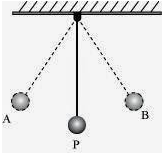
Consider the case of an oscillation pendulum.

NCERT Solutions for Class 9 Science - Chapter 11 Image 4

When an apparatus moves from its mean position P to either of its extreme positions A or B, it rises through a height h on top of the mean level P. At this time, the K.E. of the bob changes fully into P.E. The K.E. becomes zero, and also, the bob possesses P.E. solely. Because it moves towards purpose P, its P.E. decreases increasingly. Consequently, the K.E. will increase. Because the bob reaches purpose P, its P.E. becomes zero, and also, the bob possesses K.E. solely. This method is perennial as long as the apparatus oscillates.

The bob doesn’t oscillate forever. It involves rest as a result of air resistance resisting its motion. The apparatus loses its K.E. to beat this friction and stops once in a while. The law of conservation of energy isn’t desecrated because the energy lost by the apparatus to beat friction is gained by its surroundings. Hence, the overall energy of the apparatus and also the encompassing system stay preserved.

Q16Written answer

An object of mass, m is moving with a constant velocity, v. How much work should be done on the object in order to bring the object to rest?

Show solutionHide solution
Worked solution

The kinetic energy of an object of mass m, moving with a velocity, v, is given by the expression,

K.E = 1/2 mv2

In order to bring it to rest, its velocity has to be reduced to zero, and in order to accomplish that, the kinetic energy has to be drained off and sent somewhere else.

An external force has to absorb energy from the object, i.e. do negative work on it, equal to its kinetic energy, or

– 1/2 mv2.

Q17Written answer

Calculate the work required to be done to stop a car of 1500 kg moving at a velocity of 60 km/h.

Show solutionHide solution
Worked solution

Given data:

The mass of the body = 1500kg

Velocity v = 60km/hr

NCERT Solutions for Class 9 Science - Chapter 11 Image 7

The work required to stop the moving car = change in kinetic energy

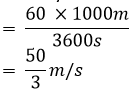
\(\begin{array}{l}= \frac{1}{2}mv^{2}\\=\frac{1}{2}\times 1500\times \left ( \frac{50}{3} \right )^{2}\\=-208333.3 J\end{array} \)
Q18Written answer

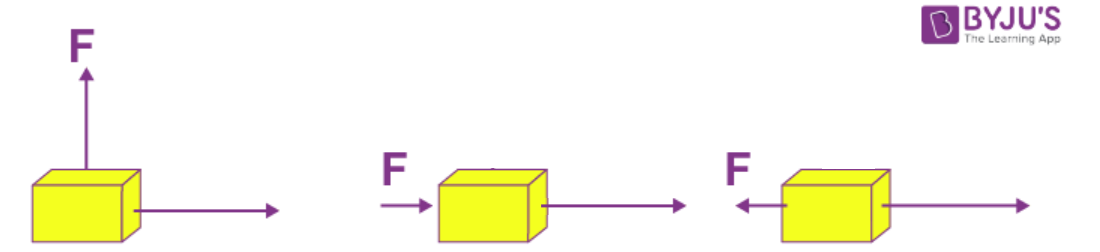
In each of the following a force, F is acting on an object of mass, m. The direction of displacement is from west to east shown by the longer arrow. Observe the diagrams carefully and state whether the work done by the force is negative, positive or zero.

NCERT Solutions for Class 9 Science - Chapter 11 Image 9

Show solutionHide solution
Worked solution

Case I

In this case, the direction of force functioning on the block is perpendicular to the displacement. Therefore, work done by force on the block will be zero.

Case II

In this case, the direction of force functioning on the block is in the direction of displacement. Therefore, work done by force on the block will be positive.

Case III

In this case, the direction of force functioning on the block is contrary to the direction of displacement. Therefore, work done by force on the block will be negative.

Q19Written answer

Soni says that the acceleration in an object could be zero even when several forces are acting on it. Do you agree with her? Why?

Show solutionHide solution
Worked solution

Acceleration in an object could be zero even when many forces work on it. This happens when all the forces get rid of one another, i.e., the online force working on the object is zero. For a uniformly moving object, the online force working on the it is zero. Hence, the acceleration of the thing is zero. Hence, Soni is correct.

Q20Written answer

Find the energy in kW h consumed in 10 hours by four devices of power 500 W each.

Show solutionHide solution
Worked solution

Given,

Power rating of the device (P) = 500 W = 0.50 kW

Time for which the device runs (T) = 10 h

Energy consumed by an electric device can be obtained by the expression

Power = Energy consumed/Time taken

∴ Energy consumed = Power × Time

Energy consumed = 0.50 × 10

Energy consumed = 5 kWh

Thus, the energy consumed by four equal rating devices in 10 h will be

⇒ 4 × 5 kWh

= 20 kWh