My Cart
Your Cart 0

    Your cart is empty.

  • Total (Amount) ₹0.00
NCERT · Class 7 · Maths

Chapter 5: Lines and Angles

Practice each question, then open the answer or worked solution.

Exercise 5.1

Textbook page 101 · 14 questions
Q1Written answer

Find the complement of each of the following angles:

(i)

NCERT Solutions for Class 7 Maths Chapter 5 Lines and Angles Image 1

Show solutionHide solution
Worked solution

Solution:-

Two angles are said to be complementary if the sum of their measures is 90o.

The given angle is 20o

Let the measure of its complement be xo.

Then,

= x + 20o = 90o

= x = 90o – 20o

= x = 70o

Hence, the complement of the given angle measures 70o.

(ii)
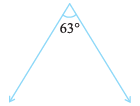
NCERT Solutions for Class 7 Maths Chapter 5 Lines and Angles Image 2

Solution:-

Two angles are said to be complementary if the sum of their measures is 90o.

The given angle is 63o

Let the measure of its complement be xo.

Then,

= x + 63o = 90o

= x = 90o – 63o

= x = 27o

Hence, the complement of the given angle measures 27o.

(iii)
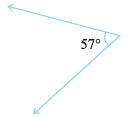
NCERT Solutions for Class 7 Maths Chapter 5 Lines and Angles Image 3

Solution:-

Two angles are said to be complementary if the sum of their measures is 90o.

The given angle is 57o

Let the measure of its complement be xo.

Then,

= x + 57o = 90o

= x = 90o – 57o

= x = 33o

Hence, the complement of the given angle measures 33o.
Q2Written answer

Find the supplement of each of the following angles:

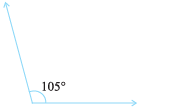
(i)

NCERT Solutions for Class 7 Maths Chapter 5 Lines and Angles Image 4

Show solutionHide solution
Worked solution

Solution:-

Two angles are said to be supplementary if the sum of their measures is 180o.

The given angle is 105o

Let the measure of its supplement be xo.

Then,

= x + 105o = 180o

= x = 180o – 105o

= x = 75o

Hence, the supplement of the given angle measures 75o.

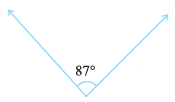
(ii)

NCERT Solutions for Class 7 Maths Chapter 5 Lines and Angles Image 5

Solution:-

Two angles are said to be supplementary if the sum of their measures is 180o.

The given angle is 87o

Let the measure of its supplement be xo.

Then,

= x + 87o = 180o

= x = 180o – 87o

= x = 93o

Hence, the supplement of the given angle measures 93o.

(iii)

NCERT Solutions for Class 7 Maths Chapter 5 Lines and Angles Image 6

Solution:-

Two angles are said to be supplementary if the sum of their measures is 180o.

The given angle is 154o

Let the measure of its supplement be xo.

Then,

= x + 154o = 180o

= x = 180o – 154o

= x = 26o

Hence, the supplement of the given angle measures 93o.

Q3Written answer

Identify which of the following pairs of angles are complementary and which are supplementary.

(i) 65o, 115o

Show solutionHide solution
Worked solution

Solution:-

We have to find the sum of given angles to identify whether the angles are complementary or supplementary.

Then,

= 65o + 115o

= 180o

If the sum of two angle measures is 180o, then the two angles are said to be supplementary.

∴ These angles are supplementary angles.

(ii) 63o, 27o

Solution:-

We have to find the sum of given angles to identify whether the angles are complementary or supplementary.

Then,

= 63o + 27o

= 90o

If the sum of two angle measures is 90o, then the two angles are said to be complementary.

∴ These angles are complementary angles.

(iii) 112o, 68o

Solution:-

We have to find the sum of given angles to identify whether the angles are complementary or supplementary.

Then,

= 112o + 68o

= 180o

If the sum of two angle measures is 180o, then the two angles are said to be supplementary.

∴ These angles are supplementary angles.

(iv) 130o, 50o

Solution:-

We have to find the sum of given angles to identify whether the angles are complementary or supplementary.

Then,

= 130o + 50o

= 180o

If the sum of two angle measures is 180o, then the two angles are said to be supplementary.

∴ These angles are supplementary angles.

(v) 45o, 45o

Solution:-

We have to find the sum of given angles to identify whether the angles are complementary or supplementary.

Then,

= 45o + 45o

= 90o

If the sum of two angle measures is 90o, then the two angles are said to be complementary.

∴ These angles are complementary angles.

(vi) 80o, 10o

Solution:-

We have to find the sum of given angles to identify whether the angles are complementary or supplementary.

Then,

= 80o + 10o

= 90o

If the sum of two angle measures is 90o, then the two angles are said to be complementary.

∴ These angles are complementary angles.

Q4Written answer

Find the angles which are equal to their complement.

Show solutionHide solution
Worked solution

Solution:-

Let the measure of the required angle be xo.

We know that the sum of measures of complementary angle pair is 90o.

Then,

= x + x = 90o

= 2x = 90o

= x = 90/2

= x = 45o

Hence, the required angle measure is 45o.

Q5Written answer

Find the angles which are equal to their supplement.

Show solutionHide solution
Worked solution

Solution:-

Let the measure of the required angle be xo.

We know that the sum of measures of supplementary angle pair is 180o.

Then,

= x + x = 180o

= 2x = 180o

= x = 180/2

= x = 90o

Hence, the required angle measure is 90o.

Q6Written answer

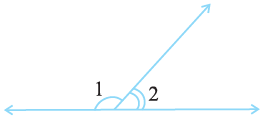
In the given figure, ∠1 and ∠2 are supplementary angles. If ∠1 is decreased, what changes should take place in ∠2 so that both angles still remain supplementary?

NCERT Solutions for Class 7 Maths Chapter 5 Lines and Angles Image 7

Show solutionHide solution
Worked solution

Solution:-

From the question, it is given that

∠1 and ∠2 are supplementary angles.

If ∠1 is decreased, then ∠2 must be increased by the same value. Hence, this angle pair remains supplementary.

Q7Written answer

Can two angles be supplementary if both of them are:

(i). Acute?

Show solutionHide solution
Worked solution

Solution:-

No. If two angles are acute, which means less than 90o, then they cannot be supplementary because their sum will always be less than 90o.

(ii). Obtuse?

Solution:-

No. If two angles are obtuse, which means more than 90o, then they cannot be supplementary because their sum will always be more than 180o.

(iii). Right?

Solution:-

Yes. If two angles are right, which means both measure 90o, then they can form a supplementary pair.

∴ 90o + 90o = 180

Q8Written answer

An angle is greater than 45o. Is its complementary angle greater than 45o or equal to 45o or less than 45o?

Show solutionHide solution
Worked solution

Solution:-

Let us assume the complementary angles be p and q,

We know that the sum of measures of complementary angle pair is 90o.

Then,

= p + q = 90o

It is given in the question that p > 45o

Adding q on both sides,

= p + q > 45o + q

= 90o > 45o + q

= 90o – 45o > q

= q < 45o

Hence, its complementary angle is less than 45o.

Q9Written answer

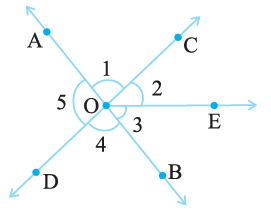
In the adjoining figure:

NCERT Solutions for Class 7 Maths Chapter 5 Lines and Angles Image 8

(i) Is ∠1 adjacent to ∠2?

Show solutionHide solution
Worked solution

Solution:-

By observing the figure, we came to conclude that,

Yes, as ∠1 and ∠2 have a common vertex, i.e., O and a common arm, OC.

Their non-common arms, OA and OE, are on both sides of the common arm.

(ii) Is ∠AOC adjacent to ∠AOE?

Solution:-

By observing the figure, we came to conclude that,

No, since they have a common vertex O and common arm OA.

But, they have no non-common arms on both sides of the common arm.

(iii) Do ∠COE and ∠EOD form a linear pair?

Solution:-

By observing the figure, we came to conclude that,

Yes, as ∠COE and ∠EOD have a common vertex, i.e. O and a common arm OE.

Their non-common arms, OC and OD, are on both sides of the common arm.

(iv) Are ∠BOD and ∠DOA supplementary?

Solution:-

By observing the figure, we came to conclude that,

Yes, as ∠BOD and ∠DOA have a common vertex, i.e. O and a common arm OE.

Their non-common arms, OA and OB, are opposite to each other.

(v) Is ∠1 vertically opposite to ∠4?

Solution:-

Yes, ∠1 and ∠2 are formed by the intersection of two straight lines AB and CD.

(vi) What is the vertically opposite angle of ∠5?

Solution:-

∠COB is the vertically opposite angle of ∠5. Because these two angles are formed by the intersection of two straight lines AB and CD.

Q10Written answer

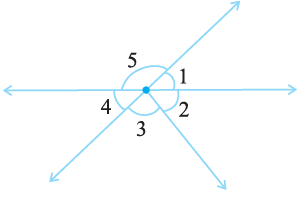
Indicate which pairs of angles are:

NCERT Solutions for Class 7 Maths Chapter 5 Lines and Angles Image 9

(i) Vertically opposite angles.

Show solutionHide solution
Worked solution

Solution:-

By observing the figure, we can say that

∠1 and ∠4, ∠5 and ∠2 + ∠3 are vertically opposite angles. Because these two angles are formed by the intersection of two straight lines.

(ii) Linear pairs.

Solution:-

By observing the figure, we can say that,

∠1 and ∠5, ∠5 and ∠4, as these have a common vertex and also have non-common arms opposite to each other.