Q1Written answer
Have you seen anything made of bronze? What?
Show solutionHide solution
Worked solution
Answer: Yes, I have seen statues, medals, utensils and lamps made up of bronze.
Your cart is empty.
Practice each question, then open the answer or worked solution.
Have you seen anything made of bronze? What?
Answer: Yes, I have seen statues, medals, utensils and lamps made up of bronze.
Find out from your elders about some of the things made from bronze that were or are still used in your house. From its colour, try to identify which one of them is made from copper, which from brass, and which from bronze.
Answer: With the help of my elders, I could find the following things:
The copper is reddish brown in colour, and I found utensils and statues of gods.
The brass is yellowish in colour, and I found some utensils of brass.
The bronze is shiny grey in colour, and I found medals and lamps.
Arrangements of Water:
Look, this pole shown under the ground joins with another wheel which has a number of pots on it.
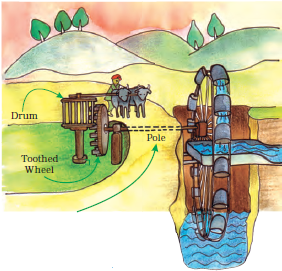
Q1: Now imagine: how would this garland of pots lift water from the well?
Answer: The garland of pots is connected to the toothed wheel, and thus the garland of pots moves. Once a pot is in water, it gets filled with water. Then the pot moves upward, carrying water along with it.
Q2: Do you now get some idea about how the tanks could have been filled by lifting water from the wells? Even today, we can see clay pipes in the walls of the fort. These pipes would have been used to carry water to different places in the palace.
Answer: Yes, bullocks have been used to move the garland of pots to lift the water up to the tank.
Where else have you seen such wheels attached to each other? For example, in the gear of a cycle or somewhere else?
Answer: Besides cycles, I have seen such attached wheels in pulleys, toy cars, sewing machines, industrial machines and some mechanical watches.
Look around and find out how water is pumped up from the ground to higher places.
Answer: These days, electric water pumps, windmills and boring machines are used for lifting the water, but in villages, bullocks are still in use for lifting the water.
How is water pumped up using electricity? How is water lifted without electricity?
Answer: Using electricity, the electric motor runs the water pump, which sucks water from the well or underground. In the absence of electricity, hand pumps and pulleys are used for lifting water.
Close your eyes and go back in time!
Imagine that you are in those days when there was a busy town inside Golconda. Think about the questions given below and discuss them in class. You could even put up a play.
Q1: What is the Sultan doing in the palace? What kind of clothes is he wearing? What dishes are being offered to him? But why does he seem so worried? And in what language is he talking?
Answer: The Sultan is holding a meeting with his ministers. He is wearing a traditional dress with a crown and lots of jewellery. Many types of foods, drinks and sweets are being offered to him. He seems to be worried about the possible attack from his enemies. He is talking in Persian.
Q2: Imagine the rooms in the palace—the beautiful carpets and curtains, the fountains on the terrace… and the sweet smell of roses and chameli—where is this coming from?
Answer: The room looks luxurious, decorated with beautiful carpets and curtains. Fountains run on the terrace. The beautiful fragrance of roses and chameli is coming from the garden.
Q3: What are the different kinds of factories you can see? How many people are working there? What are they doing? What are they wearing? How long do you think they work?
Answer: I can see several factories where clothes, utensils and idols are being made. About 30 people are working in the factory. They are working with their tools. They are wearing a dhoti with a shirt. I think they work for long hours, right from the early mornings to late evenings.