Q21Written answer
Question: 21
How much does an inland letter cost?
Show solutionHide solution
Worked solution
Answer: The cost of the inland letter is Rs 2.50.
Look at the postal rates given in the chart.
Your cart is empty.
Practice each question, then open the answer or worked solution.
Question: 21
How much does an inland letter cost?
Answer: The cost of the inland letter is Rs 2.50.
Look at the postal rates given in the chart.
Question: 22
How much will you have to pay for stamps on a letter weighing 50 grams?
Answer: The stamps are required upto 20 grams = Rs 5.00
For next 20 grams = Rs 2.00
For next 10 grams = Rs 2.00
Total cost of stamps = Rs 5.00 + Rs 2.00 + Rs 2.00
= Rs 9.00
Therefore, I have to pay Rs 9.00 for stamps on a letter weighing 50 grams.
Question: 23
Akash wants to send a parcel of the Math Magic textbook to his friend Rani in Chennai. The book weighs 200 g. See the chart to find the cost of posting the book.
Answer: Akash has to parcel the book to send it to Rani. Following are the costs he has to pay for the parcel:
The weight of the book = 200 grams
The cost of a parcel upto 50 grams = Rs 5.00
The cost of additional 150 grams = Rs 3.00 × 3
= Rs 9.00
Total cost = Rs 5.00 + Rs 9.00
= Rs 14
Question: 24
Read the weight shown in the picture. Find out the cost of sending a parcel of that weight.

Answer: The weight of the parcel on the weighing machine = 225 gram
Postal charges for 50 grams = Rs 5.00
For additional 50 grams = Rs 3.00
For next 50 grams = Rs 3.00
For next 50 grams = Rs 3.00
For next 50 grams = Rs 3.00
Total postal charges = Rs 5.00 + Rs 3.00 + Rs 3.00 + Rs 3.00 + Rs 3.00 = Rs 17.00
NCERT book Page No: 146
How Many Stamps?

Question: 25
Rahul needs stamps of Rupees 25 for his parcel. He went to the post office. Only stamps of Rs 1, Rs 2, Rs 5 and Rs 10 were there at that time. Using those stamps, in how many different ways can he make Rs 25?
Answer: By using available stamps, he can make Rs 25 in the following ways:
(a) Rs 1 × Rs 25 = Rs 25
(b) Rs 2 × Rs 12 + Rs 1 = Rs 24 + Rs 1
= Rs 25
(c) Rs 5 × Rs 5 = Rs 25
(d) Rs 10 × Rs 2 + Rs 5 = Rs 20 + Rs 5
= Rs 25
(e) Rs 10 + Rs 5 × Rs 3 = Rs 10 + Rs 15
= Rs 25
Question: 26
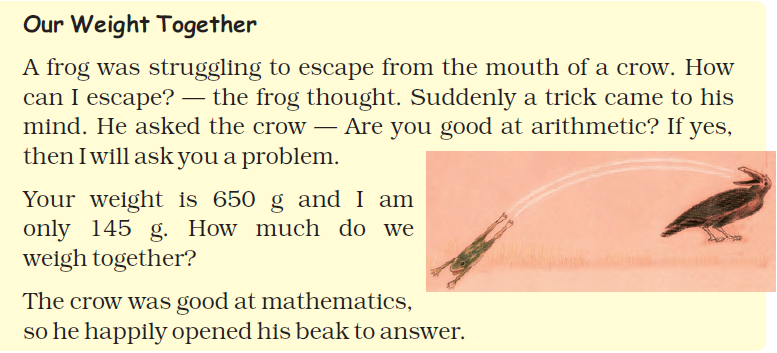
What happened after that? So what was the answer the crow wanted to give?
Answer: As the crow opened its mouth to answer the frog’s question, the frog escaped from his mouth. Crow gave the answer as follows: We weigh 795 gm together.
NCERT book Page No: 147
Am I Fit or Fat?
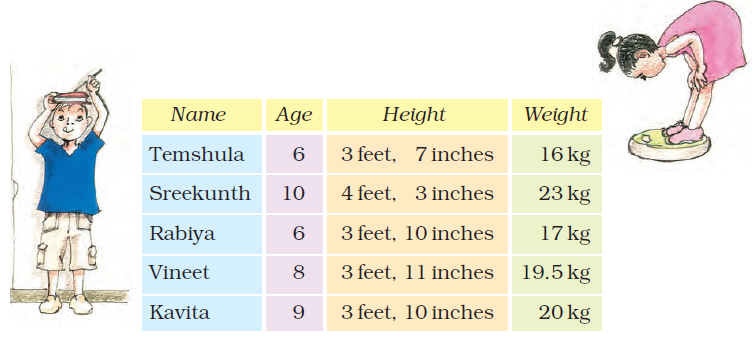
The chart shows the height and weight of children between 6 and 10 years old.
Question: 27
Now, you also fill the table by finding out the age, height and weight of any five friends.
Answer: Some of my friends’ name, age, height and weight are as follows:
| Name | Age | Height | Weight |
| Kavita | 7 | 4 feet 4 inches | 24 kg |
| Shreya | 6 | 4 feet 2 inches | 20 kg |
| Anjali | 10 | 5 feet 2 inches | 30 kg |
| Nikita | 9 | 5 feet 1 inch | 25 kg |
| Rashmi | 8 | 4 feet 9 inches | 22 kg |
NCERT book Page No: 148
How Many Oranges?
Question: 28
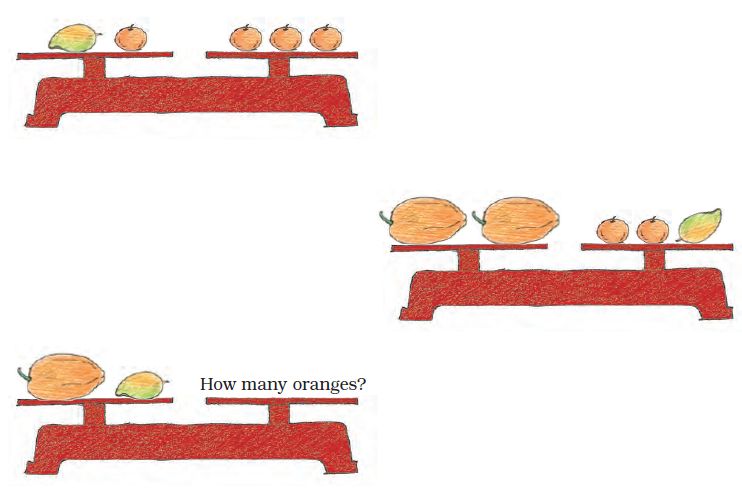
All oranges have equal weight. The two papayas have the same weight. The weights in the first and second balances are equal.
How many oranges balance the weight in the third?
Answer: In the first balance,
1 Mango + 1 Orange = 3 Oranges
1 Mango = 3 Oranges – 1 Orange
1 Mango = 2 Oranges
Hence, 1 Mango = 2 Oranges
In the second balance,
2 Papaya = 2 Oranges + 1 Mango
2 Papaya = 2 Oranges + 2 Oranges [1 Mango = 2 Oranges]
2 Papaya = 4 Oranges
Hence, 1 Papaya = 2 Oranges
In the third balance,
1 Papaya + 1 Mango = 2 Oranges + 2 Oranges [1 Papaya = 2 Oranges and 1 Mango = 2 Oranges]
1 Papaya + 1 Mango = 4 Oranges
Therefore, in the third balance, 4 Oranges will balance 1 Papaya and 1 Mango together.
Find That Marble
Question: 29
There are 3 marbles of the same size, but one marble is slightly heavier or lighter than the other two. Can you find which is that marble and if it is heavier or lighter? You can use a balance only two times.

Answer: Let us take the three marbles as M1, M2 and M3 in which one of them is heavier or lighter than the other two.
Put marbles M1 and M2 in different pans.
First case: If both are equal, then M3 is heavier or lighter than these marbles.
Second case: Put M1 and M3 in different pans
(a) If they are equal, then M2 is heavier or lighter.
(b) M1 < M3 then M2 = M3 and M1 will be lighter than M1 and M3.