My Cart
Your Cart 0

    Your cart is empty.

  • Total (Amount) ₹0.00
NCERT · Class 12 · Economics

Chapter 5: Market Equilibrium

Practice each question, then open the answer or worked solution.

Questions

25 questions
Q11Written answer

How will a change in the price of coffee affect the equilibrium price of tea? Explain the effect on equilibrium quantity also through a diagram.

Show solutionHide solution
Worked solution

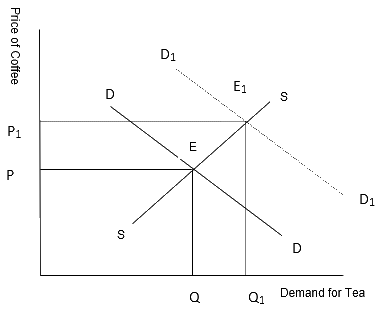
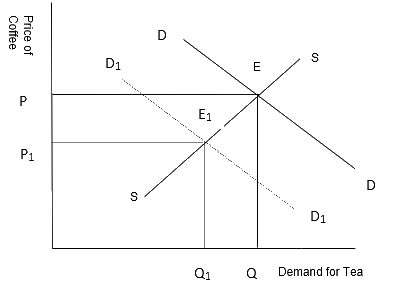
Coffee and tea are regarded as substitutes for each other, and therefore, any price change in coffee will result in changing the demand for tea. It can be said that when the coffee price increases, it will increase the demand for tea and when the coffee price decreases, the demand for tea is reduced.

Diagrammatically it can be represented as:
NCERT Microeconomics Solutions for Class 12 Chapter 5

In the above diagram, when the price of coffee increases (from P to P1), the demand for tea increases which is shown by (Q to Q1).
NCERT Microeconomics Solutions for Class 12 Chapter 5-1

In the above diagram, when the price of coffee decreases from (P to P1), there is a decrease in demand for tea (Q to Q1).
Q12Written answer

How do the equilibrium price and the quantity of a commodity change when the price of input used in its production changes?

Show solutionHide solution
Worked solution

Change in input price brings about changes in equilibrium price and quantity of the commodity produced in the following ways:

1. When input price is increased: In case a firm increases the input price, the cost of production will increase, this will result in a decline in profit, and hence supply will take a hit. The supply curve will move left while the demand curve will remain the same. The equilibrium price will increase with reduced output.

2. When input price is decreased: In case a firm decreases the input price, the cost of production will reduce which will encourage the firm to produce more and increase supply. This will result in the supply curve moving right with the demand curve remaining still. The equilibrium price will be lower with increased output.

Q13Written answer

If the price of a substitute Y of good X increases, what impact does it have on the equilibrium price and quantity of good X?

Show solutionHide solution
Worked solution

As X and Y are substitutes for each other, any change in the price of the substitute will have an immediate effect on the price of the other. In this case, if the price of Y increases, then it will result in an increase in demand for X and due to this increase in demand, there will be a rise in equilibrium price and the quantity of output of the good X.

Q14Written answer

Compare the effect of the shift in the demand curve on the equilibrium when the number of firms in the market is fixed with the situation when entry-exit is permitted.

Show solutionHide solution
Worked solution

When the number of firms is fixed in a market, an increase in demand will result in an increased equilibrium price and increased output. Similarly, if entry-exit is allowed, then there will be a decrease in the equilibrium price. There will be more entry of firms as all will be looking to earn a super normal profit. But the entry of more firms causes a decrease in profit, and all firms will start earning normal profits.

Q15Written answer

Explain through a diagram the effect of a rightward shift of both the demand and supply curves on equilibrium price and quantity.

Show solutionHide solution
Worked solution

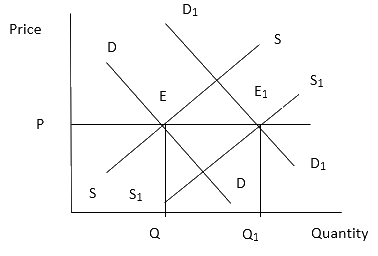
A rightward shift in both the demand and supply curves can occur in three situations, as explained below:

1. When both the demand and supply curve increase equally, then there will be no change in the equilibrium price, although there will be a change in the equilibrium point.

This can be depicted with a diagram as follows:

NCERT Microeconomics Solutions for Class 12 Chapter 5-2

2. When the demand curve increases at a faster rate than the supply curve, there will be a higher equilibrium price and higher output.

3. When the demand curve increases at a slower rate than the supply curve, there will be a fall in equilibrium price and a rise in output.

Q16Written answer

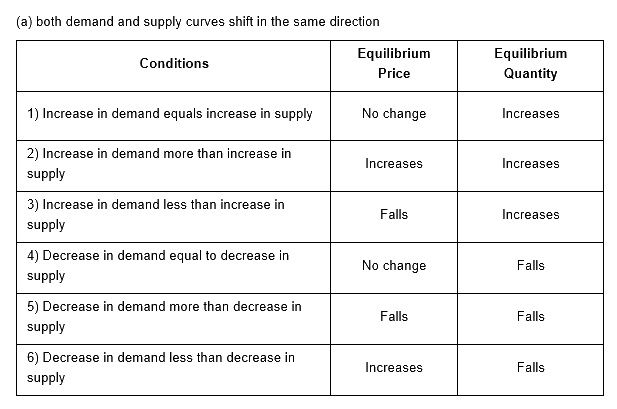
How are the equilibrium price and quantity affected when

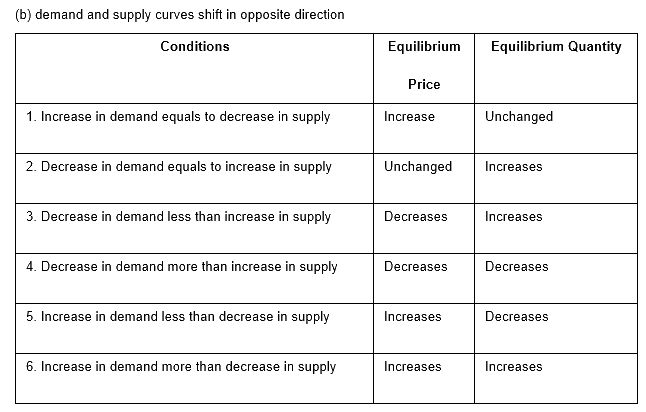
(a) both demand and supply curves shift in the same direction?

(b) demand and supply curves shift in opposite directions?

NCERT Microeconomics Solutions for Class 12 Chapter 5-3

NCERT Microeconomics Solutions for Class 12 Chapter 5-4

Show solutionHide solution
Worked solution

Solution coming soon.

Q17Written answer

In what respect do the supply and demand curves in the labour market differ from those in the goods market?

Show solutionHide solution
Worked solution

The points of differentiation between the labour market and the goods market are as follows:

1. In a goods market, consumers make the demand for goods, whereas, in a labour market, firms make the demands.

2. In a goods market, firms perform the supply of goods, whereas, in a labour market, households provide the supply of labour.

3. Firms act as suppliers in a goods market, whereas households act as suppliers in the labour market.

Q18Written answer

How is the optimal amount of labour determined in a perfectly competitive market?

Show solutionHide solution
Worked solution

In a perfectly competitive market, the optimal amount of labour is determined by considering the cost and benefit that is obtained by employing the additional labour. A firm will hire labourers till that point, where the cost of employing additional labour becomes equal to the benefits derived from it. At that point, it can be said that the marginal cost of labour is equal to the marginal benefit of labour, or the wage rate is equal to the marginal revenue product.

It can be represented as follows:

NCERT Microeconomics Solutions for Class 12 Chapter 5-5

W = VMPL

Where,

W = Wage rate

VMPL = Value of Marginal Product of Labour

Q19Written answer

How is the wage rate determined in a perfectly competitive labour market?

Show solutionHide solution
Worked solution

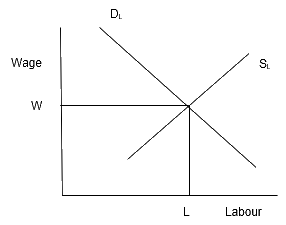
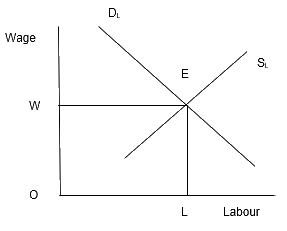
In a perfectly competitive labour market, the wage rate will be determined by the point of intersection of the demand and supply of labour. The demand for labour is determined by the marginal product of labour. The rate at which demand equals supply is called as equilibrium wage rate.

NCERT Microeconomics Solutions for Class 12 Chapter 5-6

Q20Written answer

Can you think of any commodity on which a price ceiling is imposed in India? What may be the consequence of the price ceiling?

Show solutionHide solution
Worked solution

Price ceiling refers to the act of lowering prices as compared to the prevailing market price. This is done to help families below the poverty line survive with essential items. In India, a price ceiling is implemented on various food items such as wheat, rice and sugar and on fuels such as kerosene oil.

The consequences of the price ceiling are as follows:

1. As the price is artificially imposed by the government, it will lead to excess demand for the goods.

2. The amount of goods allotted is fixed per individual, and it may not be sufficient to meet the requirement. The shortage is detected, which makes the consumer dissatisfied.

3. It has been often seen that the quality of goods that are sent for supply is not fit for consumption due to adulteration.

4. Due to unfulfilled requirements from the allotted quota, people get ready to pay more for additional goods, which leads to black marketing leading to a man-made shortage in the market.