My Cart
Your Cart 0

    Your cart is empty.

  • Total (Amount) ₹0.00
NCERT · Class 12 · Economics

Chapter 2: Theory of Consumer Behaviour

Practice each question, then open the answer or worked solution.

Questions

26 questions
Q11Written answer

If a consumer has monotonic preferences, can she be indifferent between the bundles (10, 8) and (8, 6)?  

Show solutionHide solution
Worked solution

The bundle (10, 8) contains more quantities of both products. Therefore, if a consumer has monotonic preferences, they would prefer the bundle (10, 8) over the bundle (8, 6). So, the consumer cannot be indifferent between the two bundles.
Q12Written answer

Suppose a consumer’s preferences are monotonic. What can you say about her preference ranking over the bundles (10, 10), (10, 9) and (9, 9)? 

Show solutionHide solution
Worked solution

If the consumer’s preferences are monotonic, the bundles can be ranked as follows:

Rank 1 – (10, 10)

Rank 2 – (10, 9)

Rank 3 – (9, 9)

Bundle (10, 10) will always have a higher preference for the monotonic consumer.

Q13Written answer

Suppose your friend is indifferent to the bundles (5, 6) and (6, 6). Are the preferences of your friend monotonic? 

Show solutionHide solution
Worked solution

No, the preferences of the friend are not monotonic. If the friend had a monotonic preference, they would not be indifferent to the bundles (5, 6) and (6, 6). Since the bundle (6, 6) has more quantities of both goods, they would naturally prefer it over the other bundle.

Q14Written answer

Suppose there are two consumers in the market for a good and their demand functions are as follows:

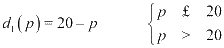
d1 (p) = 20 − p for any price less than or equal to 20 and d1 (p) = 0 at any price greater than 20.

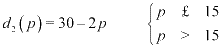
d2 (p) = 30 − 2p for any price less than or equal to 15 and d1 (p) = 0 at any price greater than 15.

Find out the market demand function.

Show solutionHide solution
Worked solution

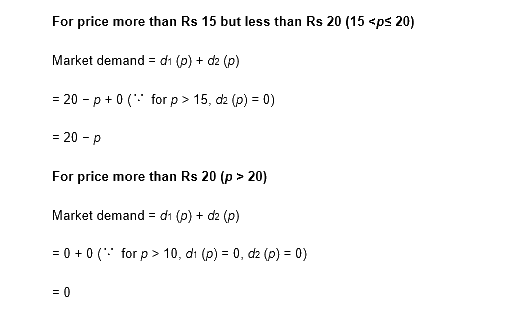
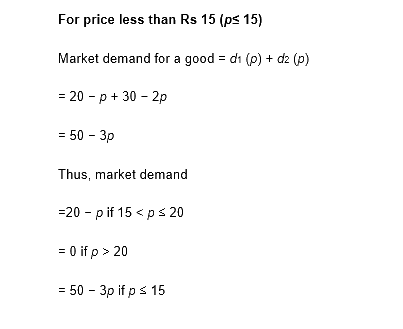
According to the question,

NCERT Microeconomics Solutions for Class 12 Chapter 2- 4

NCERT Microeconomics Solutions for Class 12 Chapter 2- 5

NCERT Microeconomics Solutions for Class 12 Chapter 2- 6

NCERT Microeconomics Solutions for Class 12 Chapter 2- 7

Q15Written answer

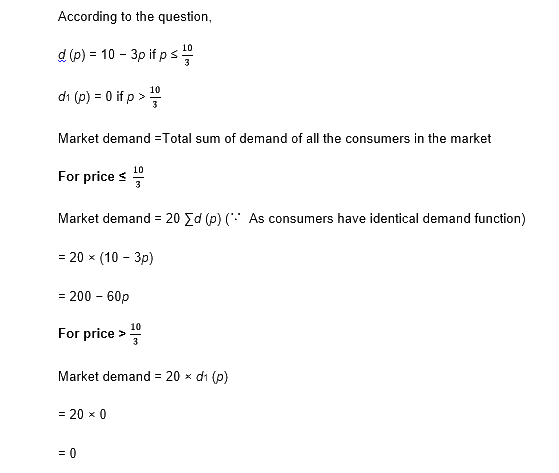
Suppose there are 20 consumers for a good and they have identical demand functions:

D (p) = 10 − 3p for any price less than or equal to  and d1 (p) = 0 at any price greater than.

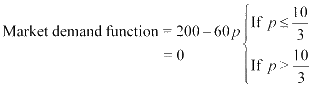
What is the market demand function?

NCERT Microeconomics Solutions for Class 12 Chapter 2- 8

NCERT Microeconomics Solutions for Class 12 Chapter 2- 9

Show solutionHide solution
Worked solution

Solution coming soon.

Q16Written answer

Consider a market where there are just two consumers and suppose their demands for the good are given as follows:

Calculate the market demand for the goods.

p d1 d2
1

2

3

4

5

6

9

8

7

6

5

4

24

20

18

16

14

12

Show solutionHide solution
Worked solution

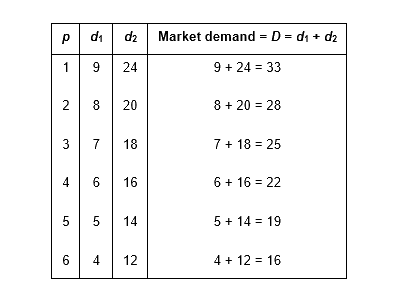
The market demand can be calculated as follows

NCERT Microeconomics Solutions for Class 12 Chapter 2- 10

Q17Written answer

What do you mean by a normal good? 

Show solutionHide solution
Worked solution

A normal good is a good for which the demand increases with an increase in the consumer’s income or wages. For example, let’s consider a fruit like an apple. When the consumer’s income increases, the demand for apples also increases.

Q18Written answer

What do you mean by an ‘inferior good’? Give some examples. 

Show solutionHide solution
Worked solution

Inferior goods are goods for which the demand decreases with an increase in the consumer’s income. For example, consider goods like cheap cigarettes, low-cost furniture and inexpensive fast food items. There are always better alternatives to these products, which are priced higher. So, when the consumer’s affordability increases, the need for inferior goods decreases.

Q19Written answer

What do you mean by substitutes? Give examples of two goods which are substitutes of each other.

Show solutionHide solution
Worked solution

Substitutes are goods of the same category which can be used interchangeably to some extent. For example, let us consider the products tea and coffee. Both of these products fall under the same classification of hot beverages, fulfil similar needs and are also similarly priced. Hence, a consumer will shift to coffee if the price of tea increases and vice versa.

Q20Written answer

What do you mean by complements? Give examples of two goods which are complements of each other. 

Show solutionHide solution
Worked solution

Complements are goods which are usually consumed together and complement each other. An example would be tea and sugar or printers and cartridges. The prices of complementary goods also affect each other’s demand. For example, if the price of sugar goes up, it is likely that the demand for tea will decrease significantly.