My Cart
Your Cart 0

    Your cart is empty.

  • Total (Amount) ₹0.00
NCERT · Class 12 · Economics

Chapter 6: Open Economy Macroeconomics

Practice each question, then open the answer or worked solution.

Questions

19 questions
Q11Written answer

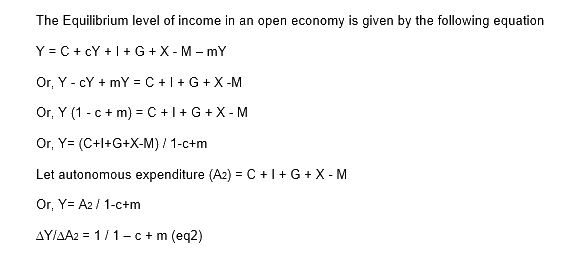
Why is the open economy autonomous expenditure multiplier smaller than the closed economy one?
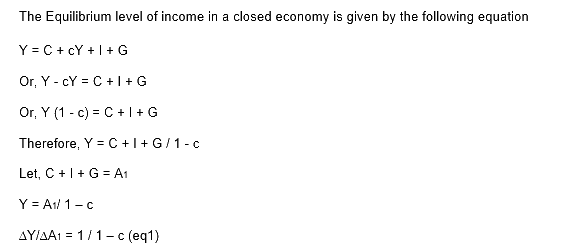
NCERT Macroeconomics Solutions Class 12 Chapter 6-6

NCERT Macroeconomics Solutions Class 12 Chapter 6-7

Show solutionHide solution
Worked solution

On comparing the two equations and the denominators of the two multipliers, it can be concluded that multiplier in an open economy is smaller than the closed economy as denominator of open economy is greater than the closed economy.
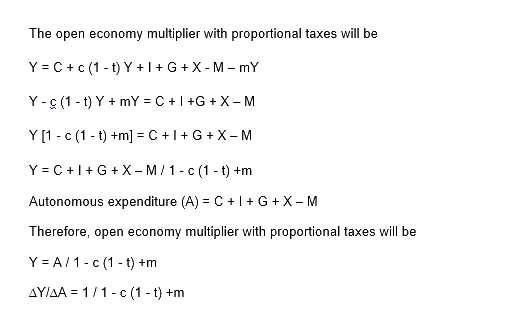
Q12Written answer

Calculate the open economy multiplier with proportional taxes, T = tY, instead of lump−sum taxes as assumed in the text.

NCERT Macroeconomics Solutions Class 12 Chapter 6-9

Show solutionHide solution
Worked solution

Solution coming soon.

Q13Written answer

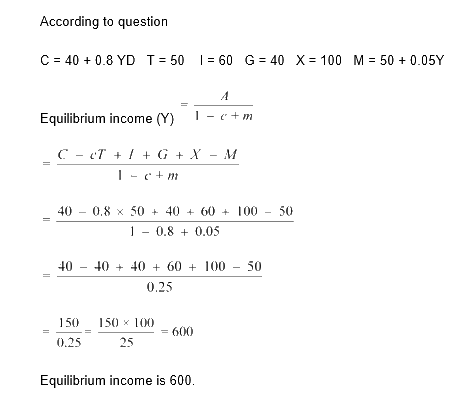
Suppose C = 40 + 0.8Y D. T = 50, I = 60, G = 40, X = 90, M = 50 + 0.05Y

(a) Find equilibrium income

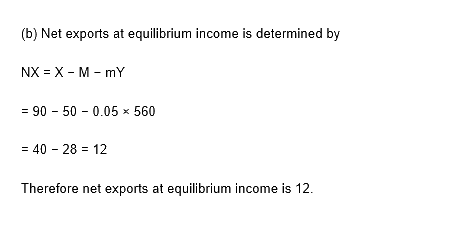
(b) Find the net export balance at equilibrium income

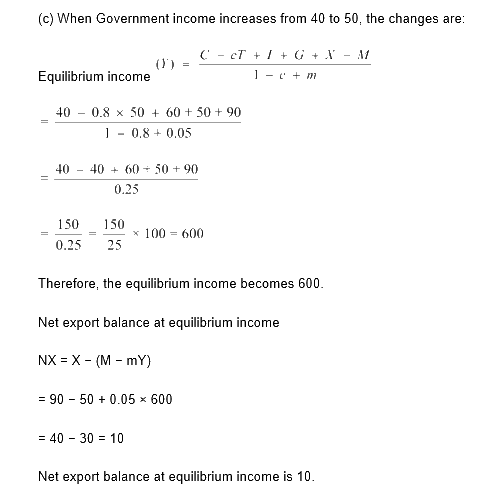
(c) What happens to equilibrium income and the net export balance when the government purchases increase from 40 to 50?

NCERT Macroeconomics Solutions Class 12 Chapter 6-10

Show solutionHide solution
Worked solution

Therefore, equilibrium income is Rs. 560

NCERT Macroeconomics Solutions Class 12 Chapter 6-11

NCERT Macroeconomics Solutions Class 12 Chapter 6-12

Q14Written answer

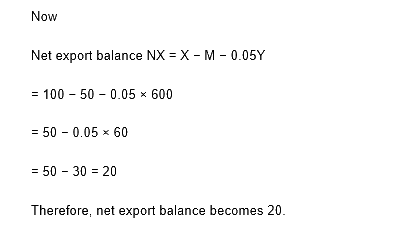
In the above example, if exports change to X = 100, find the change in equilibrium income and the net export balance.

NCERT Macroeconomics Solutions Class 12 Chapter 6-12

Show solutionHide solution
Worked solution

Solution coming soon.

Q15Written answer

Explain why G − T = (Sg − I) − (X − M).

Show solutionHide solution
Worked solution

Savings and income are equal at equilibrium level in an economy while in an open economy savings and investments are different.

Y = C + I + G + X – M

NX = NX = X – M

Y = C + I + G + NX

Y – C – G = I + NX (eq.1)

Y – C – G can be regarded as national savings (S) or the net national income which is obtained after all consumption and government spending.

Therefore, it can be written that

Y – C – G = S

Or, S = I + NX

S = Private Savings (Sp) + Government Savings (Sg)

Now

S = Sp + Sg

Sp + Sg = I + NX (as S = I + NX)

NX = Sp + Sg – I (eq.2)

We know,

Sp = Y – C – T

Sg = T – G

Putting the values in eq.2 we get

NX = Y – C – T + T – G – I

NX = Y – C – G – I

G = Y – C – I – NX

Now subtracting T from both sides

G – T = Y – C – I – NX – T

G – T = Y – C – T – I – NX

G – T = (Sp– I) – NX

Where, NX = X – M

G – T = (SP– I) – (X – M)

Q16Written answer

If inflation is higher in country A than in Country B, and the exchange rate between the two countries is fixed, what is likely to happen to the trade balance between the two countries?

Show solutionHide solution
Worked solution

Exchange rate plays an important role in the level of trade taking place in a country. In this question we see that country A is having a higher inflation than B. As exchange rate is fixed in this context it will be beneficial for the country A to import goods from country B and for B to export goods to country A. Therefore, country A will be experiencing trade deficit as import is more than export and similarly country B will experience trade surplus as there is more export and comparatively less imports.

Q17Written answer

Should a current account deficit be a cause for alarm? Explain.

Show solutionHide solution
Worked solution

An excess of import of goods, services and transfers over total exports of goods, services and transfers is called as current account deficit. This situation makes a country debtor to all other nations of the world. But this generally cannot be considered an alarming situation because countries can be having deficits which is used for increasing productivity and exports in future.

Q18Written answer

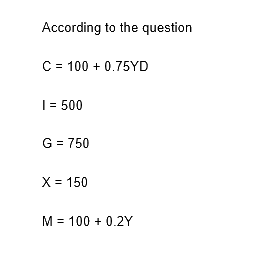
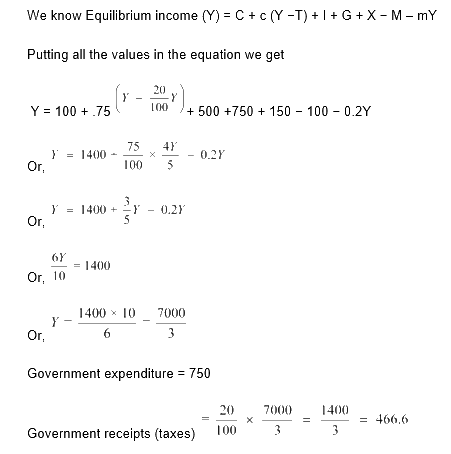
Suppose C = 100 + 0.75Y D, I = 500, G = 750, taxes are 20 per cent of income, X = 150, M = 100 + 0.2Y. Calculate equilibrium income, the budget deficit or surplus and the trade deficit or surplus.

NCERT Macroeconomics Solutions Class 12 Chapter 6-13

NCERT Macroeconomics Solutions Class 12 Chapter 6-14

NCERT Macroeconomics Solutions Class 12 Chapter 6-15

Show solutionHide solution
Worked solution

Solution coming soon.

Q19Written answer

Discuss some of the exchange rate arrangements that countries have entered into to bring about stability in their external accounts.

Show solutionHide solution
Worked solution

The following exchange rate arrangements helped bring stability to external accounts:

1. Crawling peg is a system of continuous and regular adjustments that allows a variation of 1% at any given time.

2. Under the system of wider bands, adjustments are allowed in fixed exchange rates. A variation of 10% is applied between the currencies of any two countries. A country can depreciate its currency to improve the Balance of payments. It will lead to an increase in demand for domestic goods as the purchasing power of other currencies increases which results in more exports.

3. The third type is called managed floating, where the government has the authority to make changes in the exchange rate as per situation. The variation is not limited, unlike the previous two measures.

NCERT Solution for Class 12 Economics Chapter 6 – Open Economy Macroeconomics.  This chapter explains, in brief, a manner about how the open economy macroeconomics functions.

Chief concepts of this chapter –
  • Open economy
  • Balance of payment
  • Current account
  • Capital account
  • Balance of trade
  • Autonomous transaction
Conclusion