My Cart
Your Cart 0

    Your cart is empty.

  • Total (Amount) ₹0.00
NCERT · Class 12 · Economics

Chapter 5: Government Budget and Economy

Practice each question, then open the answer or worked solution.

Questions

14 questions
Q1Written answer

Explain why public goods must be provided by the government.

Show solutionHide solution
Worked solution

Public goods are those goods where there is no competition, and the use of goods is not restricted to only one individual. These goods are for use by all individuals in society. Such goods are used for the welfare of society.

Therefore, the government should provide public goods for the following reasons:

1. So that benefits of the public goods can be enjoyed by all members of the society.

2. So that the consumption of these goods will not impact the consumption of any other individual.
Q2Written answer

Distinguish between revenue expenditure and capital expenditure.

Show solutionHide solution
Worked solution
Basis of Comparison Capital Expenditure Revenue Expenditure
Definition Expenditure incurred for acquiring assets to enhance the capacity of an existing asset that results in increasing its lifespan The expense incurred for maintaining the day-to-day activities of a business
Term Long term Short term
Value addition Enhances the value of an existing asset Does not enhance the value of an existing asset
Physical Existence Have a physical presence except for intangible assets Do not have a physical presence
Occurrence Non-recurring in nature Recurring in nature
Capitalisation Yes No
Impact on Revenue Do not reduce business revenue Reduces business revenue
Benefits Long-term benefits for business Short-term benefits for business
Examples Highway, tunnel, metro projects, etc. Pension, salary, etc.
Q3Written answer

‘The fiscal deficit gives the borrowing requirement of the government.’ Elucidate.

Show solutionHide solution
Worked solution

A fiscal deficit is referred to as a shortfall in the government’s income as compared to its spending. A high fiscal deficit means that the government is borrowing more money than it is earning. A higher fiscal deficit creates a burden of loan and interest payments for the future generation.

Fiscal deficit is determined by

Total Expenditure – Total Receipts excluding borrowings

Q4Written answer

Give the relationship between the revenue deficit and the fiscal deficit.

Show solutionHide solution
Worked solution

A revenue deficit is referred to as an excess of revenue expenditure as compared to earnings by revenue receipts of the government. A fiscal deficit is a bigger phenomenon where the difference is between the total expenditure and total receipts obtained by the government. When the revenue deficit increases correspondingly, the fiscal deficit also increases.

Q5Written answer

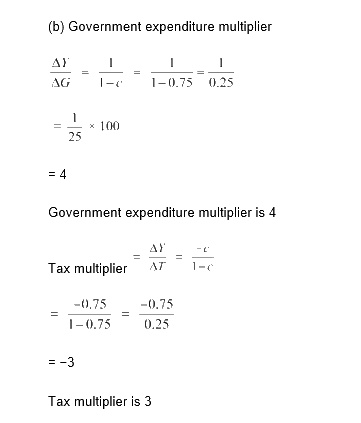
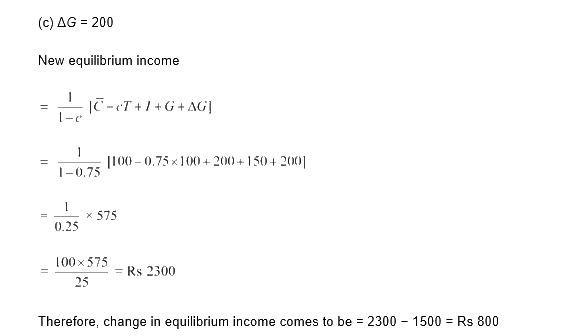
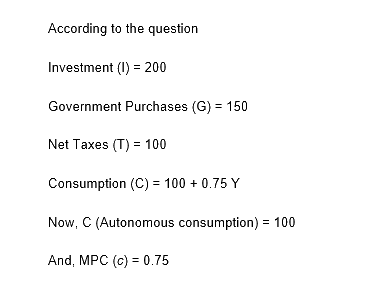
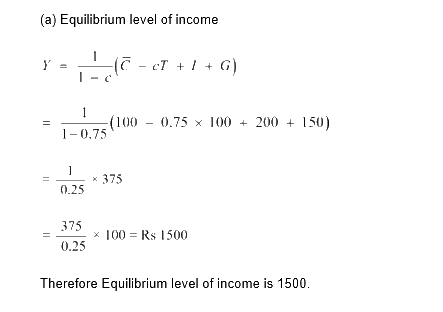
Suppose that for a particular economy, investment is equal to 200, government purchases are 150, net taxes (that is, lump-sum taxes minus transfers) is 100 and consumption is given by C = 100 + 0.75Y (a) What is the level of equilibrium income? (b) Calculate the value of the government expenditure multiplier and the tax multiplier. (c) If government expenditure increases by 200, find the change in equilibrium income.

NCERT Macroeconomics Solutions Class 12 Chapter 5-1

NCERT Macroeconomics Solutions Class 12 Chapter 5-2

NCERT Macroeconomics Solutions Class 12 Chapter 5-3

NCERT Macroeconomics Solutions Class 12 Chapter 5-4

Show solutionHide solution
Worked solution

Solution coming soon.

Q6Written answer

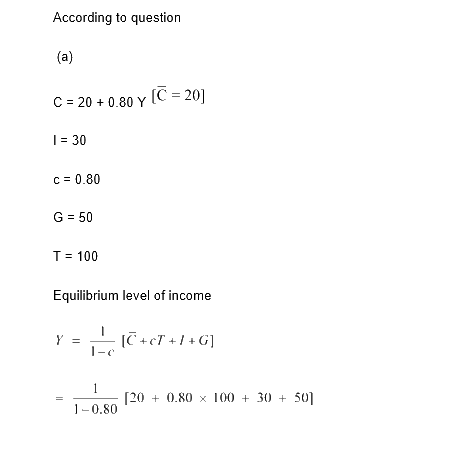
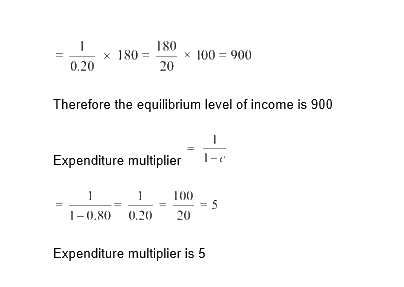
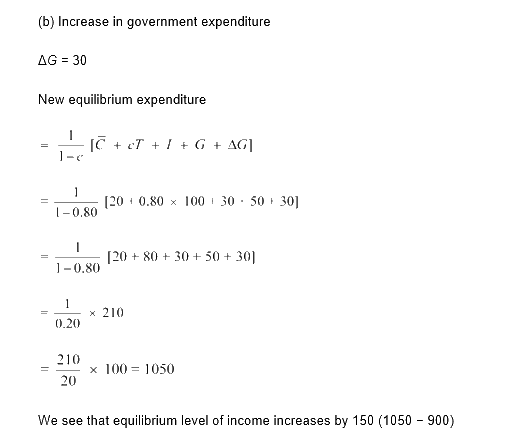
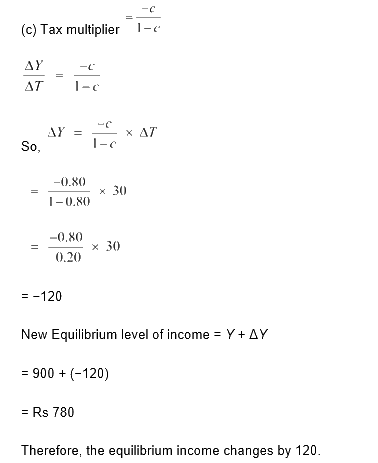
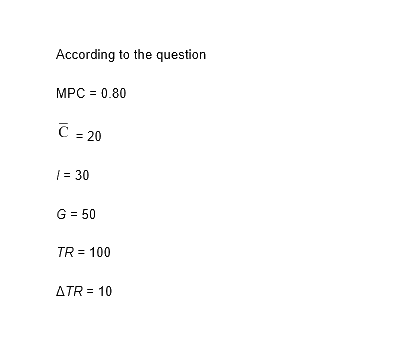
Consider an economy described by the following functions: C = 20 + 0.80Y, I = 30, G = 50, TR = 100 (a) Find the equilibrium level of income and the autonomous expenditure multiplier in the model. (b) If government expenditure increases by 30, what is the impact on equilibrium income? (c) If a lump-sum tax of 30 is added to pay for the increase in government purchases, how will equilibrium income change?

NCERT Macroeconomics Solutions Class 12 Chapter 5-5

NCERT Macroeconomics Solutions Class 12 Chapter 5-6

NCERT Macroeconomics Solutions Class 12 Chapter 5-7

NCERT Macroeconomics Solutions Class 12 Chapter 5-8

Show solutionHide solution
Worked solution

Solution coming soon.

Q7Written answer

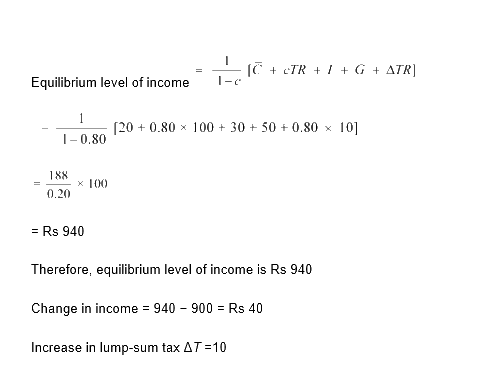
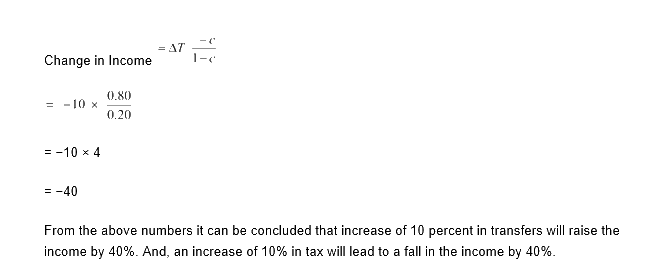
In the above question, calculate the effect on the output of a 10 per cent increase in transfers and a 10 per cent increase in lump-sum taxes. Compare the effects of the two.

NCERT Macroeconomics Solutions Class 12 Chapter 5-9

NCERT Macroeconomics Solutions Class 12 Chapter 5-10

NCERT Macroeconomics Solutions Class 12 Chapter 5-11

Show solutionHide solution
Worked solution

Solution coming soon.

Q8Written answer

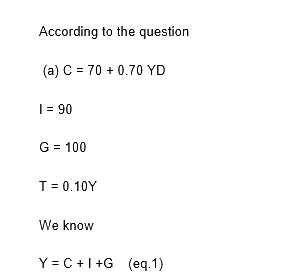
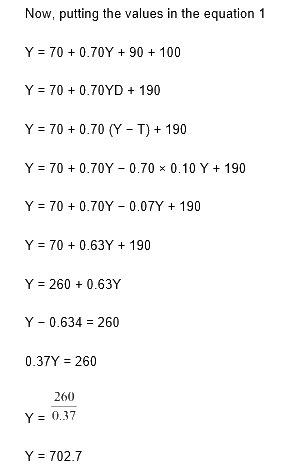
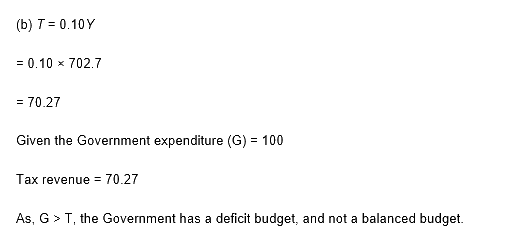
We suppose that C = 70 + 0.70Y D, I = 90, G = 100, T = 0.10Y (a) Find the equilibrium income. (b) What are tax revenues at equilibrium Income? Does the government have a balanced budget?

NCERT Macroeconomics Solutions Class 12 Chapter 5-12

NCERT Macroeconomics Solutions Class 12 Chapter 5-13

NCERT Macroeconomics Solutions Class 12 Chapter 5-14

Show solutionHide solution
Worked solution

Solution coming soon.

Q9Written answer

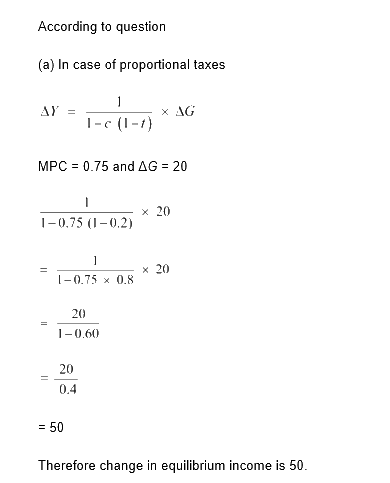
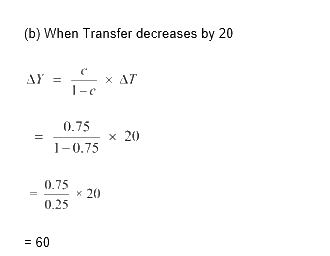
Suppose the marginal propensity to consume is 0.75, and there is a 20 per cent proportional income tax. Find the change in equilibrium income for the following (a) Government purchases increase by 20 (b) Transfers decrease by 20.

NCERT Macroeconomics Solutions Class 12 Chapter 5-15

NCERT Macroeconomics Solutions Class 12 Chapter 5-16

Show solutionHide solution
Worked solution

Therefore, the change in equilibrium income is 20.

Q10Written answer

Explain why the tax multiplier is smaller in absolute value than the government expenditure multiplier.

Show solutionHide solution
Worked solution

The tax multiplier always has a negative value and therefore is smaller in absolute value than the government expenditure multiplier. Government expenditure creates an impact on the total expenditure and the taxes through the multiplier. It also influences disposable income, which impacts the overall consumption level.

The following example will help in understanding the tax multiplier better.

Assume MPC be to 0.50.

Now, the government expenditure multiplier = 1 / 1 – c

= 1 / 1 – 0.50

= 1 / 0.50

=2

Tax multiplier = – c / 1- c

= -0.50 / 1 – 0.50

= −1

This shows that the government expenditure multiplier is always more than the tax multiplier.