My Cart
Your Cart 0

    Your cart is empty.

  • Total (Amount) ₹0.00
NCERT · Class 11 · Maths

Chapter 10: Straight Lines Exercise 10.3

Practice each question, then open the answer or worked solution.

Questions

18 questions
Q11Written answer

Prove that the line through the point (x1, y1) and parallel to the line Ax + By + C = 0 is A (x – x1) + B (y – y1) = 0.

Show solutionHide solution
Worked solution

Let the slope of line Ax + By + C = 0 be m

Ax + By + C = 0

So, y = -A/Bx – C/B

m = -A/B

By using the formula,

Equation of the line passing through point (x1, y1) and having slope m = -A/B is

y – y1 = m (x – x1)

y – y1= -A/B (x – x1)

B (y – y1) = -A (x – x1)

∴ A(x – x1) + B(y – y1) = 0

So, the line through point (x1, y1) and parallel to the line Ax + By + C = 0 is A (x – x1) + B (y – y1) = 0

Hence proved.
Q12Written answer

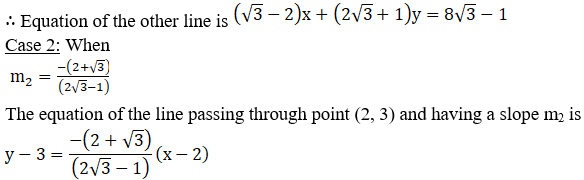
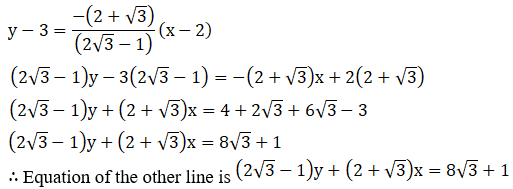
Two lines passing through the point (2, 3) intersects each other at an angle of 60o. If slope of one line is 2, find equation of the other line.

Show solutionHide solution
Worked solution

Given: m1 = 2

Let the slope of the first line be m1

And let the slope of the other line be m2.

Angle between the two lines is 60°.

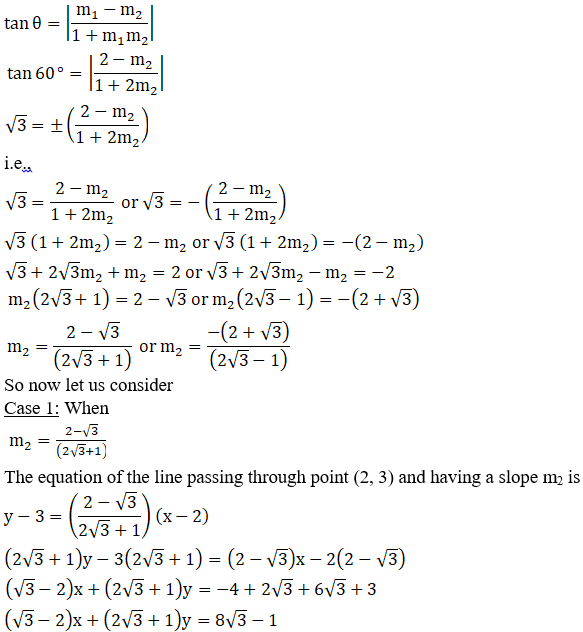
So,

NCERT Solutions for Class 11 Maths Chapter 10 – Straight Lines image - 38

NCERT Solutions for Class 11 Maths Chapter 10 – Straight Lines image - 39

NCERT Solutions for Class 11 Maths Chapter 10 – Straight Lines image - 40

Q13Written answer

Find the equation of the right bisector of the line segment joining the points (3, 4) and (–1, 2).

Show solutionHide solution
Worked solution

Given:

The right bisector of a line segment bisects the line segment at 90°.

End-points of the line segment AB are given as A (3, 4) and B (–1, 2).

Let mid-point of AB be (x, y)

x = (3-1)/2= 2/2 = 1

y = (4+2)/2= 6/2 = 3

(x, y) = (1, 3)

Let the slope of line AB be m1

m1 = (2 – 4)/(-1 – 3)

= -2/(-4)

= 1/2

And let the slope of the line perpendicular to AB be m2

m2 = -1/(1/2)

= -2

The equation of the line passing through (1, 3) and having a slope of –2 is

(y – 3) = -2 (x – 1)

y – 3 = – 2x + 2

2x + y = 5

∴ The required equation of the line is 2x + y = 5

Q14Written answer

Find the coordinates of the foot of perpendicular from the point (–1, 3) to the line 3x – 4y – 16 = 0.

Show solutionHide solution
Worked solution

Let us consider the co-ordinates of the foot of the perpendicular from (-1, 3) to the line 3x – 4y – 16 = 0 be (a, b)

So, let the slope of the line joining (-1, 3) and (a, b) be m1

m1 = (b-3)/(a+1)

And let the slope of the line 3x – 4y – 16 = 0 be m2

y = 3/4x – 4

m2 = 3/4

Since these two lines are perpendicular, m1 × m2 = -1

(b-3)/(a+1) × (3/4) = -1

(3b-9)/(4a+4) = -1

3b – 9 = -4a – 4

4a + 3b = 5 …….(1)

Point (a, b) lies on the line 3x – 4y = 16

3a – 4b = 16 ……..(2)

Solving equations (1) and (2), we get

a = 68/25 and b = -49/25

∴ The co-ordinates of the foot of perpendicular is (68/25, -49/25)

Q15Written answer

The perpendicular from the origin to the line y = mx + c meets it at the point (–1, 2). Find the values of m and c.

Show solutionHide solution
Worked solution

Given:

The perpendicular from the origin meets the given line at (–1, 2).

The equation of line is y = mx + c

The line joining the points (0, 0) and (–1, 2) is perpendicular to the given line.

So, the slope of the line joining (0, 0) and (–1, 2) = 2/(-1) = -2

Slope of the given line is m.

m × (-2) = -1

m = 1/2

Since, point (-1, 2) lies on the given line,

y = mx + c

2 = 1/2 × (-1) + c

c = 2 + 1/2 = 5/2

∴ The values of m and c are 1/2 and 5/2, respectively.

Q16Written answer

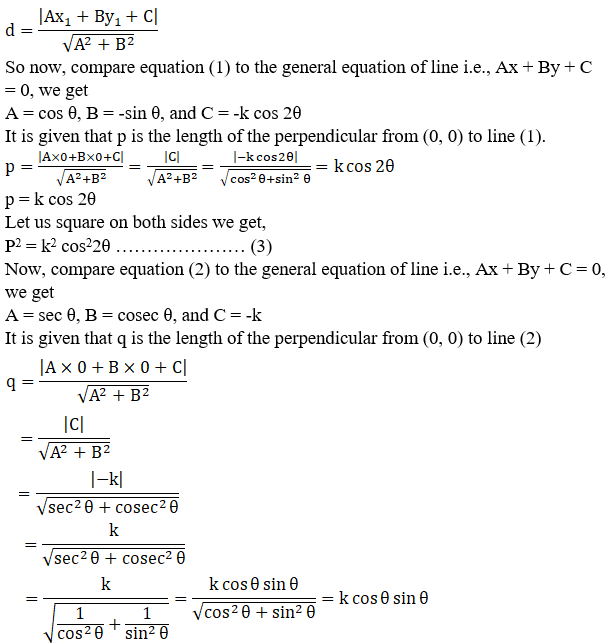
If p and q are the lengths of perpendiculars from the origin to the lines x cos θ − y sin θ = k cos 2θ and x sec θ + y cosec θ = k, respectively, prove that p2 + 4q2 = k2

Show solutionHide solution
Worked solution

Given:

The equations of given lines are

x cos θ – y sin θ = k cos 2θ …………………… (1)

x sec θ + y cosec θ = k ……………….… (2)

Perpendicular distance (d) of a line Ax + By + C = 0 from a point (x1, y1) is given by

NCERT Solutions for Class 11 Maths Chapter 10 – Straight Lines image - 41

q = k cos θ sin θ

Multiply both sides by 2, we get

2q = 2k cos θ sin θ = k × 2sin θ cos θ

2q = k sin 2θ

Squaring both sides, we get

4q2 = k2 sin22θ …………………(4)

Now add (3) and (4) we get

p2 + 4q2 = k2 cos2 2θ + k2 sin2 2θ

p2 + 4q2 = k2 (cos2 2θ + sin2 2θ) [Since, cos2 2θ + sin2 2θ = 1]

∴ p2 + 4q2 = k2

Hence proved.

Q17Written answer

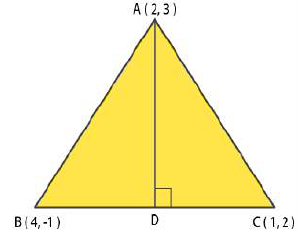
In the triangle ABC with vertices A (2, 3), B (4, –1) and C (1, 2), find the equation and length of altitude from the vertex A.

Show solutionHide solution
Worked solution

NCERT Solutions for Class 11 Maths Chapter 10 – Straight Lines image - 42

Let AD be the altitude of triangle ABC from vertex A.

So, AD is perpendicular to BC

Given:

Vertices A (2, 3), B (4, –1) and C (1, 2)

Let slope of line BC = m1

m1 = (- 1 – 2)/(4 – 1)

m1 = -1

Let slope of line AD be m2

AD is perpendicular to BC

m1 × m2 = -1

-1 × m2 = -1

m2 = 1

The equation of the line passing through point (2, 3) and having a slope of 1 is

y – 3 = 1 × (x – 2)

y – 3 = x – 2

y – x = 1

Equation of the altitude from vertex A = y – x = 1

Length of AD = Length of the perpendicular from A (2, 3) to BC

Equation of BC is

y + 1 = -1 × (x – 4)

y + 1 = -x + 4

x + y – 3 = 0 …………………(1)

Perpendicular distance (d) of a line Ax + By + C = 0 from a point (x1, y1) is given by

NCERT Solutions for Class 11 Maths Chapter 10 – Straight Lines image - 43

Now compare equation (1) to the general equation of line i.e., Ax + By + C = 0, we get

Length of AD =
NCERT Solutions for Class 11 Maths Chapter 10 – Straight Lines image - 44

∴ The equation and the length of the altitude from vertex A are y – x = 1 and

√2 units respectively.

Q18Written answer

If p is the length of perpendicular from the origin to the line whose intercepts on the axes are a and b, then show that 1/p2 = 1/a2 + 1/b2 

Show solutionHide solution
Worked solution

Equation of a line whose intercepts on the axes are a and b is x/a + y/b = 1

bx + ay = ab

bx + ay – ab = 0 ………………..(1)

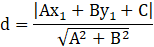
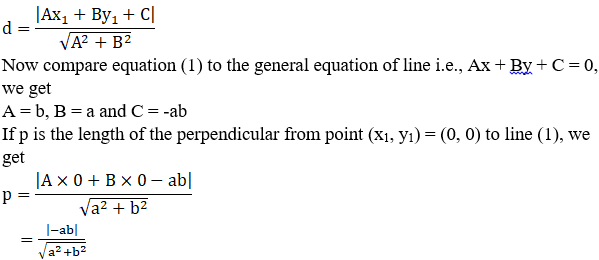
Perpendicular distance (d) of a line Ax + By + C = 0 from a point (x1, y1) is given by

NCERT Solutions for Class 11 Maths Chapter 10 – Straight Lines image - 45

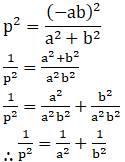
Now square on both the sides we get

NCERT Solutions for Class 11 Maths Chapter 10 – Straight Lines image - 46

∴ 1/p2 = 1/a2 + 1/b2

Hence proved.