Draw a quadrilateral in the Cartesian plane whose vertices are (– 4, 5), (0, 7), (5, – 5) and (– 4, –2). Also, find its area.
Show solutionHide solution
Let ABCD be the given quadrilateral with vertices A (-4,5) , B (0,7), C (5.-5) and D (-4,-2).
Now, let us plot the points on the Cartesian plane by joining the points AB, BC, CD, AD, which gives us the required quadrilateral.
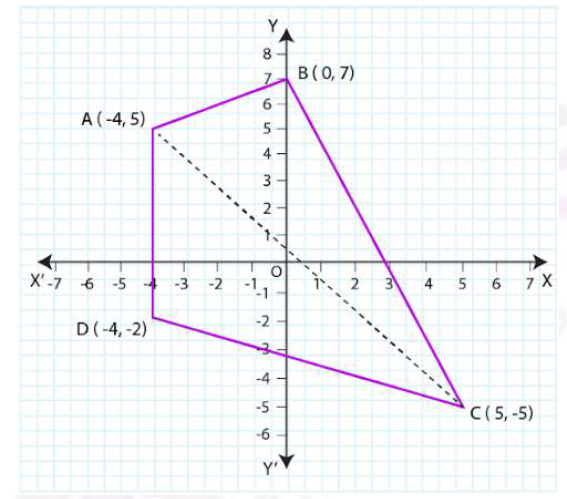
To find the area, draw the diagonal AC.
So, area (ABCD) = area (∆ABC) + area (∆ADC)
Then, area of triangle with vertices (x1,y1) , (x2, y2) and (x3,y3) is
Are of ∆ ABC = ½ [x1 (y2 – y3) + x2 (y3 – y1) + x3 (y1 – y2)]
= ½ [-4 (7 + 5) + 0 (-5 – 5) + 5 (5 – 7)] unit2
= ½ [-4 (12) + 5 (-2)] unit2
= ½ (58) unit2
= 29 unit2
Are of ∆ ACD = ½ [x1 (y2 – y3) + x2 (y3 – y1) + x3 (y1 – y2)]
= ½ [-4 (-5 + 2) + 5 (-2 – 5) + (-4) (5 – (-5))] unit2
= ½ [-4 (-3) + 5 (-7) – 4 (10)] unit2
= ½ (-63) unit2
= -63/2 unit2
Since area cannot be negative, area ∆ ACD = 63/2 unit2
Area (ABCD) = 29 + 63/2
= 121/2 unit2