My Cart
Your Cart 0

    Your cart is empty.

  • Total (Amount) ₹0.00
NCERT · Class 11 · Maths

Chapter 1: Sets Miscellaneous Exercise

Practice each question, then open the answer or worked solution.

Questions

16 questions
Q11Written answer

Let A and B be sets. If A ∩ X = B ∩ X = ϕ and A ∪ X = B ∪ X for some set X, show that A = B.
(Hints: A = A ∩ (A ∪ X) , B = B ∩ (B ∪ X), and use Distributive law.)

Show solutionHide solution
Worked solution

According to the question,

Let A and B be two sets such that A ∩ X = B ∩ X = ϕ and A ∪ X = B ∪ X for some set X.

To show, A = B

Proof:

A = A ∩ (A ∪ X) = A ∩ (B ∪ X) [A ∪ X = B ∪ X]

= (A ∩ B) ∪ (A ∩ X) [Distributive law]

= (A ∩ B) ∪ Φ [A ∩ X = Φ]

= A ∩ B (i)

Now, B = B ∩ (B ∪ X)

= B ∩ (A ∪ X) [A ∪ X = B ∪ X]

= (B ∩ A) ∪ (B ∩ X) … [Distributive law]

= (B ∩ A) ∪ Φ [B ∩ X = Φ]

= A ∩ B (i)

Hence, from equations (i) and (ii), we obtain A = B

Q12Written answer

Find sets A, B and C such that A ∩ B, B ∩ C and A ∩ C are non-empty sets and A ∩ B ∩ C = Φ.
Solution:

Let us assume, A {0, 1}

B = {1, 2}

And, C = {2, 0}

According to the question,

A ∩ B = {1}

B ∩ C = {2}

And,

A ∩ C = {0}

∴ A ∩ B, B ∩ C and A ∩ C are not empty sets.

Hence, we get

A ∩ B ∩ C = Φ

Show solutionHide solution
Worked solution

Solution coming soon.

Q13Written answer

In a survey of 600 students in a school, 150 students were found to be taking tea, and 225 were taking coffee, 100 were taking both tea and coffee. Find how many students were taking neither tea nor coffee.

Show solutionHide solution
Worked solution

Let us assume that,

U = The set of all students who took part in the survey

T = The set of students taking tea

C = The set of students taking coffee

Total number of students in a school, n (U) = 600

Number of students taking tea, n (T) = 150

Number of students taking coffee, n (C) = 225

Also, n (T ∩ C) = 100

Now, we have to find the number of students taking neither coffee nor tea, i.e., n (T ∩ C’)

∴ According to the question,

n ( T ∩ C’ )= n( T ∩ C )’

= n (U) – n (T ∩ C)

= n (U) – [n (T) + n(C) – n (T ∩ C)]

= 600 – [150 + 225 – 100]

= 600 – 275

= 325

∴ Number of students taking neither coffee nor tea = 325 students

Q14Written answer

In a group of students, 100 students know Hindi, 50 know English and 25 know both. Each of the students knows either Hindi or English. How many students are there in the group?

Show solutionHide solution
Worked solution

Let us assume that,

U = The set of all students in the group

E = The set of students who know English

H = The set of students who know Hindi

∴ H ∪ E = U

Given that,

Number of students who know Hindi n (H) = 100

Number of students who know English, n (E) = 50

Number of students who know both, n (H ∩ E) = 25

We have to find the total number of students in the group, i.e., n (U)

∴ According to the question,

n (U) = n(H) + n(E) – n(H ∩ E)

= 100 + 50 – 25

= 125

∴ Total number of students in the group = 125 students

Q15Written answer

In a survey of 60 people, it was found that 25 people read newspaper H, 26 read newspaper T, 26 read newspaper I, 9 read both H and I, 11 read both H and T, 8 read both T and I, 3 read all three newspapers. Find:

(i) The number of people who read at least one of the newspapers.
(ii) The number of people who read exactly one newspaper.

Show solutionHide solution
Worked solution

(i) Let us assume that,

A = The set of people who read newspaper H

B = The set of people who read newspaper T

C = The set of people who read newspaper I

According to the question,

Number of people who read newspaper H, n (A) = 25

Number of people who read newspaper T, n (B) = 26

Number of people who read the newspaper I, n (C) = 26

Number of people who read both newspaper H and I, n (A ∩ C) = 9

Number of people who read both newspaper H and T, n (A ∩ B) = 11

Number of people who read both newspaper T and I, n (B ∩ C) = 8

And, the number of people who read all three newspapers H, T and I, n (A ∩ B ∩ C) = 3

Now, we have to find the number of people who read at least one of the newspapers

∴, we get

NCERT Solutions for Class 11 Chapter 1 Miscallenous Ex Image 1

= 25 + 26 + 26 – 11 – 8 – 9 + 3

= 80 – 28

= 52

∴ There are a total of 52 students who read at least one newspaper.

(ii) Let us assume that,

a = The number of people who read newspapers H and T only

b = The number of people who read newspapers I and H only

c = The number of people who read newspapers T and I only

d = The number of people who read all three newspapers

According to the question,

D = n(A ∩ B ∩ C) = 3

Now, we have

n(A ∩ B) = a + d

n(B ∩ C) = c + d

And,

n(C ∩ A) = b + d

∴ a + d + c +d + b + d = 11 + 8 + 9

a + b + c + d = 28 – 2d

= 28 – 6

= 22

∴ The number of people who read exactly one newspaper = 52 – 22

= 30 people

Q16Written answer

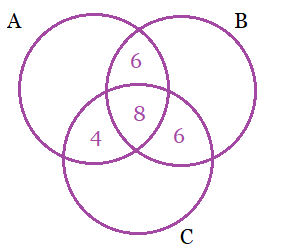
In a survey, it was found that 21 people liked product A, 26 liked product B and 29 liked product C. If 14 people liked products A and B, 12 people liked products C and A, 14 people liked products B and C, and 8 liked all three products. Find how many liked product C only.

Show solutionHide solution
Worked solution

Let A, B and C = the set of people who like product A, product B and product C, respectively.

Now, according to the question,

Number of students who like product A, n (A) = 21

Number of students who like product B, n (B) = 26

Number of students who like product C, n (C) = 29

Number of students who like both products A and B, n (A ∩ B) = 14

Number of students who like both products A and C, n (C ∩ A) = 12

Number of students who like both products C and B, n (B ∩ C) = 14

Number of students who like all three products, n (A ∩ B ∩ C) = 8

NCERT Solutions for Class 11 Chapter 1 Miscallenous Ex Image 2

From the Venn diagram, we get

Number of students who only like product C = {29 – (4 + 8 + 6)}

= {29 – 18}

= 11 students

Access other exercise solutions of Class 11 Maths Chapter 1 – Sets

The other exercise, NCERT Class 11 Maths Solutions Chapter 1, can be accessed using the links given below.

Exercise 1.1 Solutions 6 Questions

Exercise 1.2 Solutions 6 Questions

Exercise 1.3 Solutions 9 Questions

Exercise 1.4 Solutions 12 Questions

Exercise 1.5 Solutions 7 Questions

Exercise 1.6 Solutions 8 Questions