My Cart
Your Cart 0

    Your cart is empty.

  • Total (Amount) ₹0.00
NCERT · Class 11 · Economics

Chapter 6: Employment Growth, Informalisation and Other Issues

Practice each question, then open the answer or worked solution.

Questions for NCERT Economics Solutions Class 11 Chapter 7

22 questions
Q11Written answer

The following table shows distribution of workforce in India for the year 1972-73. Analyse it and give reasons for the nature of workforce distribution. You will notice that the data is pertaining to the situation in India 30 years ago

Place of Residence Workforce (in millions)
Male Female Total
Rural

Urban

125

32

69

7

195

39

(i) In the above-mentioned table, the total workforce in the year 1972-73 was 234 million, which comprised a workforce of 195 million from the rural population and 39 million from the urban population. This shows that 83% of the total workforce was rural-based while the remaining 17% was from the urban population, which is an indicator of the involvement of the bulk of the rural population in agriculture and allied sectors.

(ii) Rural workforce composition was 64% male and 36% female. Whereas in the urban population, it was 82% male workers and 18% female workers. This shows that the level of participation of males in both urban and rural populations was higher than females, as there were fewer opportunities for women’s education. Society’s structure was such that it discouraged females from taking up a job.

(iii) It can be seen that the women workforce in rural areas was 36% while it is 18% for urban women. The majority of the rural population was agriculture based or, in some allied activities, still had low productivity. Less productivity leads to poverty.

Show solutionHide solution
Worked solution

From the above data, it can be concluded that 30 years back, the Indian economy was in a state of acute unemployment and poverty. There was disguised unemployment in agriculture and a low level of female participation in the workforce.
Q12Written answer

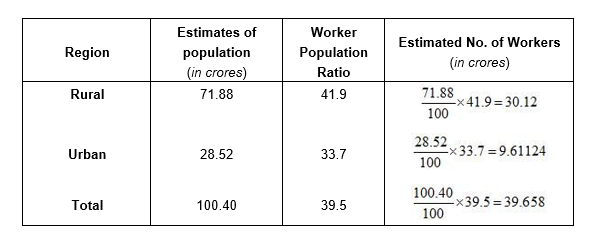
The following table shows the population and worker population ratio for India in 1999-2000. Can you estimate the workforce (urban and total) for India? 

Region Estimates of population

(in crores)

Worker Population Ratio Estimated No. of Workers

(in crores)

Rural


71.88


41.9


Economics Solutions Class 11 Chapter 7-2
 

Urban


28.52


33.7


Total 100.40 39.5

Economics Solutions Class 11 Chapter 7-3

Economics Solutions Class 11 Chapter 7-4

Show solutionHide solution
Worked solution

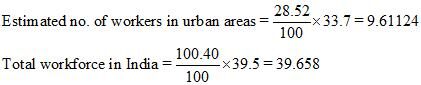
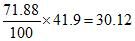
Therefore it can be seen that workers in urban areas were around 9.61 crores, and the total workforce of India was approximately 39.7 crores.

Q13Written answer

Why are regular salaried employees more in urban areas than in rural areas?

Show solutionHide solution
Worked solution

Salaried employees are those who are on the permanent payroll of an employer. This is true for skilled workers. The concentration of salaried workers is more in urban areas as the jobs in urban areas require workers with special skills. Such centres exist in urban areas where people can get trained and enhance those skills in order to earn a regular salary. Training requires education that cannot be obtained in rural areas. Companies and industries also look for properly skilled workers available in the city. Therefore there is more concentration of salaried employees in urban areas than in rural areas.

Q14Written answer

Why are less women found in regular salaried employment?

Show solutionHide solution
Worked solution

Women are involved in economic activities that are not stable and hence, do not have steady incomes. A steady income and permanent contract can be obtained from a salaried occupation. As female education is not given priority, they lack the professional skills that are necessary for steady employment. Women are more vulnerable when compared to men and possess low bargaining power. Females are paid less than males. Therefore it is common for women to be in self-employment.

Q15Written answer

Analyse the recent trends in sectoral distribution of workforce in India.

Show solutionHide solution
Worked solution

There are three sectors in an economy: Primary, Secondary and Tertiary. It makes up the structure of occupation in an economy. The primary sector consists of agriculture, forestry, mining, and fishing. Secondary sectors consist of construction and manufacturing industries. The tertiary sector includes industries like trade, communication and transport. The primary source of employment is agriculture and related activities, as mentioned in the primary sector. The primary sector consists of about 57 per cent of the total workforce. The secondary and tertiary sectors consist of 18 and 25 per cent of the workforce. The tertiary sector is emerging as a potential source of employment and is also contributing to GDP. It is seen that the rural population is mostly involved in the primary sector while the urban population is involved in the secondary and tertiary sectors.

Q16Written answer

Compared to the 1970s, there has hardly been any change in the distribution of workforce across various industries. Comment.

Show solutionHide solution
Worked solution

There have been changes in the way the workforce is distributed as compared to 1970 and can be shown as follows:

1. The workforce engaged in the primary sector was around 74 per cent during the year 1970 while it has come down to 50%. The service sector, along with the Secondary sector, has shown great improvement.

2. More preference is to have regular employment with a salary. But self-employment is where most people are employed.

Q17Written answer

Do you think that in the last 50 years, employment generated in the country is commensurate with the growth of GDP in India? How?

Show solutionHide solution
Worked solution

Employment generated in India during the last 50 years is not commensurate with the GDP growth, and that’s why it is referred to as jobless growth. This situation arises when GDP is growing in an economy, but there is no expansion of employment opportunities relative to that. In other words, the economy is producing more goods and services without generating the required level of employment. This phase started with the initialisation of economic reforms in 1991, and since then, the economy has been failing to maintain a balance between GDP and employment growth rate.

Q18Written answer

Is it necessary to generate employment in the formal sector rather than in the informal sector? Why?

Show solutionHide solution
Worked solution

It is necessary to generate employment in the formal sector for these reasons:

1. Formal sectors provide benefits such as a pension, gratuity, and provident fund, which is not there in the informal sector.

2. There is the assurance of regular income in the formal sector

3. More income is there for those working in the formal sector

4. Poverty and income inequality will be reduced if more employment is generated in the formal sector

Q19Written answer

Victor is able to get work only for two hours in a day. Rest of the day, he is looking for work. Is he unemployed? Why? What kind of jobs could persons like Victor is doing?

Show solutionHide solution
Worked solution

Victor is not an unemployed worker. Instead, he is working only two hours a day which is not sufficient for him to be considered a full-time worker. As per statistics by National Sample Survey, anyone who works below 28 hours a week is said to be underemployed. The work that Victor does can include delivering newspapers, working in a restaurant, courier delivery boy and teller in a bank.

Q20Written answer

You are residing in a village. If you are asked to advice the village panchayat, what kinds of activities would you suggest for the improvement of your village which would also generate employment.

Show solutionHide solution
Worked solution

The following suggestions will help in generating employment:

1. Increase in production from the agriculture and industrial sectors can help in increasing employment. Small-scale industries should be encouraged in order to generate more employment.

2. Higher production results in demand for more workers. Rural workers should be made aware of the new technologies and how they will help them in getting employed.

3. Rise in population leads to a lack of jobs and unemployment. The population should be controlled by adopting proper safety measures (birth control)

4. The rural areas should be allowed to level up using suggestions and moving away from an agrarian-based economy.

5. Finance should be readily provided with facilities of credit so that it will help the farmers.

6. Schools should be set up to educate the village children and also to give technical knowledge for workers.