My Cart
Your Cart 0

    Your cart is empty.

  • Total (Amount) ₹0.00
NCERT · Class 11 · Chemistry

Chapter 4: Chemical Bonding and Molecular Structure

Practice each question, then open the answer or worked solution.

Questions

40 questions
Q31Written answer

What do you understand by bond pairs and lone pairs of electrons? Illustrate by giving one example of each type.

Show solutionHide solution
Worked solution

A covalent bond is formed when 2 atoms combine with each other by sharing their valence electrons. The shared pairs of electrons present between the bonded atoms are called bond pairs. Each and every electron cannot participate in bonding. The pairs of electrons which do not participate in bonding are called lone pairs.

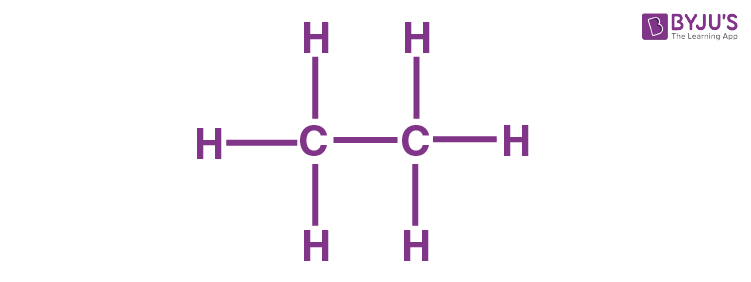
E.g. a) Ethane has 7 bond pairs but zero lone pair.

NCERT Solutions for Class 11 Chemistry- Chapter 4 Chemical Bonding and Molecular Structure image 61

b) Water has 2 bond pairs and 2 lone pairs on O- atom.

NCERT Solutions for Class 11 Chemistry- Chapter 4 Chemical Bonding and Molecular Structure image 62


Q32Written answer

Distinguish between a sigma and a pi bond.

Show solutionHide solution
Worked solution
Sr. No. Pi bond Sigma bond
1 Pi bond is formed by lateral overlapping of orbitals. Sigma bond is formed by end-to-end overlapping of orbitals.
2 It is a comparatively weak bond. It is a comparatively strong bond.
3 There is only one overlapping orbital is p-p. The overlapping orbitals are s-s, s-p, p-p.
4 Rotation around pi- bond is restricted. Rotation is possible around sigma bond.
5 Electron cloud is not symmetrical about the line joining 2 nuclei. Electron cloud is symmetrical about the line joining 2 nuclei.
6 It has 2 electron clouds, one above the plane of atomic nuclei and one below the plane of atomic nuclei. It has 1 electron cloud and that is symmetrical about the inter-nuclear axis.


Q33Written answer

Explain the formation of H2 molecule on the basis of valence bond theory.

Show solutionHide solution
Worked solution

Assuming 2 H- atoms X and Y with nuclei NX and NY and electrons eX and eY, respectively.

When X and Y are far from each other, there is no interaction between them. As soon as they come closer, the attractive force and repulsive force become active.

The repulsive forces are:

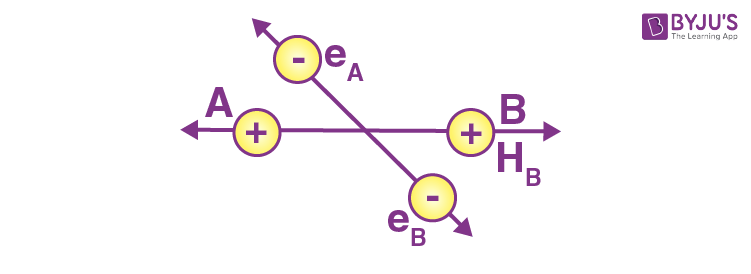
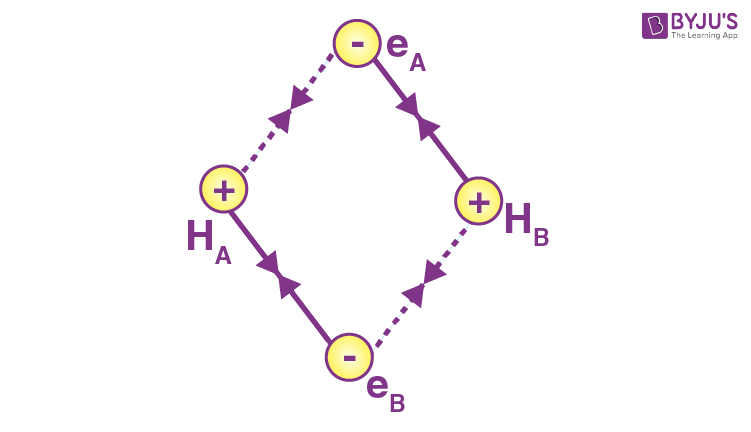
(i) Between electrons of both the atoms, i.e., eX and eY.

(ii) Between nuclei of both the atoms, i.e., NX and NY.

The attractive forces are:

(i) Between the electron and nucleus of the same atom i.e. NX – eX and NY -eY.

(ii) Between the electron of one atom and the nucleus of the other atom, i.e., NX–eY and NY–eX.

The repulsive force pushes the 2 atoms apart, whereas the attractive force tends to bring them together.


Repulsive forces:

NCERT Solutions for Class 11 Chemistry- Chapter 4 Chemical Bonding and Molecular Structure image 63

Attractive forces:

NCERT Solutions for Class 11 Chemistry- Chapter 4 Chemical Bonding and Molecular Structure image 64

The values of repulsive forces are less than that of attractive forces. Thus, 2 atoms approach each other. There is a decrease in potential energy. In the end, a stage is reached when the repulsive forces balance the attractive forces, and the system achieves the minimum energy, which leads to the formation of H2 molecule.


Q34Written answer

Write the important conditions required for the linear combination of atomic orbitals to form molecular orbitals.

Show solutionHide solution
Worked solution

The condition that is required for the linear combination of atomic orbitals to form molecular orbitals are as follows:

(i) The joining of atomic orbitals must have approximately the same energy. This implies in a homo-nuclear molecule, the 1s-orbital of one atom can join with the 1s- orbital of another atom but cannot join with the 2s-orbital.

(ii) The joining atomic orbitals must have legitimate orientations to ensure the maximum overlap.

(iii) The overlapping must be to a large extent.


Q35Written answer

Use molecular orbital theory to explain why the Be2 molecule does not exist.

Show solutionHide solution
Worked solution

Electronic configuration of Be:

1s2 2s2

The molecular orbital electronic configuration of Be2 is:

\(\begin{array}{l}\sigma _{1s}^{2}\; \sigma _{1s}^{\cdot 2}\;\sigma _{2s}^{2}\;\sigma _{2s}^{\cdot2}\end{array} \)

Thus, bond order of Be2: 0.5(Nb – Na).

Nb: No. of electrons in the bonding orbitals

Na: No. of electrons in the anti-bonding orbitals

Therefore, bond order of Be2 = 0.5(4 – 4) = 0

Zero value of bond order indicates that the given molecule is unstable. Thus, Be2 doesn’t exist.


Q36Written answer

Compare the relative stability of the following species and indicate their magnetic properties: 

O2, 

\(\begin{array}{l}O_{2}^{+}\end{array} \)
, 
\(\begin{array}{l}O_{2}^{-}\end{array} \)
(Superoxide), 
\(\begin{array}{l}O_{2}^{2-}\end{array} \)
(Peroxide)

Show solutionHide solution
Worked solution

O2 contain 16 electrons i.e. 8 electrons from each O- atom.

  • The electronic configuration of O2 is:
\(\begin{array}{l}[\sigma – (1s)]^{2}[\sigma ^{*}(1s)]^{2}[\sigma (2s)]^{2}[\sigma ^{*}(2s)]^{2}[\sigma (1p_{z})]^{2}[\pi (2p_{x})]^{2}[\pi (2p_{y})]^{2}[\pi^{*} (2p_{x})]^{1}[\pi^{*} (2p_{y})]^{1}\end{array} \)

As 1s- orbital of each O- atom does not involve in the bonding,

No. of bonding electrons = Nb = 8

No. of anti-bonding electrons = Na = 4

Now,

Bond order = 0.5(8 – 4) = 2


  • Electronic configuration of
    \(\begin{array}{l}O_{2}^{+}\end{array} \)
    is:
\(\begin{array}{l}KK[\sigma(2s)]^{2}[\sigma ^{*}(2s)]^{2}[\sigma (2p_{z})]^{2}[\pi (2p_{x})]^{2}[\pi (2p_{y})]^{2}[\pi^{*} (2p_{x})]^{1}\end{array} \)

No. of bonding electrons = Nb = 8

No. of anti-bonding electrons = Na = 3

Now,

Bond order = 0.5(8 – 3) = 2.5

As, bond dissociation energy

\(\begin{array}{l}\propto\end{array} \)

Hence, the higher the bond order, the higher stability.

The arrangement according to decreasing order of stability is given as:

\(\begin{array}{l}O_{2}^{+} > O_{2} > O_{2}^{-} > O_{2}^{2-}\end{array} \)


  • Electronic configuration of
    \(\begin{array}{l}O_{2}^{-}\end{array} \)
    (Superoxide) is:
\(\begin{array}{l}KK[\sigma(2s)]^{2}[\sigma ^{*}(2s)]^{2}[\sigma (2p_{z})]^{2}[\pi (2p_{x})]^{2}[\pi (2p_{y})]^{2}[\pi^{*} (2p_{x})]^{2}[\pi^{*} (2p_{y})]^{1}\end{array} \)

No. of bonding electrons = Nb = 8

No. of anti-bonding electrons = Na = 5

Now,

Bond order = 0.5(8 – 5) = 1.5


  • Electronic configuration of
    \(\begin{array}{l}O_{2}^{2-}\end{array} \)
    (peroxide) is:
\(\begin{array}{l}KK[\sigma(2s)]^{2}[\sigma ^{*}(2s)]^{2}[\sigma (2p_{z})]^{2}[\pi (2p_{x})]^{2}[\pi (2p_{y})]^{2}[\pi^{*} (2p_{x})]^{2}[\pi^{*} (2p_{y})]^{2}\end{array} \)

No. of bonding electrons = Nb = 8

No. of anti-bonding electrons = Na = 6

Now,

Bond order = 0.5(8 – 6) = 1


Q37Written answer

Write the significance of a plus and a minus sign shown in representing the orbitals

Show solutionHide solution
Worked solution

Generally, molecular orbital is represented by the ‘wave function’.

Positive (+) sign in representing a molecular orbital indicates positive wave function.

Negative (-) sign in representing a molecular orbital indicates negative wave function.


Q38Written answer

Describe the hybridisation in case of PCl5. Why are the axial bonds longer as compared to equatorial bonds?

Show solutionHide solution
Worked solution

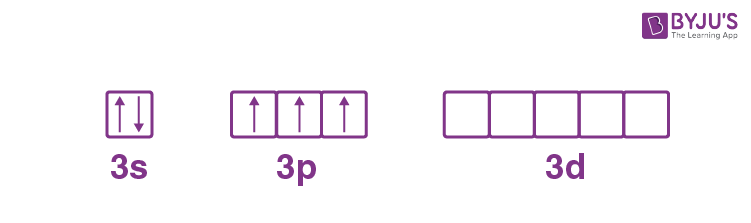
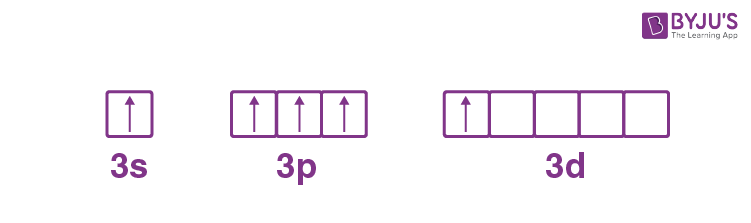
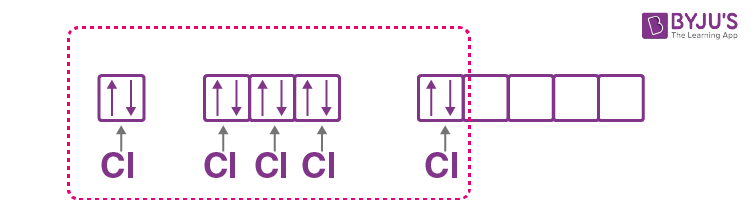
The electronic configurations of the outer orbital of phosphorus in excited state and in ground state are given below:

Ground State:

NCERT Solutions for Class 11 Chemistry- Chapter 4 Chemical Bonding and Molecular Structure image 65

Excited State:

NCERT Solutions for Class 11 Chemistry- Chapter 4 Chemical Bonding and Molecular Structure image 66

Phosphorus atom has sp3d hybridization. These orbitals are filled due to the donation of electron pairs by 5 Cl- atoms: PCl5

NCERT Solutions for Class 11 Chemistry- Chapter 4 Chemical Bonding and Molecular Structure image 67

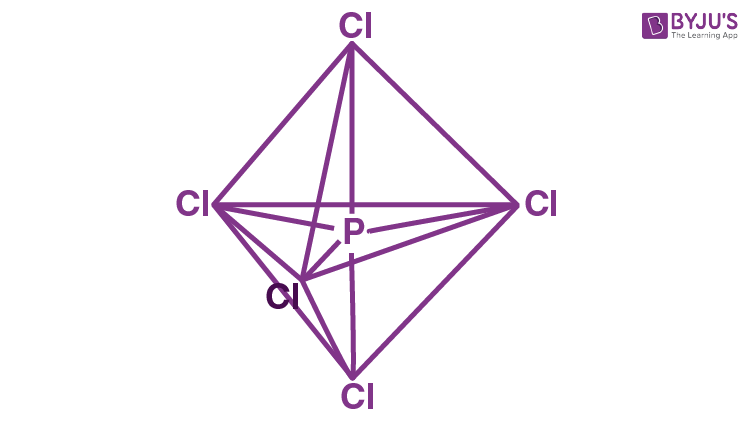
The 5 sp3d hybrid orbitals present here are directed towards 5 corners of trigonal bipyramidal. Thus, the geometry of PCl5 is given below:

NCERT Solutions for Class 11 Chemistry- Chapter 4 Chemical Bonding and Molecular Structure image 68

PCl5 contains 5 P- Cl sigma bonds. Out of which, 3 P-Cl bonds lie in only 1 plane, and they are making

\(\begin{array}{l}120^{\circ}\end{array} \)

Out of 2 remaining P-Cl bonds, one bond lie above the equatorial plane, and one bond lie below the equatorial bond. And they are making

\(\begin{array}{l}90^{\circ}\end{array} \)

Equatorial bond pairs repel axial bond pairs to a large extent. So, equatorial bonds are slightly shorter than axial bonds.


Q39Written answer

Define hydrogen bond. Is it weaker or stronger than the van der Waals forces?

Show solutionHide solution
Worked solution

“H-bond is defined as an attractive force acting between the hydrogen attached to an electronegative atom of one molecule and an electronegative atom of a different molecule”.

As there is a difference in the electronegativities between the atoms, the bond pair electronegative atom and hydrogen atom is drifted away from H- atom. Therefore, the hydrogen atom gets electropositive w.r.t. the other atom and procures a positive charge.


\(\begin{array}{l}4^{\delta } – X^{\delta }\;………..H^{\delta +} – X^{\delta -}\;………….H^{\delta +} – X^{\delta -}\end{array} \)


The value of H- bond is minimum in gaseous state and maximum in the solid state.

Two types of hydrogen bonds are there:

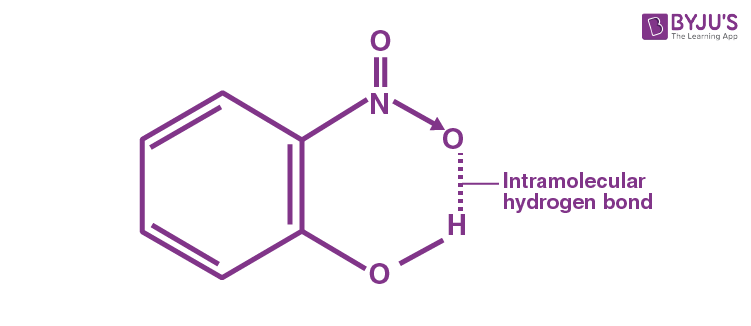
(a) Intramolecular hydrogen bond, e.g., o- nitrophenol

(b) Intermolecular hydrogen bond, e.g., HF, H2O etc.

NCERT Solutions for Class 11 Chemistry- Chapter 4 Chemical Bonding and Molecular Structure image 69

H- bonds are stronger than Van der Waals forces as H- bonds are regarded as an extreme form of the dipole-dipole interaction.


Q40Written answer

What is meant by the term bond order? Calculate the bond order of: N2, O2, O2+ and O2–.

Show solutionHide solution
Worked solution

Bond Order: It is defined as 0.5 times the difference between the “number of electrons present in bonding orbitals and number of electrons present in anti-bonding orbitals” of a molecule.

Bond Order = 0.5(Nb – Na);

Na: No. of anti-bonding electrons

Nb: No. of bonding electrons

O2 contain 16 electrons, i.e., 8 electrons from each O- atom.


  • Electronic configuration of O2 is:
\(\begin{array}{l}[\sigma – (1s)]^{2}[\sigma ^{*}(1s)]^{2}[\sigma (2s)]^{2}[\sigma ^{*}(2s)]^{2}[\sigma (1p_{z})]^{2}[\pi (2p_{x})]^{2}[\pi (2p_{y})]^{2}[\pi^{*} (2p_{x})]^{1}[\pi^{*} (2p_{y})]^{1}\end{array} \)

No. of bonding electrons = Nb = 8

No. of anti-bonding electrons = Na = 4

Now,

Bond order = 0.5(8 – 4) = 2


  • Electronic configuration of
    \(\begin{array}{l}O_{2}^{-}\end{array} \)
    (superoxide) is:
\(\begin{array}{l}KK[\sigma(2s)]^{2}[\sigma ^{*}(2s)]^{2}[\sigma (2p_{z})]^{2}[\pi (2p_{x})]^{2}[\pi (2p_{y})]^{2}[\pi^{*} (2p_{x})]^{2}[\pi^{*} (2p_{y})]^{1}\end{array} \)

No. of bonding electrons = Nb = 8

No. of anti-bonding electrons = Na = 5

Now,

Bond order = 0.5(8 – 5) = 1.5


  • Electronic configuration of
    \(\begin{array}{l}O_{2}^{+}\end{array} \)
    is:
\(\begin{array}{l}KK[\sigma(2s)]^{2}[\sigma ^{*}(2s)]^{2}[\sigma (2p_{z})]^{2}[\pi (2p_{x})]^{2}[\pi (2p_{y})]^{2}[\pi^{*} (2p_{x})]^{1}\end{array} \)

No. of bonding electrons = Nb = 8

No. of anti-bonding electrons = Na = 3

Now,

Bond order = 0.5(8 – 3) = 2.5


  • Electronic configuration of N2 is:
\(\begin{array}{l}[\sigma(1s)]^{2}[\sigma ^{*}(1s)]^{2}[\sigma (2s)]^{2}[\sigma ^{*}(2s)]^{2}[\pi (2p_{x})]^{2}[\pi (2p_{y})]^{2}[\pi (2p_{z})]^{2}\end{array} \)

No. of bonding electrons = Nb = 10

No. of anti-bonding electrons = Na = 4

Now,

Bond order = 0.5(10 – 4) = 3